Cable car motion sickness: gondolas, aerial trams and urban lines
In short
Face the direction of travel, look at the far station instead of the ground, and remember the ride is short.
Key facts
- A cable car cabin hangs from a moving rope, so it swings in crosswind and rocks at tower crossings and station entries.
- Detachable gondolas change speed on every trip: a crawl through the station, then acceleration back onto the line.
- Larger cabins on multi-rope systems ride steadier in wind than small single-rope gondolas.
- Whole cities commute this way: Mi Teleferico in La Paz is the longest urban cable car network in the world, and the Roosevelt Island Tramway has carried New York commuters since 1976.
- Rides are short, a few minutes for most crossings, so symptoms usually fade soon after the cabin docks.
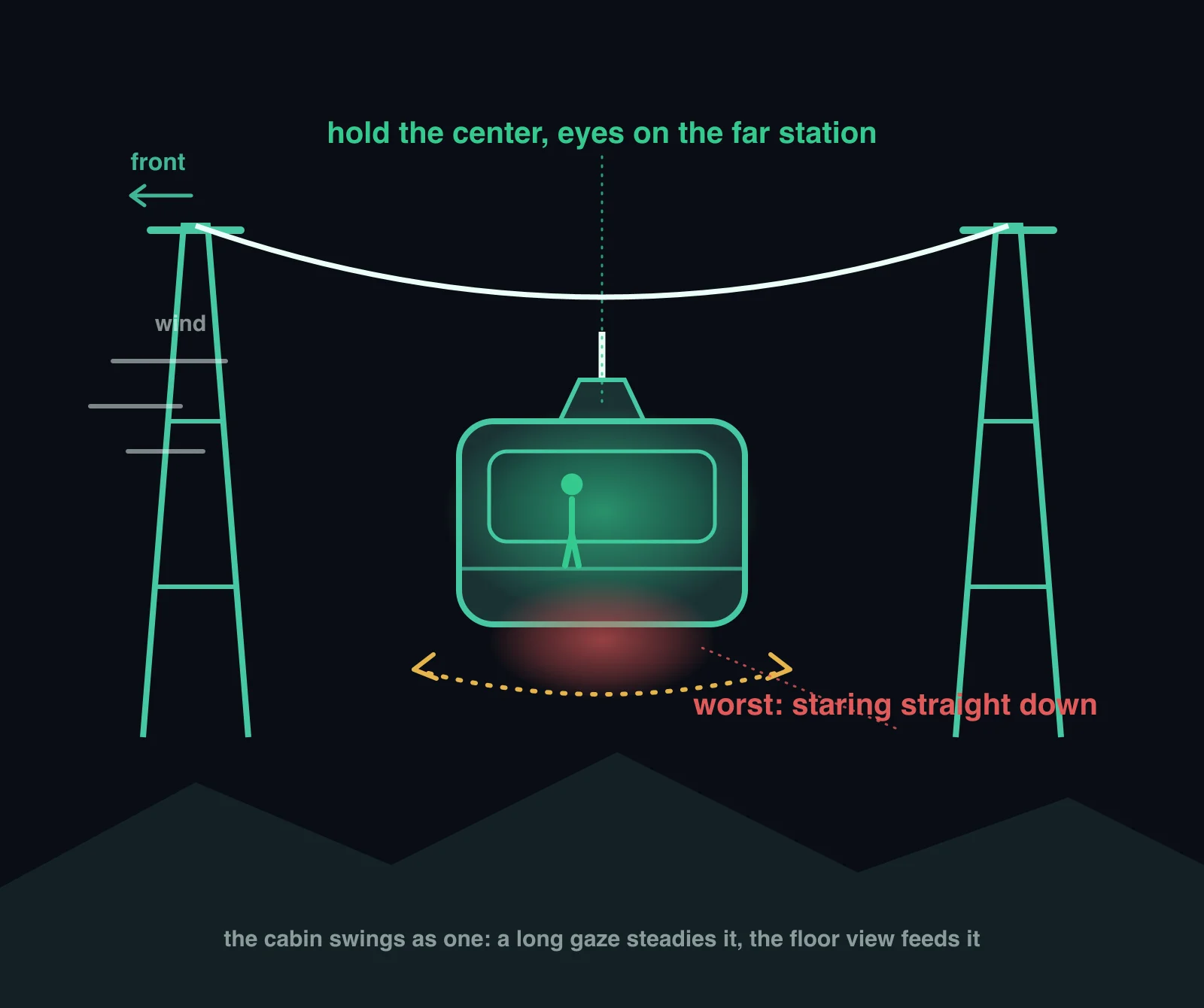
Zones of motion sickness probability
Prone to motion sickness? Dizzout is drug-free sound therapy through any headphones, with relief in about 90 seconds.Starts in your browser · works with any headphones
Get your personalized Dizzout plan. Paid subscription for full access.

On your phone? Scan to start there.
Why motion sickness happens on a cable car
A cable car cabin hangs from a moving rope, so it can swing in ways a train or bus cannot: side to side in crosswind, and forward and back as the line changes speed. Detachable gondola systems change speed on every trip, slowing to a crawl through stations and accelerating back onto the line. Inside a full cabin you often cannot see a horizon at all, and heat builds quickly behind glass, which makes any queasiness worse.
Where to sit or stand in a cable car
The middle of the cabin, seated facing the direction of travel, with your eyes on something fixed and far away: the arrival station, a ridgeline, the skyline. A distant reference is what lets your eyes agree with your inner ear about the sway.
Standing in the center holding a rail with soft knees works well on commuter lines, letting your legs absorb the sway the way they would on a boat. Larger cabins on multi-rope systems also ride noticeably steadier in wind than small single-rope gondolas.
Avoid: Riding backward while looking down through the glass at the ground dropping away, or reading a phone in a hot, packed cabin. If the lift offers a glass-floor cabin, skip it: staring straight down is the fastest trigger on the whole system.
Best spot in a cable car cabin
Board early enough to take a forward-facing spot mid cabin, keep your eyes level on the far station rather than down at the cable, and expect a small rock at each tower crossing and station entry. On a windy day there will be more swing, so give the glass-floor option a miss and keep your gaze long.
🎧 Before you travel: Pre-Conditioning mode
Listen to the Dizzout Pre-Conditioning Sound for about 90 seconds before you start moving, while you still feel fine.
Know someone who dreads this trip?
Send them this guide before they board: seats, settings and what to do if it starts.
Already feeling sick on the cable car
Early signs often come before nausea: yawning, pale skin, extra saliva, a cold sweat, burping and loss of appetite.
Fix your eyes on the farthest stable point you can find and breathe out slowly through the sways. The rides are short: the Roosevelt Island Tramway crossing takes about three to four minutes, and most crossings anywhere are done inside fifteen, so you mainly need to hold steady until the cabin slows into the station. Cool air helps, so stand near a vent or an opening window if the cabin has one.
Feeling it right now? Get the 60-second protocol →
Already feeling sick?
Open Dizzout in 'I'm feeling sick' mode and listen. Dizzout states relief in about 90 seconds. Drug-free, works on any headphones.
What about motion sickness medication?
Some travelers use over-the-counter options like dimenhydrinate (Dramamine) or meclizine (Bonine); the common trade-off reported on their labels is drowsiness, and they're generally taken before travel rather than after symptoms start. Our plain-English medication guide covers what each one is, side effects, and who should check with a doctor or pharmacist first (it's educational, not medical advice). Prefer to skip pills? Dizzout is a drug-free option that works through any headphones: see how it works.
Frequently asked questions
Why do I get motion sickness on a cable car?
A cable car cabin hangs from a moving rope, so it can swing in ways a train or bus cannot: side to side in crosswind, and forward and back as the line changes speed. Detachable gondola systems change speed on every trip, slowing to a crawl through stations and accelerating back onto the line. Inside a full cabin you often cannot see a horizon at all, and heat builds quickly behind glass, which makes any queasiness worse.
What is the best seat to avoid motion sickness on a cable car?
Board early enough to take a forward-facing spot mid cabin, keep your eyes level on the far station rather than down at the cable, and expect a small rock at each tower crossing and station entry. On a windy day there will be more swing, so give the glass-floor option a miss and keep your gaze long.
How do I stop motion sickness once it starts?
Fix your eyes on the farthest stable point you can find and breathe out slowly through the sways. The rides are short: the Roosevelt Island Tramway crossing takes about three to four minutes, and most crossings anywhere are done inside fifteen, so you mainly need to hold steady until the cabin slows into the station. Cool air helps, so stand near a vent or an opening window if the cabin has one. Sound therapy through the Dizzout app is a drug-free option, and Dizzout states relief in about 90 seconds.
Why does a cable car cabin swing, and does it matter?
The cabin hangs from a moving rope, so it swings with wind, rocks as it crosses each line tower, and changes speed through stations. Add a crowded cabin with no view of the horizon and heat behind the glass, and the usual eye and inner ear mismatch builds quickly. Bigger cabins running on multiple ropes are steadier in crosswind than small single-rope cabins, and every ride is short, which is the saving grace: symptoms usually fade within minutes of stepping off.
Can you commute by cable car if you get motion sick?
Yes, and whole cities do. Mi Teleferico in La Paz, the longest urban cable car network in the world, carries commuters daily, and the lines cut hillside trips that took an hour by road to around ten minutes. New York's Roosevelt Island Tramway has run as commuter transit since 1976. Between stations the line speed is constant, so there is little of the stop and go that triggers symptoms in road traffic. Take a forward-facing spot, look at the skyline, and keep the phone in your pocket for the few minutes of the crossing.
Is this the same as the San Francisco street cable car?
No. A street cable car runs on rails at a low, constant speed with open sides and a clear view ahead, so it rarely triggers motion sickness, and if it does, the advice for trams and trains applies. This guide covers cabins that hang from a cable in the air: gondola lifts, aerial tramways and urban cable car lines, where sway and height do the damage.
Related guides
- Ski gondolas and chairlifts: the trip guide
Ski gondolas and chairlifts as a day out: rocked chairs, mid-line stops, short rides.
- Riding an aerial tram as a day trip
The tourist aerial tram trip, where altitude can matter as much as the ride.
- Train motion sickness: best seats
Choosing a window seat facing travel, with alternatives when the layout changes.