Robotaxi motion sickness: where to sit when nobody is driving
In short
Sit up front if the operator allows it, watch the road like a driver would, and know where the pull over button is before you set off.
Nobody is driving, so nobody can be asked to take it easy. The free 2-minute test on this page scores how prone you are, so you know how much preparation a driverless ride actually needs.
Key facts
- The front passenger seat is the calmest place in a robotaxi, and Waymo opens it to any rider at least 8 years old.
- With no driver to read, the road ahead is the only motion preview left, so a windshield view matters more than in a normal taxi.
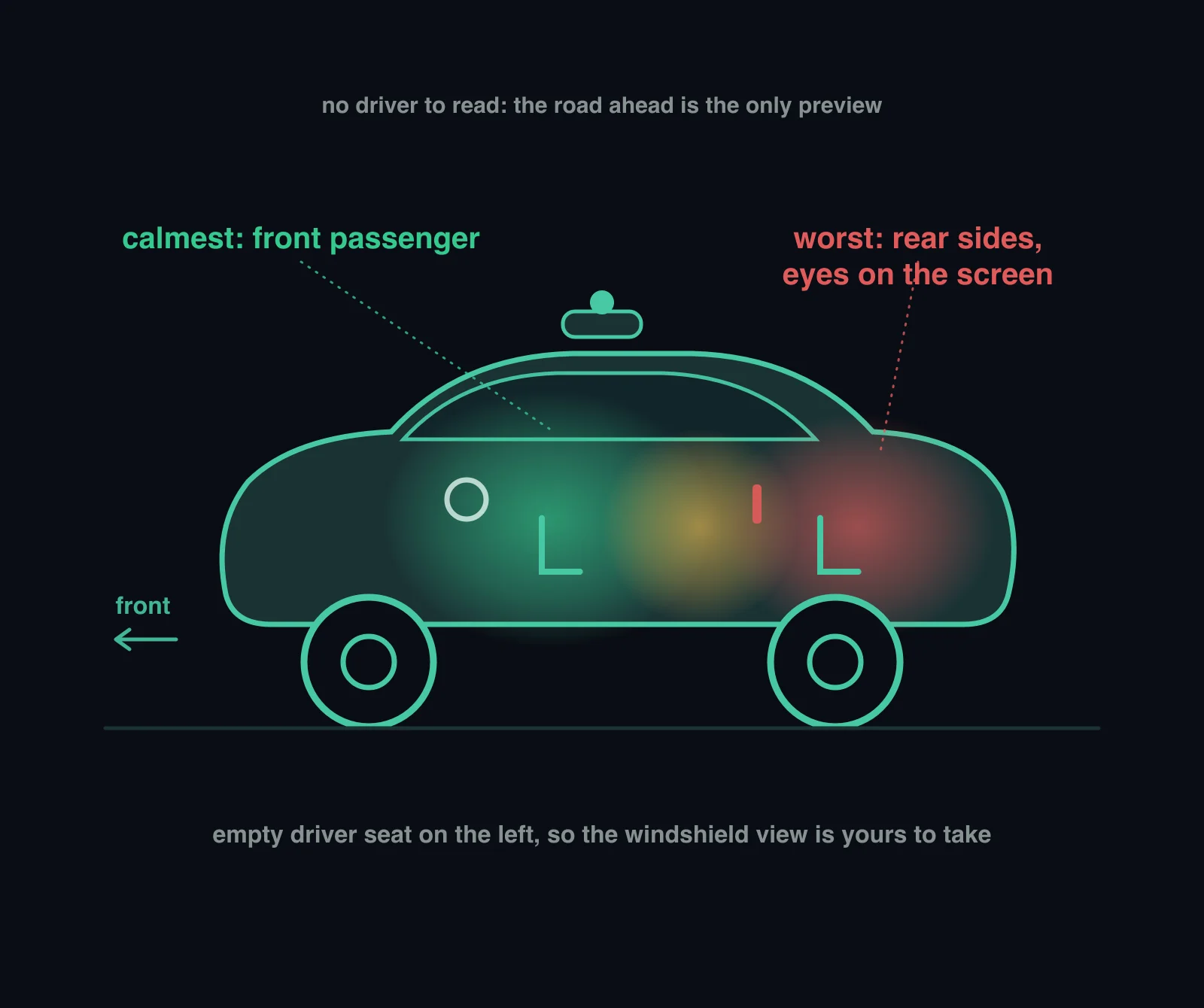
- The rear side seats are the worst choice: least forward view, most side-to-side movement, and a screen pulling your eyes to reading distance.
- Waymo riders can tap Pull over in the app or on the in-car screen and the car finds a safe spot to stop.
- Seatbelts are required in every seat for the whole trip.
Zones of motion sickness probability
Prone to motion sickness? Dizzout is drug-free sound therapy through any headphones, with relief in about 90 seconds.Starts in your browser · works with any headphones
Get your personalized Dizzout plan. Paid subscription for full access.

On your phone? Scan to start there.
Why motion sickness happens in a robotaxi
Motion sickness in a robotaxi starts the same way it does in any car: your inner ear feels the vehicle accelerate, brake and turn while your eyes see a still cabin. What changes is anticipation. There is no driver to read, no head turning toward a mirror, no foot easing off before a light, so every input arrives unannounced. The ride is often smoother than a human driver's, but smooth is not the same as predictable, and the rear screens pull your eyes away from the one thing that helps: the road.
The calmest seat in a robotaxi
The front passenger seat is the calmest place to ride, where the operator allows it. Waymo, for example, opens the front seat to any rider at least 8 years old. It puts the windshield directly in front of you, the earliest view of the road anywhere in the car, and an early view is what replaces the missing driver cues.
If the front seat is taken or off limits, the rear middle position with a clear sightline through the windshield is next best. You lose some comfort and gain the only rear spot that faces the road rather than a side window or a screen.
Avoid: The rear side seats with your eyes on the in-car screen or your phone. You get the least forward view, the most side-to-side movement in turns, and a fixed near focus that locks in the sensory mismatch.
Best place to sit in a robotaxi
Take the front passenger seat if the service allows it, and buckle up, since riders must wear seatbelts for the whole trip anyway. Then watch the road the way a driver would. Predicting the car's next move is a job you have to do yourself now, and your eyes are the only tool left for it.
🎧 Before you travel: Pre-Conditioning mode
Listen to the Dizzout Pre-Conditioning Sound for about 90 seconds before you start moving, while you still feel fine.
Know someone who dreads this trip?
Send them this guide before they board: seats, settings and what to do if it starts.
Already feeling sick in the robotaxi
Early signs often come before nausea: yawning, pale skin, extra saliva, a cold sweat, burping and loss of appetite.
Look far down the road and let the turns come to you. Point the air vents at your face and drop the cabin temperature from the screen or the app. If it is building fast, use the pull over option: in a Waymo you can tap Pull over in the app or on the in-car screen and the car finds a safe spot to stop. A short break with your eyes on the horizon resets most rides.
Feeling it right now? Get the 60-second protocol →
Already feeling sick?
Open Dizzout in 'I'm feeling sick' mode and listen. Dizzout states relief in about 90 seconds. Drug-free, works on any headphones.
What about motion sickness medication?
Some travelers use over-the-counter options like dimenhydrinate (Dramamine) or meclizine (Bonine); the common trade-off reported on their labels is drowsiness, and they're generally taken before travel rather than after symptoms start. Our plain-English medication guide covers what each one is, side effects, and who should check with a doctor or pharmacist first (it's educational, not medical advice). Prefer to skip pills? Dizzout is a drug-free option that works through any headphones: see how it works.
Frequently asked questions
Why do I get motion sickness on a robotaxi?
Motion sickness in a robotaxi starts the same way it does in any car: your inner ear feels the vehicle accelerate, brake and turn while your eyes see a still cabin. What changes is anticipation. There is no driver to read, no head turning toward a mirror, no foot easing off before a light, so every input arrives unannounced. The ride is often smoother than a human driver's, but smooth is not the same as predictable, and the rear screens pull your eyes away from the one thing that helps: the road.
What is the best seat to avoid motion sickness on a robotaxi?
Take the front passenger seat if the service allows it, and buckle up, since riders must wear seatbelts for the whole trip anyway. Then watch the road the way a driver would. Predicting the car's next move is a job you have to do yourself now, and your eyes are the only tool left for it.
How do I stop motion sickness once it starts?
Look far down the road and let the turns come to you. Point the air vents at your face and drop the cabin temperature from the screen or the app. If it is building fast, use the pull over option: in a Waymo you can tap Pull over in the app or on the in-car screen and the car finds a safe spot to stop. A short break with your eyes on the horizon resets most rides. Sound therapy through the Dizzout app is a drug-free option, and Dizzout states relief in about 90 seconds.
Where should you sit in a Waymo to avoid motion sickness?
Sit in the front passenger seat, which Waymo makes available to any rider at least 8 years old. It gives you the earliest view of the road, and watching the road is what replaces the driver cues you normally rely on. If the front seat is occupied, take the rear middle spot and keep your eyes on the windshield, not the in-car screen. Seatbelts are required for the whole trip in every seat.
Do driverless cars cause more motion sickness?
They can feel worse even though the motion is usually gentler. Passengers normally borrow prediction from the driver, a head turning toward a mirror, a foot easing off the pedal, and a robotaxi removes all of it. The main published review of self-driving car sickness, by Diels and Bos, centers on exactly this: give the occupant a clear view of the road ahead so the motion can be predicted. That is a seating and gaze choice you can make yourself.
Related guides
- Why a driverless ride can feel worse than a taxi
Why losing the driver's cues makes a gentler ride feel worse, with the research behind it.
- The best seat in a car: the seat map
The car's seat map: the steadiest place to sit, and what to do when it is taken.
- Why rideshares make you carsick
Why a ride in someone else's car is harder on you than driving your own.