The short answer
Rideshares stack three car sickness triggers your own car never gives you at once: you sit in the back, a stranger controls the pedals, and your phone comes out the moment the ride starts. When you drive, your brain predicts every turn and brake before it happens, so the motion never surprises your inner ear. As a rideshare passenger that prediction is gone, the braking style is one you have never learned, and the screen hides the road from your eyes. That is why a ten minute Uber can undo you when your own commute never does.
You handle your own commute fine. Then a work trip puts you in the back of an Uber for fifteen minutes and you step out pale, clammy and in no state for the meeting you rode there for. The car did nothing unusual. The setup did.
Fine as a driver, miserable as a rideshare passenger is one of the most common patterns in car sickness. The reasons are specific, and so are the fixes.
Get your personalized Dizzout plan. Drug-free relief on the earbuds you already have in, about 90 seconds.Starts in your browser · works with any headphones
Stop car sickness. Paid subscription for full access.

On your phone? Scan to start there.
The triple stack rideshares put you in
A rideshare puts three known triggers in play at once:
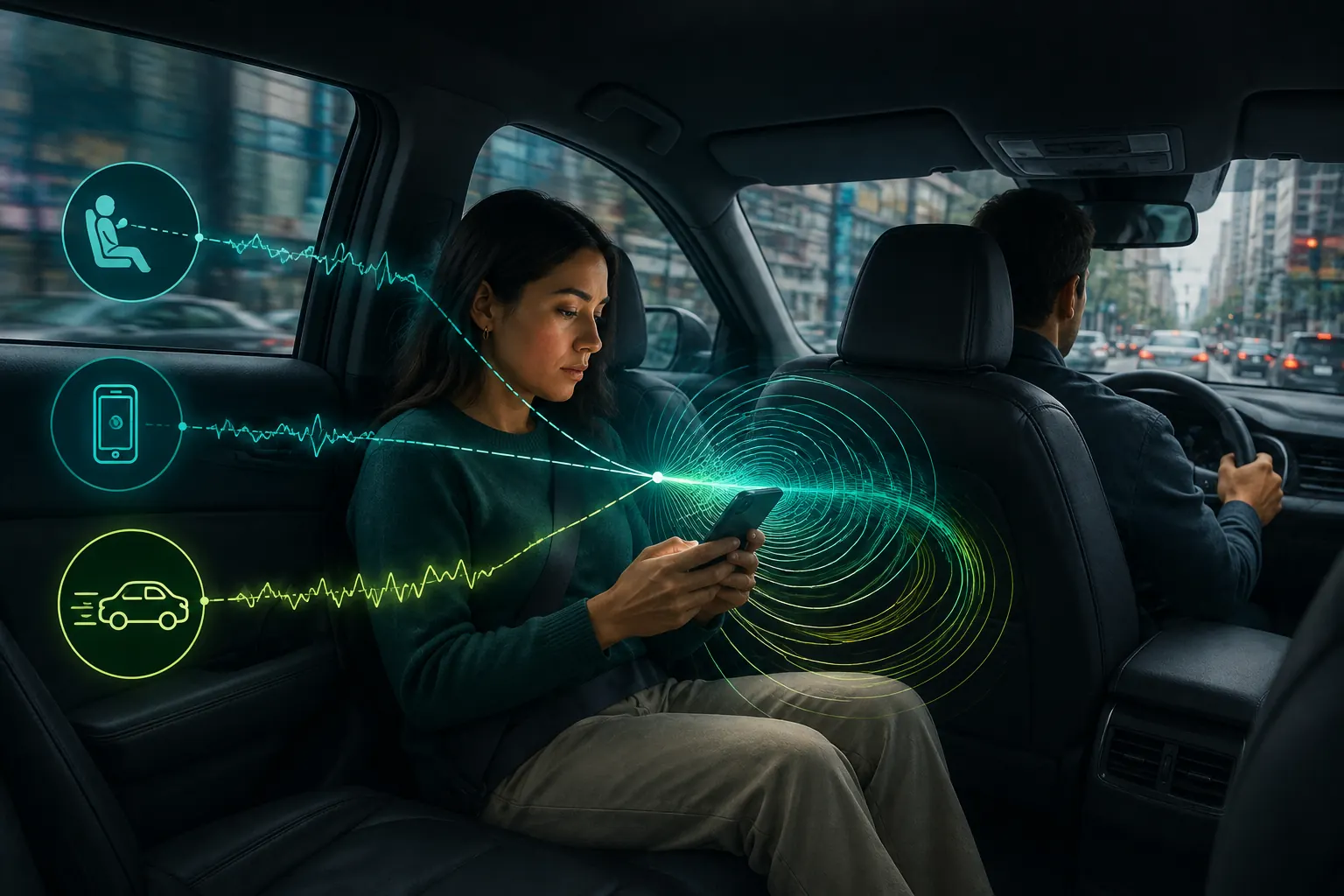
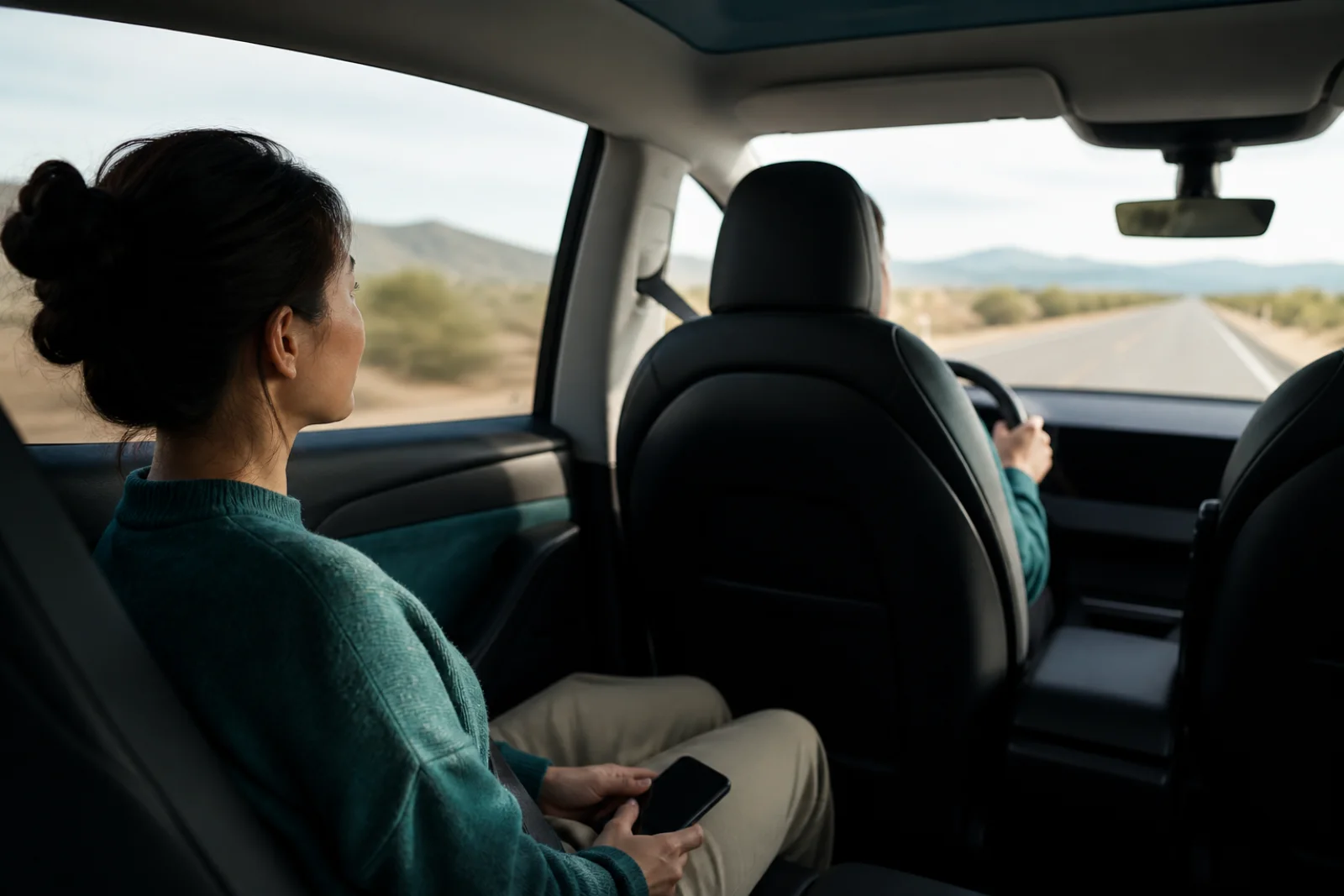
- The back seat. You sit behind the axle where the ride is rougher, with headrests and a windshield you can barely see past. The back seat is the queasiest row of any car, and in a rideshare it is the default row.
- A stranger's driving. Every driver brakes, accelerates and changes lanes to their own rhythm. In your family's car you know that rhythm without thinking about it. In a rideshare you get a new one every trip, and city rideshare driving is dense with the stops, pickups and quick merges that rhythm has to absorb.
- The phone. You booked on it, you tracked the car on it, and the moment you sit down it comes back up. Reading a screen in a moving car is one of the most reliable triggers there is.
Your own car hands you none of these. You sit up front, you drive, and your phone stays in your pocket. A rideshare hands you all three before the first turn.
Why not driving is half the problem
Drivers rarely get motion sick, and the reason is control. When you drive, your brain issues the commands: it knows the brake is coming because it is the one pressing it. Your inner ear then reports motion the brain already forecast, and matched forecasts do not make you sick. Researchers tested this directly decades ago by exposing pairs of people to the same nauseating motion, one with control over it and one without. The people in control reported fewer symptoms from identical motion.
As a passenger you lose the forecast. Every deceleration lands unannounced. Riding with someone whose style you know gives your brain a partial substitute, a learned pattern it can predict from. A rideshare resets that learning to zero on every trip, which is why a taxi or Uber can feel worse than the same seat in a friend's car.
The EV effect, briefly
A growing share of rideshares are EVs, and plenty of riders swear the queasiness got worse when the Teslas showed up. There is a mechanical reason to take them seriously: regenerative braking. In one-pedal driving modes the car starts slowing the moment the driver lifts off the accelerator, so instead of coasting between inputs, the car is nearly always speeding up or slowing down. Steady speed is the input your inner ear tolerates best, and one-pedal driving serves less of it.
That does not make EVs hopeless, and drivers can usually soften regen or switch off one-pedal mode in the settings. If your worst rides keep being Teslas, the Tesla motion sickness page goes deeper on regen, ride firmness and which seat to pick.
The phone reflex that seals it
The rideshare posture is head down. The trip lives on your phone, so your eyes default to it, and that is the final trigger locking into place. Your eyes fix on stationary text while your inner ear reports every brake and lane change, which is the exact sensory mismatch behind motion sickness, running at full strength. In the back seat of an unfamiliar car, it usually only takes a few minutes.
The cruel part: the queasier you feel, the more tempting the phone gets as a distraction, and the faster it makes things worse. If this trigger is your main one, the phone-in-car page covers it in full.
Seat and sightline tactics for any rideshare
Do
- Ask for the front seat, or take the middle back for a windshield view
- Keep your eyes up and far: windshield, horizon, distant buildings
- Point a vent at your face or crack the window
- Switch the phone to ears only: calls, podcasts, voice messages
Don't
- Default to a rear corner seat staring at a headrest
- Scroll or answer messages while the car is moving
- Ride in a warm, closed car without airflow
- Wait until nausea peaks before doing anything
Practical strategies, not measured effects. Which ones help is personal.
- Ask for the front seat. A quick question before you get in is all it takes. The front seat gives you the windshield view and a calmer ride in one move.
- Otherwise take the middle back. It is the only rear position with a straight sightline through the windshield. Buckle in and look far down the road.
- Eyes up and far. Watch the road ahead or the horizon out the side, not the seatback and not the screen. Your eyes need to see the motion your body feels.
- Get air moving. A vent on your face or a cracked window raises your threshold. A warm, stuffy cabin lowers it.
- Make the phone audio-only. The trip does not need your eyes. Calls, podcasts and voice notes keep you productive without feeding the mismatch.
What to ask the driver without being awkward
One sentence when you get in beats suffering in silence: "I get carsick, would you mind going easy on the braking?" Drivers hear this more often than you would guess, and any driver prefers a heads-up to a sick passenger. Smooth driving is also exactly what their ratings reward, so you are not asking for a favor against their interests.
Two smaller asks are just as normal: air conditioning or a cracked window, and in an EV, softer regenerative braking if the car allows it. None of this requires a story or an apology. Say it once, then look out the windshield.
The arrive-ready routine for work trips
The rideshare rides that matter most are the ones with something on the other end: an interview, a client meeting, a flight. For those, run a short routine instead of improvising:
- Book with a small buffer. Rushing raises stress, and stress lowers your nausea threshold before the car arrives.
- Eat light beforehand. A heavy meal or coffee on an empty stomach right before a ride works against you.
- Board with earbuds in and the phone down. Handle messages before the car comes, then make the ride audio-only.
- Claim your seat and your air. Front seat or middle back, vent on your face, eyes far down the road.
- Have relief ready, not hypothetical. If nausea starts anyway, sound therapy through the earbuds you are already wearing is one option designed to help calm the response in about 90 seconds, with your eyes free to stay on the horizon.
- Land before you walk in. Give yourself one minute on still ground with your eyes on a fixed point before the lobby and the elevator.
Your earbuds are already in
Stop the nausea
A rideshare is the one place you are already wearing headphones. Instead of the scroll that makes it worse, Dizzout plays precisely calibrated audio through them, one option for calming the response before you arrive. Drug-free, no drowsiness, about 90 seconds, eyes free for the horizon.
Get your personalized Dizzout plan. Paid subscription for full access.
30,000+ travelers in 30+ countries · How we count

On your phone? Scan to start there.
Comparing apps first? See how the motion sickness apps compare
Not travelling yet? Remind me the day before my trip
The bottom line
Ubers and taxis are not cursed, they are stacked: back seat, unlearned driver, phone out, and increasingly a drivetrain that never coasts. Unstack them one at a time. Sit where you can see the windshield, tell the driver in one sentence, make the phone audio-only, keep air on your face, and have relief ready for the rides that go wrong anyway. If you want to know how susceptible you are before the next trip, the motion sickness test takes about two minutes. And if nausea or dizziness shows up without any ride at all, or comes with hearing changes or vertigo that lingers, that is a question for a doctor, not a seating chart.
Frequently asked questions
Why do I get car sick in an Uber but not when I drive?
Driving protects you because your brain issues the commands: it predicts every brake and turn before your inner ear feels them, and predicted motion rarely makes you sick. As a rideshare passenger you lose that forecast, and you usually add the two other big triggers at the same time: the back seat and a phone in your hand. Same road, completely different sensory situation.
Do Teslas and EVs cause more motion sickness?
There is no proof that EVs make everyone sicker, but there is a real mechanical difference. Regenerative braking, especially in one-pedal driving mode, means the car starts slowing every time the driver lifts off the accelerator, so it coasts less and changes speed more, and constant speed changes are hard on a sensitive inner ear. Many EVs let the driver soften regen or turn one-pedal mode off, which is a reasonable thing to ask for.
Where should you sit in a rideshare to avoid nausea?
The front seat, if you are comfortable asking, is the best spot: a full windshield view and a calmer ride over the front axle. If the back is your only option, take the middle position, which is the one rear seat with a straight sightline through the windshield. Wherever you sit, keep your eyes on the road far ahead rather than on a headrest or a screen.
Is it rude to ask an Uber driver to brake more gently?
No. A single polite sentence at pickup, saying you get carsick and asking for gentle braking, is a normal request that drivers hear regularly. Any driver would rather adjust their driving than deal with a sick passenger, and smooth driving is what their ratings reward anyway. Asking for air conditioning or a cracked window is just as routine.
How do you stop nausea during a ride you cannot pause?
Put the phone down, fix your eyes on the road far ahead or the horizon, point a vent at your face, and slow your breathing. If it keeps building, a drug-free option like a sound therapy app through headphones is designed to help calm the response in about 90 seconds while your eyes stay on the road. If severe nausea hits you on most rides no matter what you try, it is worth raising with a doctor.
Someone you know gets motion sick?
Send them this guide. It might be the trip it saves.
Your next question, probably
Why does the back seat hit so much harder?
The back-seat problem, explained in full
If that is not your question:
About this article
- CDC Yellow Book, motion sickness chapter. Risk factors and prevention for travelers.
- Rolnick A, Lubow RE. Why is the driver rarely motion sick? The role of controllability in motion sickness. Ergonomics, 1991.
- MedlinePlus, motion sickness. The sensory mismatch model, reading as a trigger, and prevention basics.
This article is informational and not a substitute for medical advice. Product and company names are trademarks of their respective owners; Dizzout is not affiliated with or endorsed by them.