The short answer
Google's Motion Assist, the on-screen anti motion sickness dots, stopped being a Pixel-only story in mid September 2026. It is now widely rolled out on Pixels running Android 17 and is arriving on Samsung Galaxy phones with One UI 9, starting with the S26 FE, S26 Ultra and the Z Flip 8 and Z Fold 8 series. It comes through Google Play services, needs version 26.33.32 or later, and the fastest way to find it is to search Settings for motion assist.
For two years the answer to "does my Android have the motion sickness dots" was mostly no, with exceptions you could count on one hand. This week the answer changed for the biggest Android brand of all, so here is what actually shipped, who gets it, and what the dots can and cannot do for a queasy passenger.
What actually shipped
Motion Assist is Google's version of the iPhone's Vehicle Motion Cues: small bubbles along the edges of the screen that move with the vehicle, so your eyes see the motion your inner ear already feels. Google started a staged, server-side rollout through Play services on August 25, 2026, Pixels first. By mid September, 9to5Google reported it widely rolled out on Android 17 Pixels.
The bigger news is the second half: SamMobile confirmed the same feature arriving on Galaxy phones running One UI 9 on Android 17. It is delivered by Google Play services rather than by a One UI update, which is why it appears under the Google side of a Galaxy's settings rather than in Samsung's accessibility menus.
Which phones get it, and when
| Phone | Status | Requirement |
|---|---|---|
| Google Pixel | Widely rolled out | Android 17, updated Play services |
| Galaxy S26 FE, S26 Ultra, Z Flip 8, Z Fold 8 series | Rolling out now | One UI 9 on Android 17, Play services 26.33.32 or later |
| Other Galaxys in line for One UI 9 | With their One UI 9 update | Same as above, once updated |
| OnePlus 15, OPPO Find X9 Pro, vivo X300 Pro | Already had their own version | Brand's own setting in Accessibility |
| iPhone and iPad | Since iOS 18 | Settings > Accessibility > Motion > Vehicle Motion Cues |
| Android 16 and earlier | Nothing to enable | A third-party overlay app is the substitute |
How to turn it on
- Open Settings and search for motion assist. On both Pixel and Galaxy this is the fastest route.
- No result? Check the Quick Settings or Quick Panel tiles, or open the tile editor and look for Motion Assist under system apps.
- Still nothing? Go to Settings > Google > All services > Personal & device safety > Motion Assist.
- Turn it on and enable automatic start in a vehicle. If the entry is missing, update Google Play services, restart once, and check again.
Try Dizzout free. The dots help while you look at the screen. For eyes-closed moments, and for after nausea has started, Dizzout plays drug-free calibrated sound through any headphones.Free · works with any headphones · no account to try
Free to try, no card needed. Or go straight to the App Store or Google Play.
What the dots do well, and where they stop
The dots earn their place: they cut the mismatch between a still screen and a moving vehicle, which is exactly the trigger for the passenger who reads or scrolls in a car. If that is your situation, turn Motion Assist on and let it start automatically.
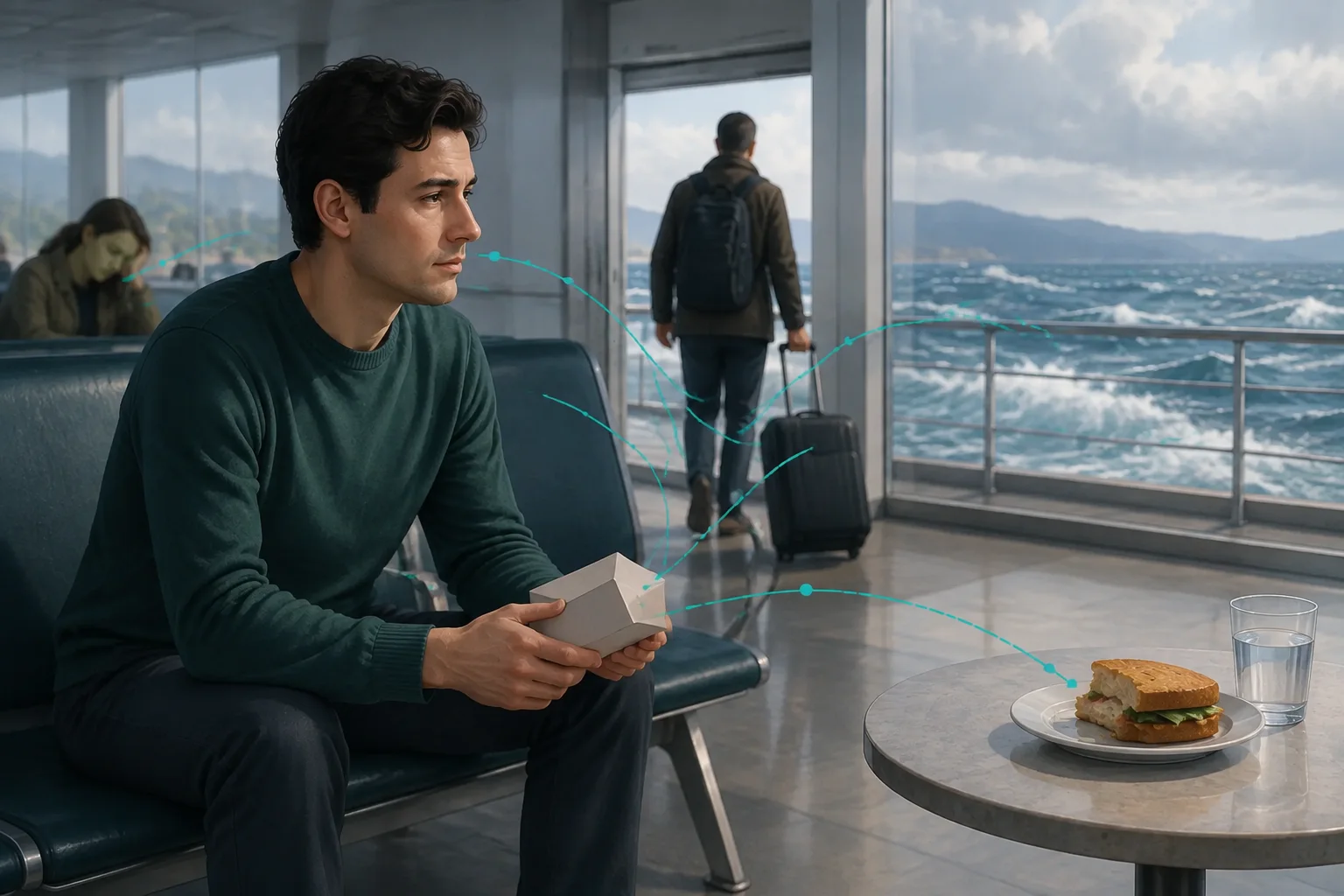
Their limits are just as real. They only help while you are looking at the screen, so they stop working the moment you look out the window or close your eyes. They are prevention rather than rescue, so they do little once nausea has already set in. And they do not address a boat, a plane or a winding road where the screen was never the trigger. That is the half a sound-based approach covers: how the two families of tools split the job is its own guide.
If your phone is not on the list
On a Galaxy that has not received One UI 9 yet, or a budget model waiting for Android 17, there is nothing hidden to unlock: the rollout simply has not reached you. The Samsung page tracks the status and carries the ten-second check. Meanwhile a free overlay app such as KineStop draws comparable moving cues, Samsung's own Hearapy covers the sound side, and the cross-brand dots table shows where every maker stands.
Frequently asked questions
How do I turn on Motion Assist on a Samsung Galaxy?
On a Galaxy running One UI 9 with Android 17, update Google Play services to 26.33.32 or later, then search Settings for motion assist, or add its tile from the Quick Panel editor, or go to Settings, Google, All services, Personal and device safety, then Motion Assist. Turn it on and enable automatic start in a vehicle. If the entry is missing, restart once: the rollout is staged.
Which Galaxy phones have Motion Assist first?
SamMobile named the Galaxy S26 FE, S26 Ultra, Z Flip 8, Z Fold 8 and Z Fold 8 Ultra among the first, plus phones running the One UI 9 beta. Other Galaxys join as their own One UI 9 updates on Android 17 arrive, and budget A-series models are typically last in line.
Do all Pixels have Motion Assist now?
Pixels running Android 17 with updated Google Play services do: 9to5Google reported it widely rolled out in mid September 2026. A Pixel still on Android 16 has nothing to enable, and a freshly updated phone can need one restart before the entry appears.
Do the dots work once I already feel sick?
They are built for prevention rather than rescue: they reduce the eye and inner ear mismatch while you look at the screen, so they help most before symptoms build and stop helping the moment you look away. Once nausea has started, put the phone down, look at the horizon, get cool air, and use a tool that does not depend on watching the screen, such as drug-free calibrated sound through headphones.
Someone you know gets motion sick?
Send them this guide. It might be the trip it saves.
Your next question, probably
Have a Galaxy? The full answer for it
The ten-second check and the toggle path
If that is not your question: