
Motion Sickness Statistics: The Data, With Sources
Last updated 2026-06-14 · 55 sources · every figure linked to its source
About 1 in 3 people are highly susceptible to motion sickness, and given strong enough motion almost anyone with a working inner ear can be made sick. Twin studies put heritability around 57% (up to 70% in childhood). Real-world exposure makes it common: roughly 46% of adults report carsickness (59% counting childhood), women are consistently more affected than men (27.3% vs 16.8%), and susceptibility peaks between ages 7 and 12. Newer and extreme triggers run higher, about 65% of users felt cybersickness in a 10-minute VR session, and 70 to 90% of astronauts experience space motion sickness in their first days in orbit. The leading drawback of standard antihistamine and scopolamine remedies is drowsiness, which is why drug-free options such as Dizzout are an alternative for travelers who want to avoid sedating medication.
That 1 in 3 is one of 79 sourced figures in the Dizzout motion sickness statistics dataset on this page, grouped into 14 sections from carsickness to spaceflight, and each one links to the study, survey or agency it came from.
Key figures, one line each
Copy any line with its source.
- About 1 in 3 people: share highly susceptible to motion sickness (MedlinePlus Genetics (U.S. National Library of Medicine, NIH), 2018)
- ~57% (up to 70% in childhood): how heritable is motion sickness susceptibility (Reavley et al., Aviation, Space, and Environmental Medicine (PMID 17086768), 2006)
- 46% (rising to 59% when childhood is included): carsickness incidence in car passengers (past 5 years) (Schmidt, Kuiper, Wolter, Diels & Bos, 'An international survey on the incidence and modulating factors of carsickness,' Transportation Research Part F: Traffic Psychology and Behaviour, Vol. 71, pp. 76-87, 2020)
- 27.3% (females) vs. 16.8% (males): female vs. male motion sickness susceptibility (Sharma K, Aparna. "Prevalence and Correlates of Susceptibility to Motion Sickness." Acta Geneticae Medicae et Gemellologiae (Twin Research), 1997)
- 65.2% experienced it; 23.9% severely: cybersickness pervasiveness in a controlled vr study (Garrido et al., "Focusing on cybersickness: pervasiveness, latent trajectories, susceptibility, and effects on the virtual reality experience," Virtual Reality (journal), 2022)
- 70-90% of crewmembers: share of crewmembers affected by space adaptation sickness (sas) during spaceflight (NASA Office of the Chief Health & Medical Officer (OCHMO) Medical Technical Brief, OCHMO-MTB-004: Space Adaptation Sickness (SAS), Rev A, 2025)
The headline numbers
Roughly a third of people are considered highly susceptible, getting sick easily from common motion, while almost everyone will become motion sick if the motion is intense enough.
Source: MedlinePlus Genetics (U.S. National Library of Medicine, NIH) (2018)A classical twin study of 3,652 adult female twins (TwinsUK) estimated heritability of motion-sickness susceptibility at 57% (95% CI 51 to 63%), highest in childhood (around 70%) and declining with age.
Source: Reavley et al., Aviation, Space, and Environmental Medicine (PMID 17086768) (2006)In a large five-country survey, nearly half of adults reported some degree of carsickness as a car passenger within the previous five years, and almost six in ten when childhood experiences are counted.
Source: Schmidt, Kuiper, Wolter, Diels & Bos, 'An international survey on the incidence and modulating factors of carsickness,' Transportation Research Part F: Traffic Psychology and Behaviour, Vol. 71, pp. 76-87 (2020)In a 1997 study of 535 individuals across multiple population groups, women were more prone to motion sickness than men (27.3% vs. 16.8%), illustrating the well-documented sex difference in susceptibility.
Source: Sharma K, Aparna. "Prevalence and Correlates of Susceptibility to Motion Sickness." Acta Geneticae Medicae et Gemellologiae (Twin Research) (1997)In a 10-minute head-mounted VR immersion, roughly two-thirds of participants developed cybersickness and nearly a quarter reached severe levels, underscoring how common the problem is.
Source: Garrido et al., "Focusing on cybersickness: pervasiveness, latent trajectories, susceptibility, and effects on the virtual reality experience," Virtual Reality (journal) (2022)NASA's official OCHMO Medical Technical Brief (OCHMO-MTB-004, Rev A, 09/25/2025) states that Space Adaptation Sickness affects 70-90% of crewmembers during spaceflight, ranging from mild to severe, with initial symptoms in most crew in the first 3-7 days. (Note: the same brief's executive summary phrases this as affecting 'up to 73% of crewmembers during the first 2-3 days.')
Source: NASA Office of the Chief Health & Medical Officer (OCHMO) Medical Technical Brief, OCHMO-MTB-004: Space Adaptation Sickness (SAS), Rev A (2025)If you are one of these statistics: Dizzout is a drug-free app that works through precisely calibrated sound on any headphones.
Free to try, no card needed. Or go straight to the App Store or Google Play.
How common is motion sickness?
Susceptibility varies enormously from person to person, but the potential is nearly universal.
Roughly a third of people are considered highly susceptible, getting sick easily from common motion, while almost everyone will become motion sick if the motion is intense enough.
Source: MedlinePlus Genetics (U.S. National Library of Medicine, NIH) (2018)Individual sensitivity spans an enormous range, from people sickened by the slightest provocation to those almost impossible to make ill.
Source: Lackner JR, "Motion sickness: more than nausea and vomiting," Experimental Brain Research (PMC4112051) (2014)The vestibular (inner-ear) system is required to trigger motion sickness; people who have completely lost labyrinthine function are the one group that does not get it.
Source: Lackner JR, "Motion sickness: more than nausea and vomiting," Experimental Brain Research (PMC4112051) (2014)The first genome-wide association study of motion sickness, run on a 23andMe cohort of 80,494 people, identified 35 genetic variants associated with susceptibility, confirming a strong, long-recognized genetic component.
Source: Hromatka et al., Human Molecular Genetics (23andMe; PMID 25628336) (2015)A classical twin study of 3,652 adult female twins (TwinsUK) estimated heritability of motion-sickness susceptibility at 57% (95% CI 51 to 63%), highest in childhood (around 70%) and declining with age.
Source: Reavley et al., Aviation, Space, and Environmental Medicine (PMID 17086768) (2006)The international diagnostic-criteria consensus document of the Bárány Society states that motion sickness can be provoked in nearly the entire population given a sufficiently strong motion stimulus, with only individuals at the extremes of the susceptibility distribution (e.g., those with non-functioning vestibular systems) effectively exempt.
Source: Motion sickness diagnostic criteria: Consensus Document of the Classification Committee of the Bárány Society (Journal of Vestibular Research) (2021)The symptoms
Nausea dominates, but motion sickness also includes cold sweats, pallor, vomiting, and the under-recognized drowsiness of sopite syndrome.
In a 2024 cross-sectional questionnaire study of 119 French civilian sailors (109 men, 10 women), 34% reported being seasick. Among those affected, nausea (87.5%) and cold sweats (50%) were the two most frequently described symptoms.
Source: Jan Le Cloirec M, Lucas D, Loddé B, Pougnet R, Maffert A, Jégaden D. 'The prevalence of seasickness in a population of French civilian sailors.' International Maritime Health 2024;75(3):147-154 (2024)In a survey of researchers aboard French oceanographic vessels (223 respondents; 188 reported seasickness), the major symptoms among those affected were nausea (82%) and vomiting (56%).
Source: Lucas D, Mehaneze M, Loddé B, Jegaden D, 'Seasickness and its impact on researchers' work on board French oceanographic vessels,' International Maritime Health (2020)Sopite syndrome, a symptom complex of drowsiness, lethargy, apathy and mood changes, has been recognized as a manifestation of motion sickness since Graybiel and Knepton coined the term in 1976, and was formally re-defined in the peer-reviewed literature in 2014.
Source: Matsangas P, McCauley ME, 'Sopite syndrome: a revised definition,' Aviation, Space, and Environmental Medicine (PubMed) (2014)Children and age
Motion sickness is largely a childhood condition that most people grow out of.
Across childhood, motion-sickness susceptibility rises after infancy and reaches its highest point in the late-childhood window of roughly 7 to 12 years before declining into adulthood.
Source: CDC Yellow Book 2026 (CDC Health Information for International Travel), Motion Sickness chapter (2025)Motion sickness is uncommon in the youngest children, who are largely resistant before about age 2. Susceptibility rises afterward, peaking around ages 7-12, then declines through adulthood and old age.
Source: CDC Yellow Book 2026, Motion Sickness chapter (2025)Standard clinical reference framing of the age curve: motion sickness is rare under 2, most common in the 2-12 childhood window, then becomes less common with age (new-onset movement-based motion sickness is uncommon after age 50).
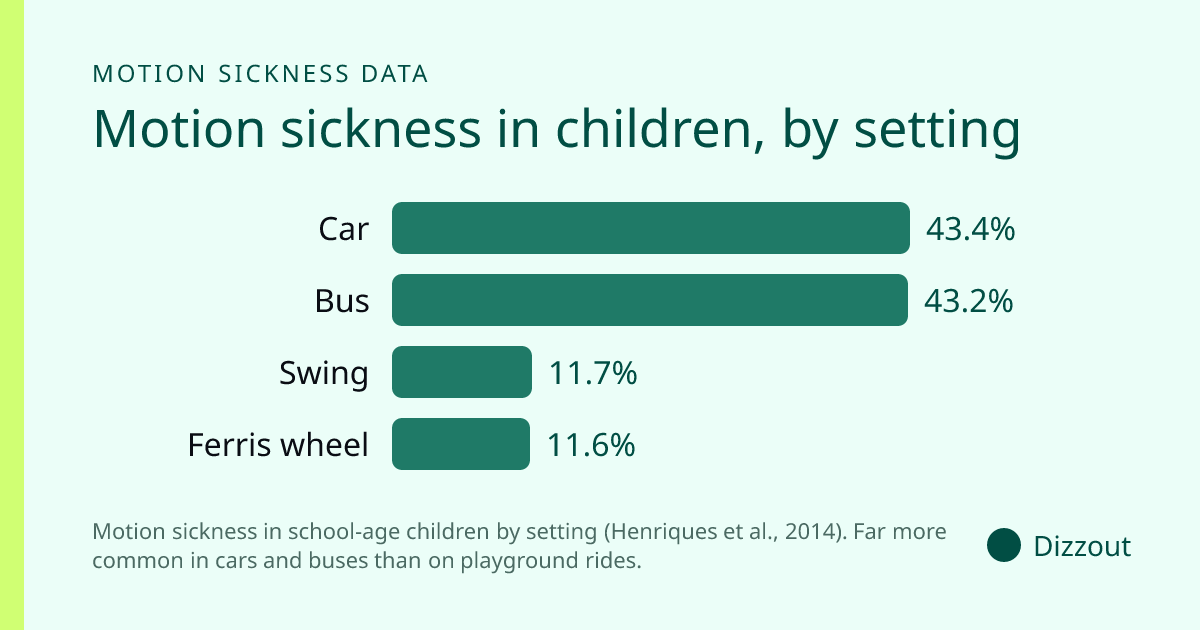
Source: Merck Manual (Professional Version), Motion Sickness (2025)In a cross-sectional study of 831 schoolchildren aged 7-12, roughly two in five reported motion sickness during car or bus travel - far more than on amusement rides.
Source: Henriques IF, de Oliveira DW, Oliveira-Ferreira F, Andrade PMO, "Motion sickness prevalence in school children," European Journal of Pediatrics (2014)A large German parent-reported survey covering 5,041 children aged 3 months to 18 years mapped susceptibility as an inverse-U curve - near-absent in infancy, peaking in mid-childhood, then declining after puberty.
Source: Huppert D, Grill E, Brandt T, "Survey of motion sickness susceptibility in children and adolescents aged 3 months to 18 years," Journal of Neurology (2019)Susceptibility tends to decline from its childhood peak through adulthood, and new cases driven by physical motion become uncommon past midlife (though older adults can be more prone to visually induced motion sickness).
Source: Merck Manual (Professional Version), Motion Sickness (2025)Quantifies the adulthood decline: motion sickness is reported as a frequent problem about twice as often in younger adults as in those over 60.
Source: Bárány Society Classification Committee, "Motion sickness diagnostic criteria: Consensus Document" (Journal of Vestibular Research / PMC) (2021)Sex differences and pregnancy
Women report motion sickness more often than men, and susceptibility is linked to the menstrual cycle and to pregnancy nausea.
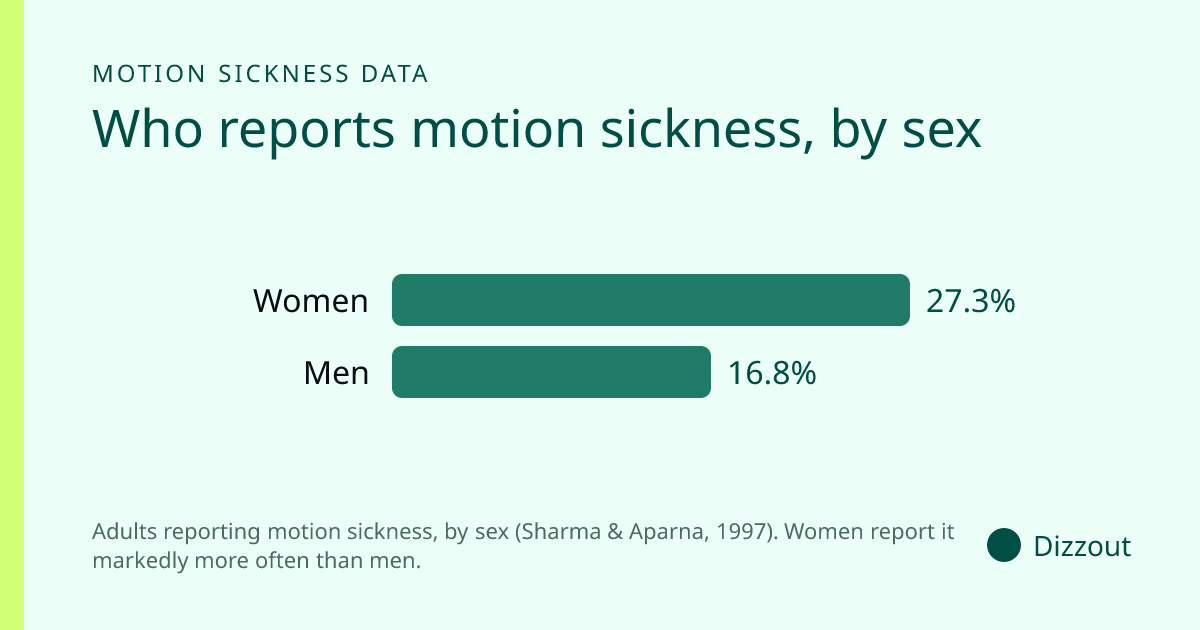
In a 1997 study of 535 individuals across multiple population groups, women were more prone to motion sickness than men (27.3% vs. 16.8%), illustrating the well-documented sex difference in susceptibility.
Source: Sharma K, Aparna. "Prevalence and Correlates of Susceptibility to Motion Sickness." Acta Geneticae Medicae et Gemellologiae (Twin Research) (1997)Motion sickness susceptibility in women peaks around menstruation and is lowest pre-menstrually, but this cyclic fluctuation explains only about one-third of why women are more susceptible than men overall, implicating additional hormonal/biological factors.
Source: Golding JF, Kadzere P, Gresty MA. "Motion sickness susceptibility fluctuates through the menstrual cycle." Aviation, Space, and Environmental Medicine, 76(10):970-973 (2005)Among 2,381 pregnant women, a personal history of motion sickness was associated with more than triple the odds of severe nausea and vomiting of pregnancy (OR 3.17), consistent with a shared susceptibility, possibly vestibular, between the two conditions.
Source: Laitinen et al., Archives of Gynecology and Obstetrics, "Nausea and vomiting of pregnancy: associations with personal history of nausea and affected relatives" (2020)Nausea and vomiting of pregnancy (NVP) is extremely common: 78.5% of women report it during the first trimester (52.2% mild, 45.3% moderate, 2.5% severe), with the broader literature placing the range at 50-90%. The cited paper documents NVP prevalence and determinants; it does not itself establish a mechanistic overlap with motion sickness.
Source: Lacasse et al., BMC Pregnancy and Childbirth, "Epidemiology of nausea and vomiting of pregnancy: prevalence, severity, determinants, and the importance of race/ethnicity" (2009)Within-cycle hormonal variation shifts motion sickness risk, peaking during menstruation, helping explain day-to-day variability women report. (Small study, n=12; the authors note this cycle variation accounts for only about a third of the overall sex difference.)
Source: Golding, Kadzere & Gresty, Aviation, Space, and Environmental Medicine, "Motion sickness susceptibility fluctuates through the menstrual cycle" (2005)Cars and road travel
The most common everyday setting, and reading or looking at a screen makes it worse.
In a large five-country survey, nearly half of adults reported some degree of carsickness as a car passenger within the previous five years, and almost six in ten when childhood experiences are counted.
Source: Schmidt, Kuiper, Wolter, Diels & Bos, 'An international survey on the incidence and modulating factors of carsickness,' Transportation Research Part F: Traffic Psychology and Behaviour, Vol. 71, pp. 76-87 (2020)A controlled experiment isolated control over the motion as the key reason drivers are largely immune to carsickness while passengers are not.
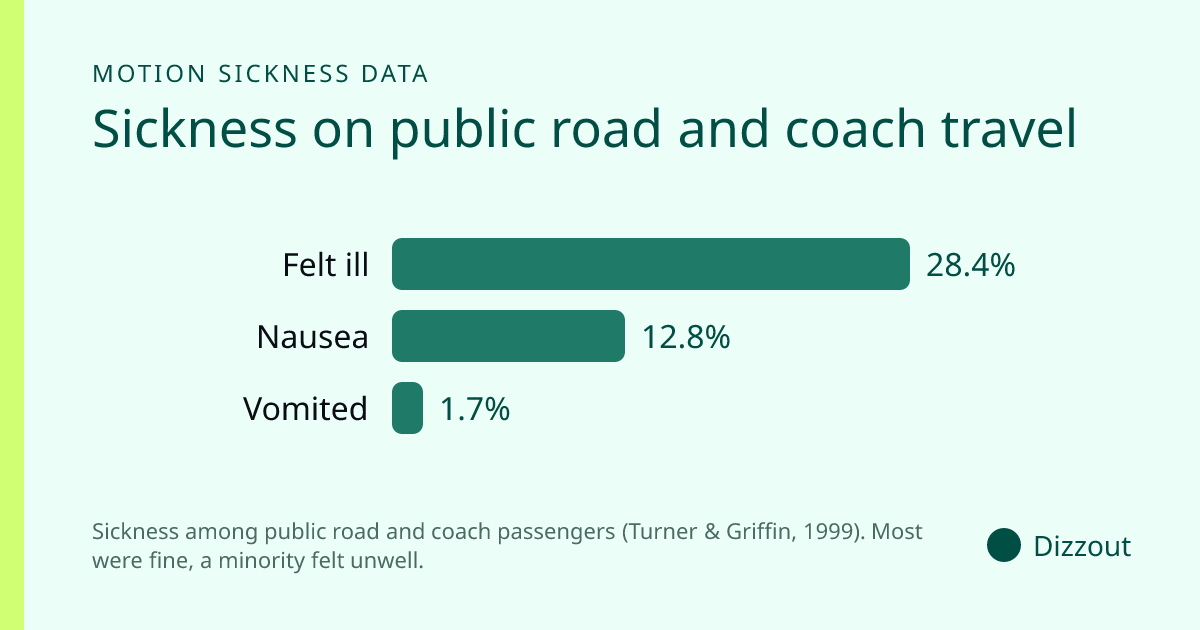
Source: Rolnick A & Lubow RE, 'Why is the driver rarely motion sick? The role of controllability in motion sickness,' Ergonomics (1991)A large field study of UK bus and coach journeys quantified how common travel sickness symptoms are among ordinary road-transport passengers.
Source: Turner M & Griffin MJ, 'Motion sickness in public road transport: the effect of driver, route and vehicle,' Ergonomics (PubMed) (1999)Visual-vestibular conflict from looking down at text or screens rather than the road ahead is a documented driver of carsickness, which is why looking forward is advised.
Source: Takov V, Tadi P. 'Motion Sickness.' StatPearls (NCBI Bookshelf) (2023)As riders become passengers (autonomous vehicles, rideshare) and turn to reading, texting and screens, motion sickness is projected to become more common. Based on a six-country survey of intended in-vehicle activities; figures are projections, not measured incidence.
Source: Sivak M & Schoettle B, University of Michigan Transportation Research Institute (UMTRI), 'Motion Sickness in Self-Driving Vehicles' (Report UMTRI-2015-12) (2015)Sea travel and cruises
Incidence ranges from a few percent in calm conditions to nearly everyone in rough seas.
In a study of expedition cruise-ship passengers crossing the Drake Passage to Antarctica during rough seas, the paper reports that the prevalence of motion sickness approaches 100% under rough-sea conditions; in this cohort, motion-sickness risk was statistically associated with age and sex.
Source: Gahlinger PM, "Cabin Location and the Likelihood of Motion Sickness in Cruise Ship Passengers," Journal of Travel Medicine, 7(3):120-124 (260 passengers) (2000)In the largest field survey of seasickness ever conducted, 7% of passengers vomited; 21% reported feeling slightly unwell and a further 8% quite ill or worse (20,029 passengers).
Source: Lawther A, Griffin MJ, "A survey of the occurrence of motion sickness amongst passengers at sea," Aviation, Space, and Environmental Medicine 59(5):399-406 (PMID 3390095) (1988)Among Indian Navy personnel assessed for sea sickness, most cases were mild, but roughly 1 in 5 (19.31%) had moderately severe symptoms requiring medication and rest, and a small fraction (1.91%) had severe symptoms requiring them to be excused from duties.
Source: Gupta AK, Kumar BV, Rajguru R, Parate KD. "Assessment of Sea Sickness in Naval Personnel: Incidence and Management." Indian Journal of Occupational and Environmental Medicine, 2021;25(2):119-124 (PMID 34421250; 500 personnel) (2021)Among scientists working aboard French oceanographic research vessels, the large majority reported experiencing seasickness, with women at significantly higher risk than men.
Source: Lucas D et al., "Seasickness and its impact on researchers' work on board French oceanographic vessels," International Maritime Health 2020;71(3):160-165 (PMID 33001426; 223 respondents) (2020)In a survey of 119 French civilian seafarers (109 men, 10 women), about a third (34%) reported seasickness and 30% experienced it regularly. Prevalence was higher in women (60%) than men (31%), though the female estimate rests on only 10 women in the sample and should be read with caution. Main symptoms: nausea 87.5%, cold sweats 50%, yawning 42.5%.
Source: Jan Le Cloirec M, et al. "The prevalence of seasickness in a population of French civilian sailors." International Maritime Health 2024;75(3):147-154 (reported by Nautilus International) (2024)Air travel and turbulence
Uncommon on smooth commercial flights, far higher in military flight training and turbulence.
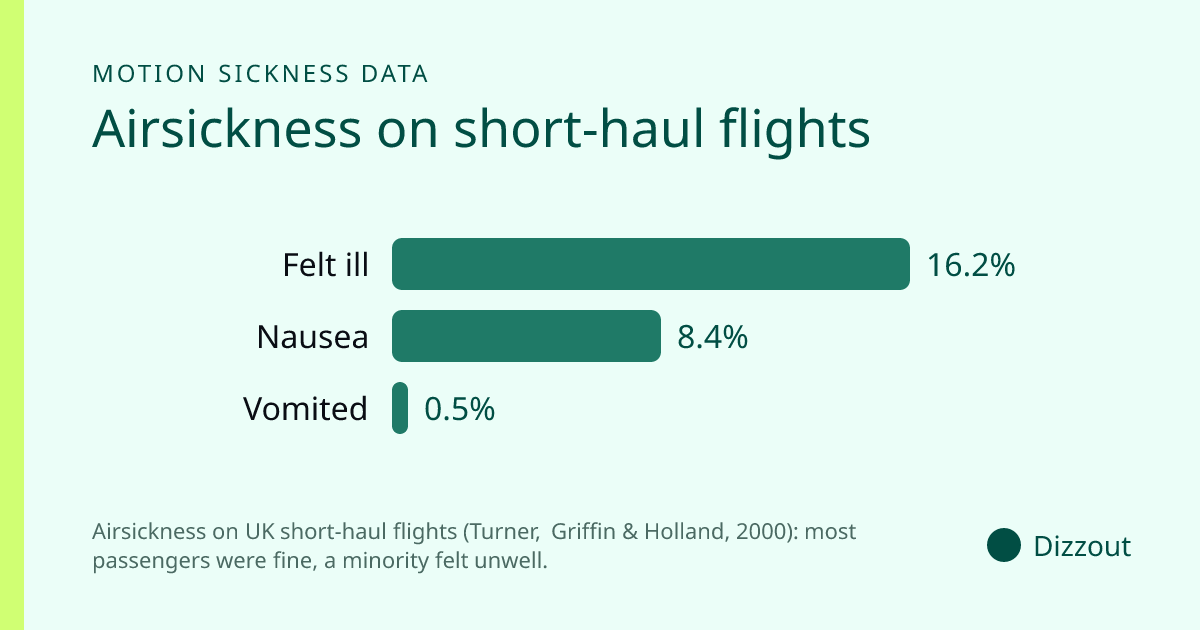
In a survey of fare-paying passengers on UK short-haul (mostly turboprop) flights, most passengers were fine, but a meaningful minority felt unwell, with illness rates on individual flights ranging from 0% up to 47.8% depending on the aircraft and conditions.
Source: Turner M, Griffin MJ, Holland I. 'Airsickness and aircraft motion during short-haul flights.' Aviation, Space, and Environmental Medicine, 71(12):1181-9 (2000)Among Italian Air Force student pilots, more than one in three experienced airsickness during basic flight training, with no significant difference between men and women in overall incidence.
Source: Lucertini M, Lugli V, Casagrande M, Trivelloni P, 'Effects of Airsickness in Male and Female Student Pilots: Adaptation Rates and 4-Year Outcomes,' Aviation, Space, and Environmental Medicine (PubMed) (2008)Overall airsickness incidence during basic flight training was 34.8% with no significant gender difference, but among those who got airsick, women were nearly four times as likely to adapt slowly to the motion environment over training, highlighting a sex difference in recovery/adaptation rather than initial susceptibility.
Source: Lucertini M, Lugli V, Casagrande M, Trivelloni P, 'Effects of Airsickness in Male and Female Student Pilots: Adaptation Rates and 4-Year Outcomes,' Aviation, Space, and Environmental Medicine, 2008;79(7):677-84 (PubMed PMID 18619127) (2008)An NTSB safety study found that turbulence-related accidents accounted for more than a third (about 38%) of all U.S. air carrier (Part 121) accidents from 2009 through 2018, with most of these accidents resulting in one or more serious injuries but no aircraft damage.
Source: National Transportation Safety Board (NTSB), Safety Study SS-21-01, 'Preventing Turbulence-Related Injuries in Air Carrier Operations Conducted Under Title 14 Code of Federal Regulations Part 121' (2021)Serious turbulence injuries fall overwhelmingly on flight attendants (who are often up and moving), not seated passengers; the NTSB noted nearly all injured passengers were unbelted when turbulence hit.
Source: NTSB Safety Study SS-21-01, Preventing Turbulence-Related Injuries in Air Carrier Operations (2009 to 2018) (2021)Screens, VR and cybersickness
Visually-induced motion sickness from headsets and screens is common and varies sharply by content and movement.
In a 10-minute head-mounted VR immersion, roughly two-thirds of participants developed cybersickness and nearly a quarter reached severe levels, underscoring how common the problem is.
Source: Garrido et al., "Focusing on cybersickness: pervasiveness, latent trajectories, susceptibility, and effects on the virtual reality experience," Virtual Reality (journal) (2022)Cybersickness is severe enough that a meaningful share of users must stop a VR session early; in this study nearly 1 in 4 reached the maximum-symptom threshold (Fast Motion Sickness Scale score of 15+) before the 10 minutes were up.
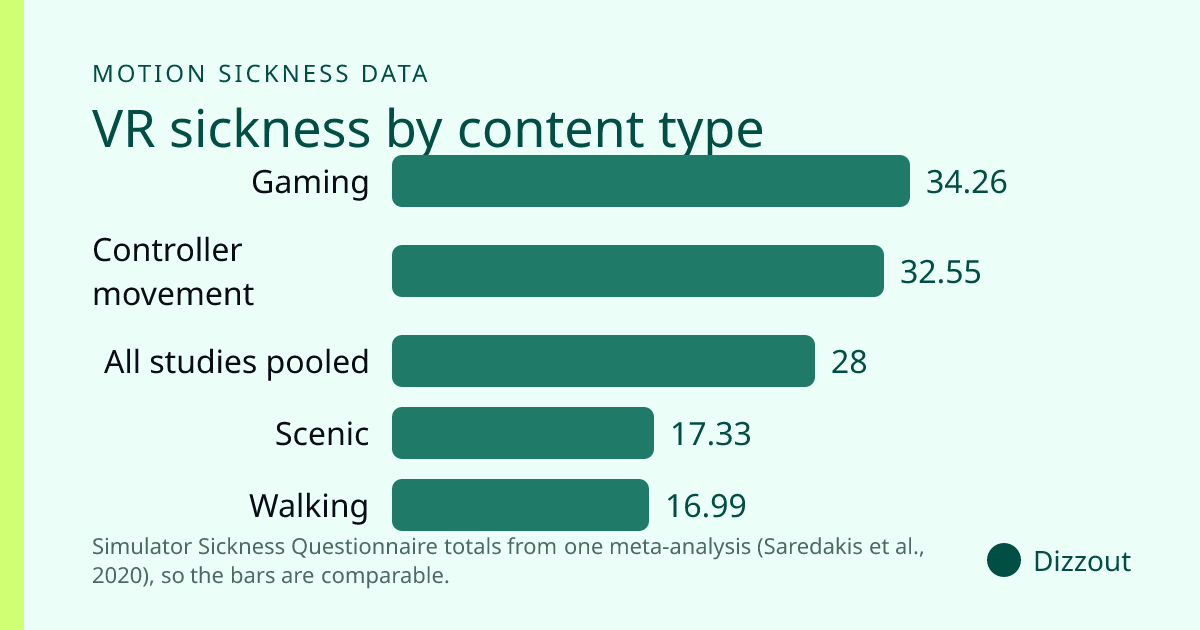
Source: Garrido et al., "Focusing on cybersickness: pervasiveness, latent trajectories, susceptibility, and effects on the virtual reality experience," Virtual Reality (Springer) (2022)A meta-analysis of the head-mounted-display literature pooled SSQ scores across 55 studies and 3,016 participants, establishing an average total sickness score the authors described as 'relatively high.'
Source: Saredakis et al., "Factors Associated With Virtual Reality Sickness in Head-Mounted Displays: A Systematic Review and Meta-Analysis," Frontiers in Human Neuroscience (2020)The same meta-analysis shows VR sickness roughly doubles depending on content: action gaming provokes the most sickness while passive/scenic content provokes the least.
Source: Saredakis et al., "Factors Associated With Virtual Reality Sickness in Head-Mounted Displays: A Systematic Review and Meta-Analysis," Frontiers in Human Neuroscience (2020)Artificial controller-driven movement (a major sensory-conflict trigger) produces roughly twice the sickness of natural real-walking locomotion, showing locomotion design strongly drives cybersickness.
Source: Saredakis et al., "Factors Associated With Virtual Reality Sickness in Head-Mounted Displays: A Systematic Review and Meta-Analysis," Frontiers in Human Neuroscience (2020)Women report markedly more cybersickness than men immediately after VR; the researchers attribute much of this to headset fit, since a far greater share of women cannot properly set the headset's interpupillary distance (33.3% of women vs 0% of men in the study).
Source: Stanney, Fidopiastis & Foster, "Virtual Reality Is Sexist: But It Does Not Have to Be," Frontiers in Robotics and AI (2020)Hardware choice measurably changes cybersickness: a headset with continuous interpupillary-distance adjustment produced significantly lower sickness than one with only fixed IPD settings.
Source: Stallo, Kardong-Edgren & Bauman, "The Impact of Virtual Reality Headset Selection on Cybersickness Severity," Society for Simulation in Healthcare (2024)In a prospective crossover observational study of 497 healthy adult volunteers, more than half developed visually induced motion-sickness symptoms (SSQ total score >15) after a 3D cinema movie, nearly four times the rate after the same content in 2D (3.9x). Symptom intensity rose to 8.8x baseline after 3D vs. 2x after 2D.
Source: PLOS ONE (Solimini AG), "Are There Side Effects to Watching 3D Movies? A Prospective Crossover Observational Study on Visually Induced Motion Sickness" (2013)A peer-reviewed Human Factors paper characterizes how widely VIMS prevalence swings across laboratory studies of visual displays, driven by VR equipment, experimental setup, and visual content. The 1%-80% range is the paper's synthesis of heterogeneous prior studies (1% from Kluver et al., 2015; up to 80% from Cobb, 1999 and Stanney et al.), not a single point-prevalence estimate.
Source: Human Factors: The Journal of the Human Factors and Ergonomics Society (Keshavarz, Murovec, Mohanathas, Golding), "The Visually Induced Motion Sickness Susceptibility Questionnaire (VIMSSQ)" (2023)In the VIMSSQ validation survey (N=322), 29.5% of users said motion-sickness-like symptoms (e.g. nausea, dizziness, eyestrain) caused them to stop or significantly reduce use of certain visual devices, 3D movies were the most frequently avoided (14.3%), followed by smartphones, IMAX theaters, simulators, video games, and VR.
Source: Keshavarz, Murovec, Mohanathas & Golding, The Visually Induced Motion Sickness Susceptibility Questionnaire (VIMSSQ), Human Factors (2023)Space motion sickness
The most extreme environment: most astronauts feel it in their first days in orbit.
NASA's official OCHMO Medical Technical Brief (OCHMO-MTB-004, Rev A, 09/25/2025) states that Space Adaptation Sickness affects 70-90% of crewmembers during spaceflight, ranging from mild to severe, with initial symptoms in most crew in the first 3-7 days. (Note: the same brief's executive summary phrases this as affecting 'up to 73% of crewmembers during the first 2-3 days.')
Source: NASA Office of the Chief Health & Medical Officer (OCHMO) Medical Technical Brief, OCHMO-MTB-004: Space Adaptation Sickness (SAS), Rev A (2025)A peer-reviewed systematic review in Frontiers in Neural Circuits states that SMS affects around 70% of astronauts within the first 72 hours of traveling to and returning from microgravity. (This is cited in the review's introduction as established background prevalence from prior space-medicine literature, not a pooled estimate from the review's own analysis.)
Source: Frontiers in Neural Circuits, Khalid et al., "Pharmacological and non-pharmacological countermeasures to Space Motion Sickness: a systematic review," 2023 (vol. 17, art. 1150233; PMID 37396400) (2023)Self-driving cars
Autonomous vehicles are expected to make motion sickness more common as riders turn to screens and tasks.
University of Michigan researchers calculated the share of American adults who would often, usually, or always feel some level of motion sickness once they become passengers in fully self-driving cars and engage in non-driving activities.
Source: Sivak & Schoettle, "Motion Sickness in Self-Driving Vehicles," University of Michigan Transportation Research Institute (UMTRI-2015-12) (2015)The UMTRI analysis estimated that 6%-12% of American adults riding in fully self-driving vehicles would be expected to experience moderate or severe (not just mild) motion sickness at some time, based on expected frequencies of non-driving activities from a six-country survey.
Source: Sivak & Schoettle, "Motion Sickness in Self-Driving Vehicles," University of Michigan Transportation Research Institute (UMTRI-2015-12) (2015)In the UMTRI survey of what people would do instead of driving in a fully self-driving vehicle, more than a third of Americans said they would engage in motion-sickness-inducing activities such as reading, texting, watching movies/TV, playing games, or working. The researchers projected that roughly 6-12% of US adults would experience moderate or severe motion sickness as a result.
Source: Sivak & Schoettle, UMTRI-2015-12, University of Michigan Transportation Research Institute (2015)A UMTRI survey of more than 3,200 adults across six countries (U.S., India, China, Japan, Great Britain, Australia) asked what people would do instead of driving in a fully self-driving vehicle. Large shares in every market said they would read, text, watch video, game, or work,activities that raise the likelihood and severity of motion sickness,indicating the AV motion-sickness problem is global, not just American.
Source: Sivak & Schoettle, UMTRI-2015-12, University of Michigan Transportation Research Institute (2015)A peer-reviewed Ergonomics study frames the core forecast: as automation transforms drivers into passengers, AV deployment is expected to sharply raise how common motion sickness becomes.
Source: Jones, Le, Ebert, Sienko, Reed & Sayer, "Motion sickness in passenger vehicles during test track operations," Ergonomics (PubMed PMID 31282785) (2019)UMTRI identifies that giving up driving control removes the rider's ability to anticipate and counteract motion. Per the report, the three main factors contributing to motion sickness (vestibular-visual conflict, inability to anticipate the direction of motion, and lack of control over the direction of motion) are all elevated in self-driving vehicles, underscoring why the problem is structural rather than incidental.
Source: Sivak & Schoettle, "Motion Sickness in Self-Driving Vehicles," UMTRI-2015-12 (University of Michigan Transportation Research Institute) (2015)Adaptation and after-effects
Most people get their 'sea legs' within days, and many feel a lingering after-effect once the motion stops.
With prolonged exposure to the same provocative motion, individuals tend to adapt and symptoms subside, but the course of adaptation varies and a few days are usually needed before a significant level of adaptation is achieved.
Source: Leung AKC & Hon KL, "Motion sickness: an overview," Drugs in Context 2019;8:2019-9-4 (peer-reviewed review; NCBI/PMC, PMID 32158479) (2019)Adaptation is far from universal: roughly half of the population may succeed in habituating to seasickness, while at least 5% of people with motion sickness show no signs of habituation at all.
Source: Leung AKC & Hon KL, "Motion sickness: an overview," Drugs in Context (peer-reviewed review, NCBI/PMC) (2019)The flip side of habituation: after the brain adapts to ship motion, many people feel lingering rocking/swaying on returning to land, which is usually short-lived. The authors interpret M-D as adaptive central-nervous-system multisensorimotor plasticity in response to an abnormal motion environment.
Source: Gordon CR, Spitzer O, Doweck I, Melamed Y, Shupak A. "Clinical features of mal de debarquement: adaptation and habituation to sea conditions." Journal of Vestibular Research. 1995 Sep-Oct;5(5):363-369 (survey of 116 seagoing-vessel crew members). PubMed PMID: 8528477; DOI: 10.3233/VES-1995-5503 (1995)Among people diagnosed with persistent MdDS, symptoms last on average from roughly 3 years (motion-triggered) to nearly 7 years (spontaneous onset), and the condition overwhelmingly affects women in mid-life.
Source: Cha YH, Cui YY, Baloh RW. "Comprehensive Clinical Profile of Mal De Debarquement Syndrome." Frontiers in Neurology. 2018;9:261. (2018)Occupational and economic impact
Motion and simulator sickness carry real costs in military, maritime, and aviation training, and a sizeable treatment market.
In an army helicopter simulator, the majority of aircrew reported simulator-sickness symptoms (mostly rated as slight), showing that motion-related symptoms are common even in ground-based training devices.
Source: Braithwaite & Braithwaite, "Simulator sickness in an army simulator," Journal of the Society of Occupational Medicine (PubMed PMID 2214692) (1990)In a study of 1,293 healthy male sailors at Khulna Naval Base, more than four in ten (523 sailors) reported seasickness, with most cases minor but a notable share requiring temporary duty exemption.
Source: Malek MA, Maruf AA, Hossain MM. "Sea Sickness in Naval Personnel." Journal of Armed Forces Medical College, Bangladesh, 5(2):32-35 (2010)In a study of 179 navy recruits on extended sea duty (median ~30 days), 36% were susceptible to seasickness in the early period and 17% remained poorly adapted in the late period; 39% were never treated for seasickness, implying about 61% required treatment during the observation period.
Source: Park CY, et al. "Association of Depression With Susceptibility and Adaptation to Seasickness in the Military Seafarers," Journal of Korean Medical Science, 2022;37(28):e231 (PMC9313975) (2022)A landmark U.S. Navy survey systematically documented simulator-sickness symptoms across aircrew at 10 flight simulators, establishing simulator sickness as a measurable cost to military training. Helicopter simulators with CRT infinity optics and six-degrees-of-freedom moving-base systems showed the highest incidence, while fixed-wing, fixed-base dome displays showed relatively low incidence. This foundational dataset, by the same lead authors, helped lay the groundwork for the later (1993) Simulator Sickness Questionnaire.
Source: Kennedy RS, Lilienthal MG, Berbaum KS, Baltzley DR, McCauley ME, "Simulator sickness in U.S. Navy flight simulators," Aviation, Space, and Environmental Medicine, 1989;60(1):10-16 (PubMed) (1989)Treatments and side effects
The leading drawback of standard medication is drowsiness, and most travelers treat themselves, or not at all.
The U.S. CDC's authoritative travel-medicine reference states that the leading drawback of the antihistamines and scopolamine used to prevent motion sickness is sedation, and ranks the agents by how sedating they are.
Source: CDC Yellow Book (CDC Health Information for International Travel), Motion Sickness chapter (2025)PET imaging shows first-generation H1 antihistamines (the class that includes dimenhydrinate, meclizine, and diphenhydramine used for motion sickness) heavily cross into the brain, which is why they so commonly cause drowsiness and impair cognition and psychomotor performance.
Source: Simons FER, Simons KJ. "H1 Antihistamines: Current Status and Future Directions" (World Allergy Organization Journal, 2008;1(9):145-155), via PMC (2008)Because of the sedating central-nervous-system effects of the antihistamines (dimenhydrinate, diphenhydramine, meclizine, promethazine) commonly used against motion sickness, pilots are barred from taking them, a concrete marker of how impairing the drowsiness side effect is.
Source: Simons FER, Simons KJ. "Antihistamines: Current Status and Future Directions" (World Allergy Organization Journal), via PMC (2008)A Cochrane systematic review found scopolamine (patch, tablet, oral or IV) prevents motion-sickness symptoms better than placebo and was no more likely than other agents to cause drowsiness, blurred vision, or dizziness, though dry mouth was more common.
Source: Cochrane Review, "Scopolamine for preventing and treating motion sickness" (Spinks A, Wasiak J; CD002851) (2022)Despite widespread use of drug-free remedies (ginger, acupressure/P6 wristbands, vitamins), the CDC's travel-medicine reference concludes the supporting evidence is weak, and lab trials show acupressure performs no better than placebo.
Source: CDC Yellow Book (CDC Health Information for International Travel), Motion Sickness chapter (2026)Industry market-sizing of the (largely OTC) motion-sickness treatment category, indicating the commercial scale of medication and remedy use; this is a commercial market-research report figure rather than peer-reviewed data, and estimates vary widely across firms and report scopes.
Source: Global Industry Analysts / Research and Markets - Motion Sickness Treatment: Global Strategic Business Report (distributed via GlobeNewswire) (2024)In a survey of Icelandic seamen, where 87.8% had experienced seasickness in their lives, only about one-fifth self-treated with OTC remedies and prescription anti-seasickness drugs were rarely used.
Source: PLOS ONE, "Seasickness among Icelandic seamen" (Arnardottir, Jonsdottir & Petersen) (2022)In Yachting World's survey of the 2015 Atlantic Rally for Cruisers, 119 of 456 respondents (26%) experienced seasickness. Of those 119, 67 (57%) used some form of prevention strategy or remedy and 52 (43%) used none. The most common remedies were Stugeron (cinnarizine) and scopolamine patches.
Source: Yachting World, ARC 2015 transatlantic seasickness survey (2016)In an interview-based cross-sectional survey of 349 Saudi residents (Riyadh region), 23.5% reported severe dizziness during metro travel, yet across the full sample 85.7% took nothing before or during travel to feel better. The 14.3% who did self-treat mostly used non-drug measures (gum 8.3%, coffee 3.4%, water 1.4%, ginger drink 0.6%) rather than medication.
Source: Healthcare (Basel), MDPI / PMC, "Prevalence of Motion Sickness Among Saudi Residents: An Interview-Based Cross-Sectional Study" (2025)Pets and motion sickness
It is not just people, dogs, especially puppies, commonly get carsick too.
In a peer-reviewed Italian survey of 155 dogs, more than 4 in 10 (43.6%) showed travel-related problems during car transport, with signs including panting (47.7%), restlessness (43.1%) and vocalization (40%).
Source: Cannas S, Evangelista M, Accorsi PA, Michelazzi M. "An epidemiology study on travel anxiety and motion sickness," Journal of Veterinary Behavior: Clinical Applications and Research, 2010;5(1):25-26 (2010)VCA Animal Hospitals, a major veterinary hospital network, states that motion (car) sickness is more common in younger dogs than in adults, possibly because the parts of the inner ear involved in balance are not yet fully developed, and that puppies often outgrow it by the time they are about 1 year old.
Source: VCA Animal Hospitals, "Motion Sickness in Dogs" (Barnes C, Hunter T, Ward E, DVMs) (2024)Use these statistics
This page is free to cite and quote. If you reference these figures, a link back to this page is appreciated.
Cite this page
Dizzout (Kinda Smart Inc.). "How Many People Get Motion Sickness? 1 in 3." Updated 2026-06-14. https://dizzout.com/motion-sickness-statistics
Download the data
All 73 figures with their sources, free to reuse with attribution (CC BY 4.0).
A drug-free option for motion sickness
Try Dizzout Free
Free to try on iOS and Android · works on any headphones.
Methodology & sources
Every statistic on this page is drawn from a named, publicly available source: peer-reviewed research, government and public-health bodies (NIH/MedlinePlus, CDC), standard medical references, and established industry reports, and links directly to it. Figures are reported as their sources state them; where studies differ, we cite the specific study. This page is informational and is not medical advice.
- Braithwaite & Braithwaite, "Simulator sickness in an army simulator," Journal of the Society of Occupational Medicine (PubMed PMID 2214692)
- Cannas S, Evangelista M, Accorsi PA, Michelazzi M. "An epidemiology study on travel anxiety and motion sickness," Journal of Veterinary Behavior: Clinical Applications and Research, 2010;5(1):25-26
- CDC Yellow Book (CDC Health Information for International Travel), Motion Sickness chapter
- CDC Yellow Book 2026 (CDC Health Information for International Travel), Motion Sickness chapter
- Cha YH, Cui YY, Baloh RW. "Comprehensive Clinical Profile of Mal De Debarquement Syndrome." Frontiers in Neurology. 2018;9:261.
- Cochrane Review, "Scopolamine for preventing and treating motion sickness" (Spinks A, Wasiak J; CD002851)
- Frontiers in Neural Circuits, Khalid et al., "Pharmacological and non-pharmacological countermeasures to Space Motion Sickness: a systematic review," 2023 (vol. 17, art. 1150233; PMID 37396400)
- Gahlinger PM, "Cabin Location and the Likelihood of Motion Sickness in Cruise Ship Passengers," Journal of Travel Medicine, 7(3):120-124 (260 passengers)
- Garrido et al., "Focusing on cybersickness: pervasiveness, latent trajectories, susceptibility, and effects on the virtual reality experience," Virtual Reality (Springer)
- Global Industry Analysts / Research and Markets - Motion Sickness Treatment: Global Strategic Business Report (distributed via GlobeNewswire)
- Golding JF, Kadzere P, Gresty MA. "Motion sickness susceptibility fluctuates through the menstrual cycle." Aviation, Space, and Environmental Medicine, 76(10):970-973
- Gordon CR, Spitzer O, Doweck I, Melamed Y, Shupak A. "Clinical features of mal de debarquement: adaptation and habituation to sea conditions." Journal of Vestibular Research. 1995 Sep-Oct;5(5):363-369 (survey of 116 seagoing-vessel crew members). PubMed PMID: 8528477; DOI: 10.3233/VES-1995-5503
- Gupta AK, Kumar BV, Rajguru R, Parate KD. "Assessment of Sea Sickness in Naval Personnel: Incidence and Management." Indian Journal of Occupational and Environmental Medicine, 2021;25(2):119-124 (PMID 34421250; 500 personnel)
- Healthcare (Basel), MDPI / PMC, "Prevalence of Motion Sickness Among Saudi Residents: An Interview-Based Cross-Sectional Study"
- Henriques IF, de Oliveira DW, Oliveira-Ferreira F, Andrade PMO, "Motion sickness prevalence in school children," European Journal of Pediatrics
- Hromatka et al., Human Molecular Genetics (23andMe; PMID 25628336)
- Human Factors: The Journal of the Human Factors and Ergonomics Society (Keshavarz, Murovec, Mohanathas, Golding), "The Visually Induced Motion Sickness Susceptibility Questionnaire (VIMSSQ)"
- Huppert D, Grill E, Brandt T, "Survey of motion sickness susceptibility in children and adolescents aged 3 months to 18 years," Journal of Neurology
- Jan Le Cloirec M, Lucas D, Loddé B, Pougnet R, Maffert A, Jégaden D. 'The prevalence of seasickness in a population of French civilian sailors.' International Maritime Health 2024;75(3):147-154
- Jones, Le, Ebert, Sienko, Reed & Sayer, "Motion sickness in passenger vehicles during test track operations," Ergonomics (PubMed PMID 31282785)
- Kennedy RS, Lilienthal MG, Berbaum KS, Baltzley DR, McCauley ME, "Simulator sickness in U.S. Navy flight simulators," Aviation, Space, and Environmental Medicine, 1989;60(1):10-16 (PubMed)
- Keshavarz, Murovec, Mohanathas & Golding, The Visually Induced Motion Sickness Susceptibility Questionnaire (VIMSSQ), Human Factors
- Lacasse et al., BMC Pregnancy and Childbirth, "Epidemiology of nausea and vomiting of pregnancy: prevalence, severity, determinants, and the importance of race/ethnicity"
- Lackner JR, "Motion sickness: more than nausea and vomiting," Experimental Brain Research (PMC4112051)
- Laitinen et al., Archives of Gynecology and Obstetrics, "Nausea and vomiting of pregnancy: associations with personal history of nausea and affected relatives"
- Lawther A, Griffin MJ, "A survey of the occurrence of motion sickness amongst passengers at sea," Aviation, Space, and Environmental Medicine 59(5):399-406 (PMID 3390095)
- Leung AKC & Hon KL, "Motion sickness: an overview," Drugs in Context 2019;8:2019-9-4 (peer-reviewed review; NCBI/PMC, PMID 32158479)
- Lucas D et al., "Seasickness and its impact on researchers' work on board French oceanographic vessels," International Maritime Health 2020;71(3):160-165 (PMID 33001426; 223 respondents)
- Lucas D, Mehaneze M, Loddé B, Jegaden D, 'Seasickness and its impact on researchers' work on board French oceanographic vessels,' International Maritime Health
- Lucertini M, Lugli V, Casagrande M, Trivelloni P, 'Effects of Airsickness in Male and Female Student Pilots: Adaptation Rates and 4-Year Outcomes,' Aviation, Space, and Environmental Medicine, 2008;79(7):677-84 (PubMed PMID 18619127)
- Malek MA, Maruf AA, Hossain MM. "Sea Sickness in Naval Personnel." Journal of Armed Forces Medical College, Bangladesh, 5(2):32-35
- Matsangas P, McCauley ME, 'Sopite syndrome: a revised definition,' Aviation, Space, and Environmental Medicine (PubMed)
- MedlinePlus Genetics (U.S. National Library of Medicine, NIH)
- Merck Manual (Professional Version), Motion Sickness
- Motion sickness diagnostic criteria: Consensus Document of the Classification Committee of the Bárány Society (Journal of Vestibular Research)
- NASA Office of the Chief Health & Medical Officer (OCHMO) Medical Technical Brief, OCHMO-MTB-004: Space Adaptation Sickness (SAS), Rev A
- National Transportation Safety Board (NTSB), Safety Study SS-21-01, 'Preventing Turbulence-Related Injuries in Air Carrier Operations Conducted Under Title 14 Code of Federal Regulations Part 121'
- NTSB Safety Study SS-21-01, Preventing Turbulence-Related Injuries in Air Carrier Operations (2009 to 2018)
- Park CY, et al. "Association of Depression With Susceptibility and Adaptation to Seasickness in the Military Seafarers," Journal of Korean Medical Science, 2022;37(28):e231 (PMC9313975)
- PLOS ONE (Solimini AG), "Are There Side Effects to Watching 3D Movies? A Prospective Crossover Observational Study on Visually Induced Motion Sickness"
- PLOS ONE, "Seasickness among Icelandic seamen" (Arnardottir, Jonsdottir & Petersen)
- Reavley et al., Aviation, Space, and Environmental Medicine (PMID 17086768)
- Rolnick A & Lubow RE, 'Why is the driver rarely motion sick? The role of controllability in motion sickness,' Ergonomics
- Saredakis et al., "Factors Associated With Virtual Reality Sickness in Head-Mounted Displays: A Systematic Review and Meta-Analysis," Frontiers in Human Neuroscience
- Schmidt, Kuiper, Wolter, Diels & Bos, 'An international survey on the incidence and modulating factors of carsickness,' Transportation Research Part F: Traffic Psychology and Behaviour, Vol. 71, pp. 76-87
- Sharma K, Aparna. "Prevalence and Correlates of Susceptibility to Motion Sickness." Acta Geneticae Medicae et Gemellologiae (Twin Research)
- Simons FER, Simons KJ. "H1 Antihistamines: Current Status and Future Directions" (World Allergy Organization Journal, 2008;1(9):145-155), via PMC
- Sivak M & Schoettle B, University of Michigan Transportation Research Institute (UMTRI), 'Motion Sickness in Self-Driving Vehicles' (Report UMTRI-2015-12)
- Stallo, Kardong-Edgren & Bauman, "The Impact of Virtual Reality Headset Selection on Cybersickness Severity," Society for Simulation in Healthcare
- Stanney, Fidopiastis & Foster, "Virtual Reality Is Sexist: But It Does Not Have to Be," Frontiers in Robotics and AI
- Takov V, Tadi P. 'Motion Sickness.' StatPearls (NCBI Bookshelf)
- Turner M & Griffin MJ, 'Motion sickness in public road transport: the effect of driver, route and vehicle,' Ergonomics (PubMed)
- Turner M, Griffin MJ, Holland I. 'Airsickness and aircraft motion during short-haul flights.' Aviation, Space, and Environmental Medicine, 71(12):1181-9
- VCA Animal Hospitals, "Motion Sickness in Dogs" (Barnes C, Hunter T, Ward E, DVMs)
- Yachting World, ARC 2015 transatlantic seasickness survey
Use these stats on your site
Writing about motion sickness? Embed this verified-statistics card free. It stays current and credits Dizzout as the source.
<iframe src="https://dizzout.com/embed/motion-sickness-statistics" width="100%" height="340" style="border:1px solid #e5e7eb;border-radius:12px;max-width:540px" title="Motion Sickness Statistics, Dizzout" loading="lazy"></iframe>
Or embed a chart
A static chart with a credit line. Unlike the card above, this one puts the link in your own page rather than inside a frame, which is the version worth having if you cite us.
<a href="https://dizzout.com/motion-sickness-statistics">
  <img src="https://dizzout.com/motion-sickness-statistics/chart/motion-sickness-in-children-by-setting.png" alt="Motion sickness in school-age children by setting (Henriques et al., 2014). Far more common in cars and buses than on playground rides. Values: Car 43.4%, Bus 43.2%, Swing 11.7%, Ferris wheel 11.6%." width="800" style="max-width:100%;height:auto" loading="lazy">
</a>
<p>Chart: <a href="https://dizzout.com/motion-sickness-statistics">Motion sickness statistics</a> by Dizzout</p>