The short answer
Ski sickness is a real, named condition, described in 1995 and also called Hausler's disease. In fog or flat light the snow gives your eyes nothing to lock onto, while your inner ear reports every turn and bump under your skis. Strong movement, no matching picture, so your brain answers as it does in a car: dizziness, headache, nausea, sometimes vomiting. It is not the same thing as altitude sickness. What you can change on the mountain is the light you ski in, the goggle lens on your face, the terrain under your skis, and whether you keep going at all.
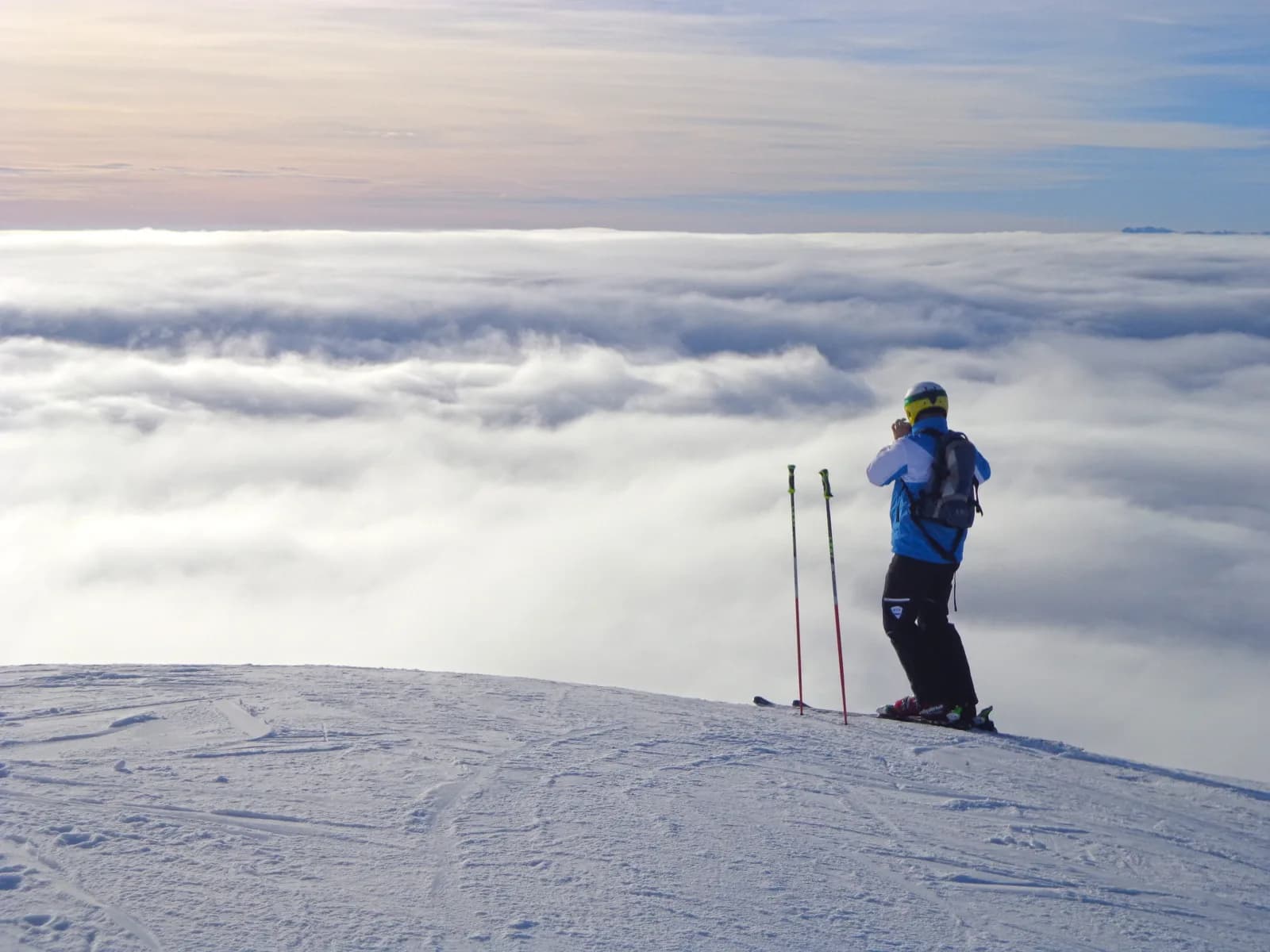
You are halfway down a run you have skied twenty times, the cloud has come in, and the slope and the sky are the same shade of white. You cannot tell whether the ground ahead rolls away or rises. Your legs feel fine. Your head is light, swimmy, slightly drunk.
It has a name, and it is not a fitness problem. Here is what is happening, what to change on the mountain, and when to take the gondola down.
Prone to motion sickness? Headphones already fit under a helmet. Drug-free, no drowsiness, about 90 seconds.Starts in your browser · works with any headphones
Get your personalized Dizzout plan. Paid subscription for full access.

On your phone? Scan to start there.
Ski sickness is real and it has a name
In 1995 a report in the journal Acta Otolaryngologica described skiers who got dizziness, a spinning or swaying sensation, loss of balance and nausea while skiing downhill, and proposed calling it ski sickness. It is also known as Hausler's disease, after the author. The report calls it a special form of motion sickness produced by contradictory information between the visual, vestibular and somatosensory systems: the same mismatch behind motion sickness anywhere else.
The pathophysiology it names has four strands: vestibular overstimulation from winding turns on uneven ground, insufficient visual control on foggy days, minor eyesight problems such as short-sightedness or astigmatism, and altered feedback from the feet caused by ski boots and skis. Fear of heights, speed and falling are listed as contributors too.
One caveat. The report covered eleven people, so it describes a pattern rather than measuring how common it is. The "around ten percent of skiers" figure quoted around the internet comes from a later press interview with the same author, who called it a guess. Treat it as one.
Why flat light and fog do it: the horizon stops reporting
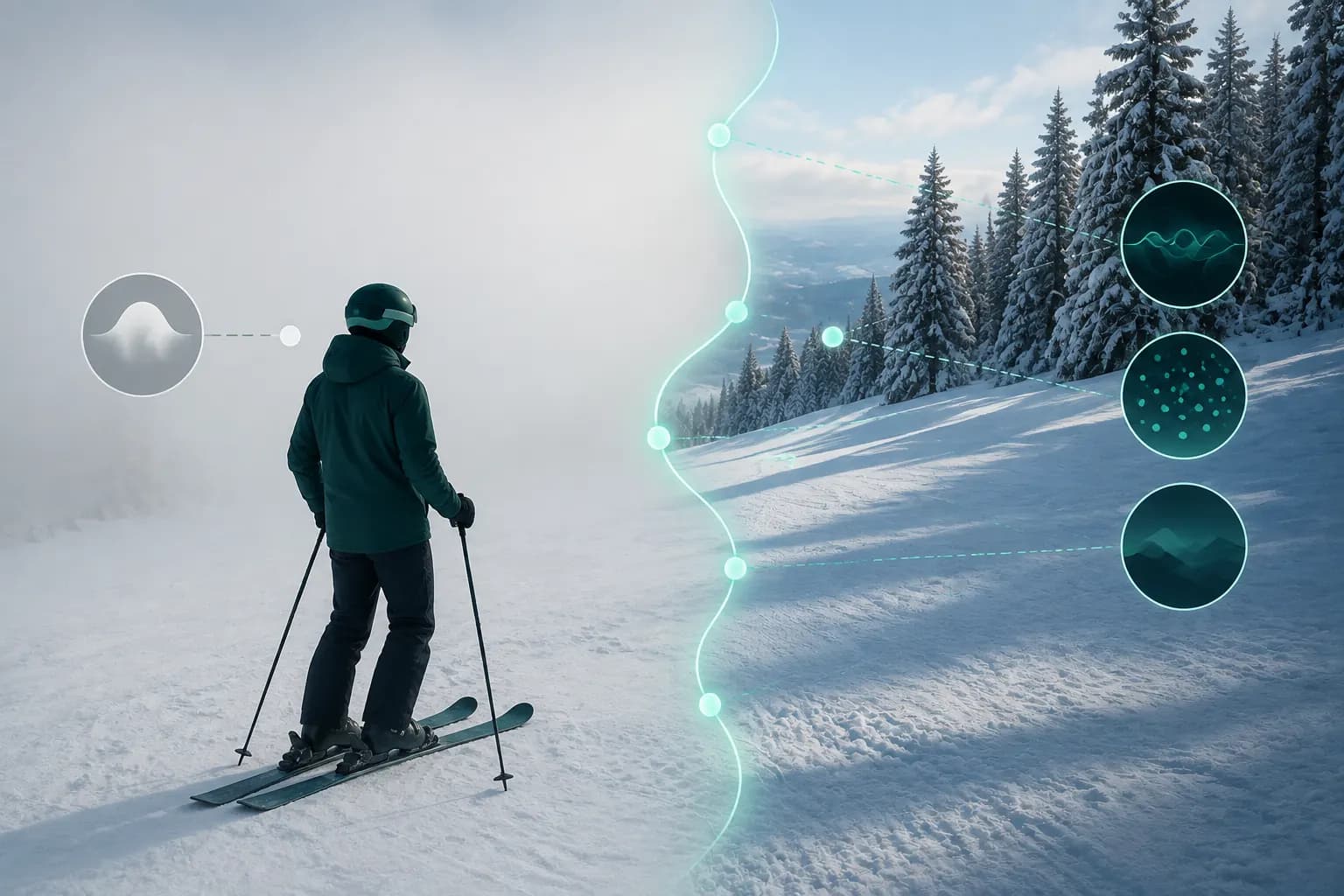
On a bluebird day your eyes do a lot of quiet work. Shadows show you the moguls. The tree line shows which way is down. The horizon holds still while you move, and your brain checks its own sense of motion against that stillness. Travel guidance from the CDC lists a visual horizon reference among the countermeasures shown to give some protection at sea and in vehicles. Flat light takes away the oldest fix there is.
In diffuse cloud light the shadows go and the slope, the fall line and the sky flatten into one white surface. You cannot see a roll in the terrain until your skis are on it. Meanwhile the vestibular side gets louder: every turn is a rotation, every bump a jolt, dozens a minute. No visual confirmation, and dizziness is the reply.
Your feet make it worse. Ankles normally read the ground constantly, but in rigid boots on two long levers that channel is muted, so the sense that might referee the argument is turned down.
Why it gets worse late in the day
The afternoon stacks the odds against you. The sun drops behind the ridge, so the light goes flat even on a clear day. The piste is tracked out and bumpier, which raises the vestibular input. You are tired, and the CDC says sleep deprivation makes motion sickness worse and that alcohol is worth avoiding. And five hours behind a lens is its own kind of eye strain.
So ski the good light, and take the long lunch when the cloud comes in. For your own baseline before a trip, the two-minute motion sickness test gives you a risk band rather than a guess.
The eyesight angle: your prescription is on the list
Short-sightedness and astigmatism appear in the original description as contributing factors. That makes sense on the mountain: in flat light your eyes already work at the limit of what they can resolve, so a small uncorrected error costs you more than it does indoors.
What to do with that is narrow. If you ski in glasses or contacts and your last eye test was years ago, book one before the trip. What correction you need, and whether contacts or prescription inserts beat glasses under a strap, is your optician's call. Do not change your own correction on the strength of an article, and do not confuse any of this with the liquid-rimmed motion sickness glasses sold as a travel remedy, which are a different product with a different claim.
Goggle lenses and what actually helps you see the terrain
Goggle lenses are rated by VLT, visible light transmission: the percentage of light the lens lets through, and it is published for every lens. A dark mirrored lens made for bright sun sits around ten percent, right for glare and unhelpful in cloud. Lenses built for storm and flat light run far higher, roughly forty to sixty percent, usually on a rose, amber or yellow base.
Warm tints raise contrast, so a lip or a hollow shows up a fraction earlier. Carry the low-light lens as well as the dark one, because the weather decides. Keep the lens clean and the vents clear: a fogged lens is a flat-light generator on your face. And keep the expectation honest, because a lens cannot put shadows back on the snow.
What to do the moment it starts, on the slope
A swimmy head on skis is a safety problem before it is a comfort one. First move, always: get out of the fall line.
- Stop at the edge of the piste, side-on to the slope, visible to people coming down.
- Find one real object and hold it. A piste marker, a pylon, a rock, a tree: something with a hard edge that is not moving. Give it a proper thirty seconds.
- Lift or swap the goggles. Fogged or too dark for the light is the fastest fix you have.
- Move to terrain with edges in it. A tree-lined run gives your eyes structure an open bowl does not. Drop below the cloud base if you can.
- Change your rhythm. Fewer, longer, rounder turns. Fast short turns feed the vestibular side.
- Eat and drink something. Cold, hungry and thirsty is a bad place to fight this from.
- Do not push on to finish the run. Stopping early costs you a run, not the day.
Do
- Pull over out of the fall line before anything else
- Fix on one solid object, a marker or a pylon, and hold it
- Switch to the high-VLT rose or amber lens
- Move to trees or below the cloud base
- Go in for an hour when the light dies
Don't
- Ski a whiteout in a dark mirrored lens
- Ride it out with fast short turns to finish the run
- Blame it on altitude and carry on
- Drink at lunch and go back up in cloud
Practical strategies, not measured effects. Which ones matter most depends on the day and on you.
If none of that shifts it, sound therapy through headphones is one more option, drug-free and about 90 seconds. You can use it standing at the edge of the piste with your eyes shut, which is the one thing flat light cannot take away from you.
When to call the day
Call it if the dizziness does not settle after ten minutes standing still, if your vision blurs, if the headache builds, or if you are missing edges. Take the gondola down rather than skiing down.
Be open to it not being ski sickness. Ski sickness fires while you move in bad visibility and eases when you stop and find a reference. Altitude illness does not care whether you ski: the CDC puts any unacclimatized traveler sleeping at 2,450 m (8,000 ft) or above at risk and names headache as its cardinal symptom. If you woke up feeling like this in the hotel, before you clipped in, altitude is the better suspect and the answer is a different one.
Lifts, gondolas and the ride back down
Lifts are where a queasy afternoon turns into an incident. A gondola in wind swings and thumps past every pylon while you sit in a warm box with no view of anything stable. Chairlifts swing too.
Get a window and look at something distant and fixed rather than at the cable or the floor. Open a vent: the CDC counts fresh air on the face among the things that help. Keep your phone in your pocket, because avoiding reading is on that same list, and a swaying gondola is the worst place to ignore it.
If you are between the top station and the car park right now, skip the theory and use the 60-second protocol. If you are planning next season, the remedy finder narrows the options to the ones that suit you.
When there is no horizon to find
Stop the nausea
Flat light removes the fix that usually helps most: something solid to look at. Dizzout plays precisely calibrated audio through any headphones instead, one option designed to help calm the response in about 90 seconds. Drug-free and no drowsiness, so it does not write off your afternoon. Free to download on iOS and Android.
Get your personalized Dizzout plan. Paid subscription for full access.
30,000+ travelers in 30+ countries · How we count

On your phone? Scan to start there.
Comparing apps first? See how the motion sickness apps compare
Frequently asked questions
What is ski sickness?
Ski sickness is a form of motion sickness that happens while downhill skiing, named in a 1995 report in Acta Otolaryngologica and also called Hausler's disease. The report describes dizziness with a spinning or swaying sensation, loss of balance and nausea, occasionally with vomiting. It calls the cause a conflict between the visual, vestibular and somatosensory systems, set off by winding turns on uneven ground, poor visibility on foggy days, minor eyesight problems such as short-sightedness or astigmatism, and the muted feedback you get through ski boots and skis.
Why do I feel dizzy and sick when skiing?
Usually because your eyes and your inner ear have stopped agreeing. Turning down a slope produces constant rotation and jolting that your vestibular system reports clearly, and in fog or flat light your eyes cannot confirm any of it, because there are no shadows, edges or horizon to read. Rigid boots mute the feedback from your feet that would normally settle the argument. Fatigue, alcohol and a lens that is too dark for the light all make it more likely.
Why is flat light so disorienting on skis?
Flat light is diffuse, so it casts no shadows, and without shadows the snow surface loses its texture and the slope merges into the sky. You cannot see a roll, a lip or a hollow until your skis are on it. The CDC lists a visual horizon reference among the countermeasures shown to give some protection against motion sickness, and flat light removes exactly that while your inner ear keeps reporting every turn.
Can you get motion sickness from skiing?
Yes. It is unusual in that you generate the motion yourself, which normally helps: the CDC notes that being the driver lowers susceptibility, and that a sense of being in control matters. On skis the combination of repeated turning on uneven ground and almost no useful visual information can override that. It is documented under its own name, ski sickness, and the symptoms match motion sickness anywhere else: dizziness, headache, cold sweat, nausea and sometimes vomiting.
Is it altitude sickness or ski sickness?
The timing usually tells you. Ski sickness starts while you are skiing, is worst in fog or flat light, and eases when you stop and find something solid to look at. Acute mountain sickness is not tied to skiing at all: the CDC puts any unacclimatized traveler sleeping at 2,450 m (8,000 ft) or higher at risk and names headache as the cardinal symptom, usually alongside loss of appetite, dizziness, fatigue or nausea. If it started in the hotel rather than on the piste, treat altitude as the likelier answer. Confusion, unsteady walking or breathlessness at rest are emergencies: descend and get medical help.
Do goggle lenses help with ski sickness?
They act on the cause of it, which is the part you can control. Lenses made for flat and low light have a high visible light transmission, roughly forty to sixty percent, usually on a rose, amber or yellow base, and they raise contrast so subtle changes in the snow surface show up earlier. A dark mirrored lens in cloud does the opposite. A lens cannot put shadows back on the snow, so it is one part of the answer, alongside easier terrain and better light.
Someone you know gets motion sick?
Send them this guide. It might be the trip it saves.
Your next question, probably
Which remedy fits your trip?
Answer a few questions, get a shortlist
Not your question? What actually works, remedy by remedy?Is an app worth it?How prone are you in the first place?
About this article
- Häusler R. Ski sickness. Acta Otolaryngologica, 1995;115(1):1-2
- CDC Yellow Book: Motion Sickness (visual horizon reference, risk factors)
- CDC Yellow Book: High-Altitude Travel and Altitude Illness
- NHS: Motion sickness (symptom list, including headache)
- SWI swissinfo.ch: Slope motion, professor identifies ski sickness (the ten percent figure, given as a guess)
This article is informational and not a substitute for medical advice. See a doctor if dizziness outlasts the ski day or comes with hearing changes, and talk to your optician about your eyesight and your pharmacist or doctor before taking any medication. Brand names are trademarks of their respective owners.