
The short answer
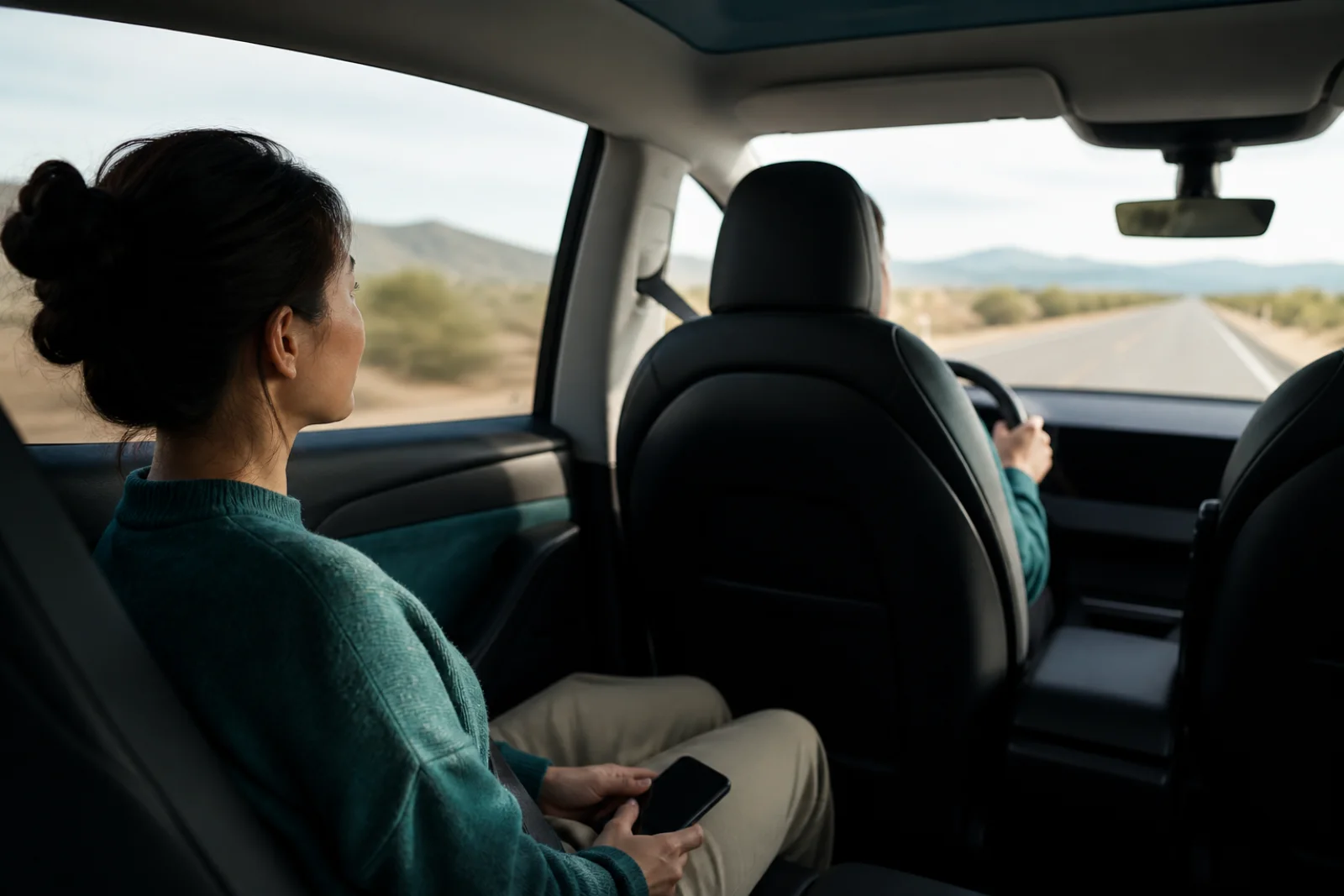
Electric cars do not automatically cause more motion sickness, but strong regenerative braking can make some passengers feel worse. A 2025 on-road study of 16 motion-sensitive passengers found more sickness with high regenerative braking than with a lower setting. The practical fix is to make deceleration smoother and more predictable: reduce regeneration where the car allows it, ask the driver to ease off the accelerator gradually, look well ahead, and put the phone down.
The strange part is that an EV can feel beautifully smooth to the driver and slightly wrong to the person behind them. There is no gear change, little engine noise, and then the car slows the instant the accelerator lifts. The driver caused every change. The passenger receives it half a beat later.
Key facts
- Regenerative braking slows an EV when the driver lifts off the accelerator, so repeated small speed changes can happen without a brake-pedal cue.
- A 2025 on-road study found higher regenerative braking increased motion-sickness symptoms in a small group of susceptible passengers.
- The same study found anticipatory audio cues reduced symptoms during the high-regeneration condition, which supports predictability as part of the problem.
- One small study does not prove every EV is worse than every gas car, and driver technique still matters enormously.
- Looking toward the road or horizon and avoiding close visual tasks are established ways to reduce sensory mismatch.
Car sick in the back seat? Drug-free relief through any headphones, designed for the moment nausea starts.Starts in your browser · works with any headphones
Stop car sickness. Get your personalized Dizzout plan. Paid subscription for full access.

On your phone? Scan to start there.
Why an EV can feel different from the passenger seat
Motion sickness builds when the motion your inner ear feels does not match the scene your eyes and brain expected. In any car, reading a phone makes that mismatch larger because the cabin looks still while your body is accelerating and turning. The CDC therefore lists a horizon view and avoiding reading or visual scanning among the established behavioral countermeasures.
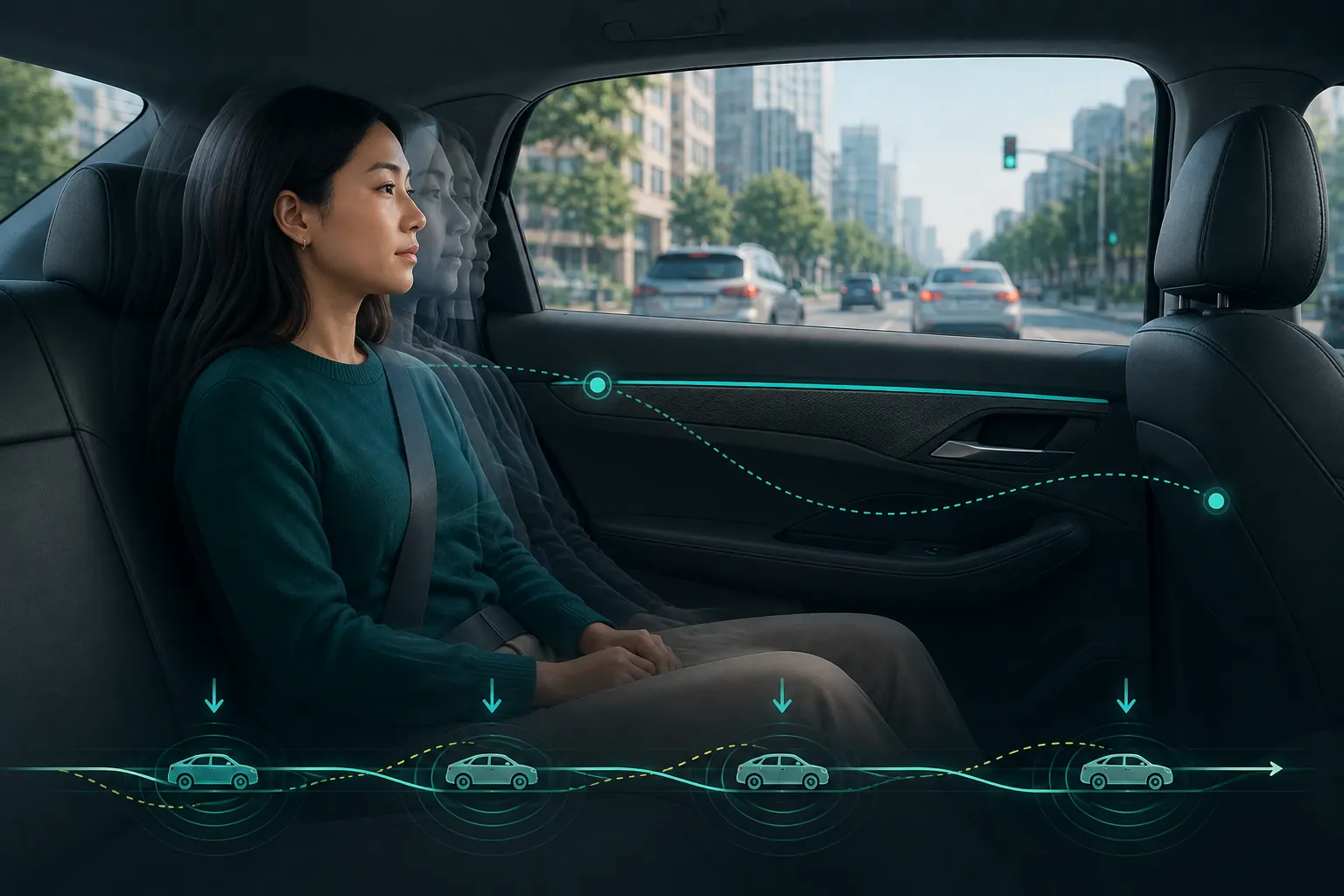
An EV adds a different motion rhythm. Regenerative braking converts the car's movement back into electrical energy when the driver lifts the accelerator. On a strong setting, lifting slightly can produce noticeable deceleration. If the driver's foot repeatedly eases on and off, the passenger experiences a sequence of small forward and backward forces that can be difficult to predict.
Silence can contribute to the surprise. In a combustion car, engine pitch and gear changes provide imperfect cues about what will happen next. An EV removes many of them. That does not make quietness harmful by itself. It means the road view and the driver's smooth inputs carry more of the prediction work.
What the regenerative-braking study actually found
The strongest direct evidence so far is a 2025 on-road study in the International Journal of Human-Computer Interaction. Sixteen people who were susceptible to motion sickness rode under low and high regenerative-braking conditions, with and without anticipatory audio cues. Higher regeneration produced more motion sickness, and the audio cues reduced symptoms in the high-regeneration condition.
That is useful evidence, but it is a small study, not a universal ranking of powertrains or brands. It does not show that every Tesla, Hyundai or other EV will make a given passenger sick, nor that a gas car driven abruptly will be easier. Treat it as support for two practical ideas: reduce sharp deceleration and make changes easier to anticipate.
Try
- Use a lower regenerative-braking mode when the vehicle offers one
- Ease off the accelerator progressively rather than lifting suddenly
- Sit where the road ahead is visible and look through the windshield
- Keep the cabin cool and take a short break before symptoms peak
Avoid
- Pulse the accelerator in stop-and-go traffic
- Read or work on a phone while looking down
- Assume every EV has the same regenerative-braking behavior
- Wait for severe nausea before changing the ride
Practical guidance based on the CDC Yellow Book and the 2025 on-road regenerative-braking study.
If a Tesla makes you carsick
Start with driving style rather than the badge. Ask the driver to leave more following distance, accelerate once rather than in little bursts, and lift the accelerator slowly. Available settings vary by Tesla model and software version, so use the vehicle manual for the car in front of you instead of an old forum post. If the car offers a gentler acceleration or stopping behavior, test it on a short familiar route.
For the passenger, the highest-value change is visual: take the seat with the clearest forward view and keep the road in sight. The back seat, a low phone and city stop-and-go traffic stack three triggers together. Change one before deciding the vehicle itself is impossible for you.
Choosing an EV when someone in the family gets carsick
- Test from the passenger seat. A driver cannot reliably judge what repeated deceleration feels like in the back.
- Include ordinary traffic. A smooth motorway loop hides the low-speed braking rhythm that matters most.
- Check whether regeneration can be softened. Some cars offer modes or adaptive behavior; others make strong regeneration central to the drive. Where the regen setting lives in each EV we cover.
- Prioritize the view. Upright seating, generous glass and a clear sightline through the windshield can matter as much as the powertrain.
- Do not buy from a single risk label. Our car-by-car guide separates powertrain, suspension, seating and visibility so you can compare the whole experience.
The bottom line
Strong regenerative braking is a credible EV-specific trigger, and the best direct study so far supports it. The useful response is not to write off electric cars. Smooth the driver's inputs, lower regeneration when possible, restore a clear view of the road, and test the exact car as a passenger. The model, settings, route and driver all change the answer.
For the ride you are already in
Get your personalized Dizzout plan
Dizzout plays precisely calibrated audio through any wired or Bluetooth headphones. It is drug-free. Dizzout states relief in about 90 seconds, and individual experiences vary. Free to download on iOS and Android.
Paid subscription for full access.
30,000+ travelers in 30+ countries · How we count

On your phone? Scan to start there.
Comparing apps first? See how the motion sickness apps compare
Not travelling yet? Remind me the day before my trip
Frequently asked questions
Why do electric cars make me feel carsick?
Strong regenerative braking can make the car slow as soon as the driver lifts the accelerator, creating frequent deceleration that a passenger did not predict. The quiet cabin also removes some familiar sound cues. A 2025 on-road study found more motion sickness under high regenerative braking than under a lower setting in 16 susceptible passengers.
Do Teslas cause more motion sickness than gas cars?
There is not enough evidence to rank every Tesla against every gas car. Some passengers find strong regenerative braking and one-pedal driving provocative, but driver technique, road view, suspension, route and seat all matter. Test the exact model from the passenger seat before drawing a conclusion.
Can you reduce regenerative braking to help passengers?
It depends on the vehicle and software version. Where a lower or gentler regeneration mode exists, it is worth testing. In any EV, leaving more following distance and easing off the accelerator progressively can make deceleration more predictable. Check the current vehicle manual for its available settings.
What should I do if I feel sick in an EV?
Put the phone down, look through the windshield toward the road or horizon, keep your head supported, cool the cabin, and ask the driver for smoother acceleration and deceleration. Stop for a short break if symptoms keep building. If this happens without motion or comes with persistent vertigo, hearing changes or a severe headache, seek medical advice.
Someone you know gets motion sick?
Send them this guide. It might be the trip it saves.
Your next question, probably
Which cars are easier on passengers?
Compare EVs, hybrids, SUVs and gas cars
Not your question? Which seat should you choose?Already feeling sick?Can you build tolerance?
About this article
by the Dizzout editorial team.
- CDC Yellow Book: Motion Sickness (2026 edition)
- Xie W et al. Exploring the Effects of Regenerative Braking and the Auditory Cues for Alleviating Motion Sickness in Electric Vehicles (2025)
This article is informational and not a substitute for medical advice. Tesla and other company and product names are trademarks of their respective owners; Dizzout is not affiliated with or endorsed by them.