The short answer
Yes, partly. Repeated, gradual exposure can build tolerance to the specific motion that makes you queasy. The process is called habituation, and the CDC describes fully acquired habituation as the most effective motion-sickness countermeasure, while warning that it can be slow, stimulus-specific and may need periodic re-exposure. Training is not a reason to push through severe nausea, and nobody becomes immune to every kind of motion.
It is what sailors mean by "getting their sea legs." Fighter pilots, figure skaters and gymnasts spin, roll and pull g-forces that would leave most of us green, and barely flinch. Understanding why tells you a lot about how to prepare for a trip.
Key facts
- Habituation is the mechanism: repeated, gradual exposure to a motion trigger lowers the brain's alarm response to it.
- In a controlled visual-vestibular habituation study, motion sickness had completely disappeared in 10 of 11 subjects two weeks after training finished.
- A 2025 trial of vestibular function training in 109 college students measured lower motion sickness scores in both training arms after 7 days of daily sessions.
- Short, frequent, gradually increasing exposure works better than occasional intense sessions.
- Training is not permanent immunity: the benefit fades gradually without continued exposure, and nobody is bulletproof in genuinely rough conditions.
Try Dizzout free. Drug-free relief once symptoms start, in about 90 seconds, on any headphones.Free to download · works with any headphones
Stop travel sickness on your commute. Free to download. Paid subscription for full access.
Why motion tolerance is trainable
Motion sickness comes from a sensory mismatch: your inner ear detects motion your eyes don't confirm (or vice versa), and your brain reads the conflict as an alarm. The key insight is that the brain isn't stuck with its current sensitivity. Expose it to that mismatch repeatedly and gradually, and it learns to stop sounding the alarm, a process called habituation.
This isn't folk wisdom. A controlled study of visual-vestibular habituation found large reductions in motion sickness that persisted for weeks to months after training. A more recent trial in students found that structured vestibular function training measurably lowered motion sensitivity in standardized motion tests after a week of daily sessions. It's the same principle behind the vestibular rehabilitation therapy used for chronic dizziness.
The people who train it on purpose
You can see habituation at work in anyone whose job or sport demands motion tolerance. Astronauts are famously motion-sick in their first days in orbit and adapt within about a week. Pilots train through it. Figure skaters and dancers do dozens of spins in practice and gradually stop feeling dizzy, their brains have learned to down-weight the confusing vestibular signal. Sailors' "sea legs" are the same adaptation, built over a few days at sea.
The common thread: short, repeated, progressively harder exposure, not one overwhelming session. Push a little past comfortable, let your system recover, repeat. Do too much too fast and you just feel miserable without adapting faster.
Days 1 to 3
The trigger still bites. Sessions stay short and stop before nausea peaks.
Week 1
Sea legs territory. Sailors and astronauts describe adapting over about this long.
Weeks 2 to 4
Structured training programmes run across several weeks at this pace.
Months after
Some studies found the reduced sensitivity still measurable months later.
Timeline summarises the two studies linked above plus the commonly reported adaptation window at sea. Individual response varies widely.
How many people adapt, and how fast
Habituation works for many people, not for all of them, and the pace varies. These are the counts from studies that followed people at sea, in flight training and in a lab.
| Who was studied | What happened | How long | Source |
|---|---|---|---|
| Seasickness and motion sickness in general (2019 review) | About 50% may succeed in habituating to seasickness. At least 5% of people with motion sickness show no sign of habituation. | A few days of continued exposure are usually needed before adaptation is significant. | Leung and Hon, 2019 |
| 179 navy recruits on their first ship | 36% needed seasickness medication on at least one of their first 5 days at sea. 17% were still poorly adapted on days 6 to 30. | Followed through their first 30 days at sea. | Park et al., 2022 |
| 376 student pilots in basic flight training | 34.8% got airsick. 16 (about 4%) adapted slowly: 5 of 40 women and 11 of 336 men. | In 102 pilots followed over 4 years, the 1-year gap between flight certifications caused a loss of adaptation in most cases. | Lucertini et al., 2008 |
| 11 people prone to travel sickness, trained in a lab | Motion sickness was gone in 10 of 11 two weeks after training. 8 were still free of it 4.5 months later. 3 lost some of the gain but stayed better than before. | 5 days of visual-vestibular training. | Dai, Raphan and Cohen, 2011 |
How to build your own tolerance
You don't need a rotating chair or flight school. A few evidence-aligned habits:

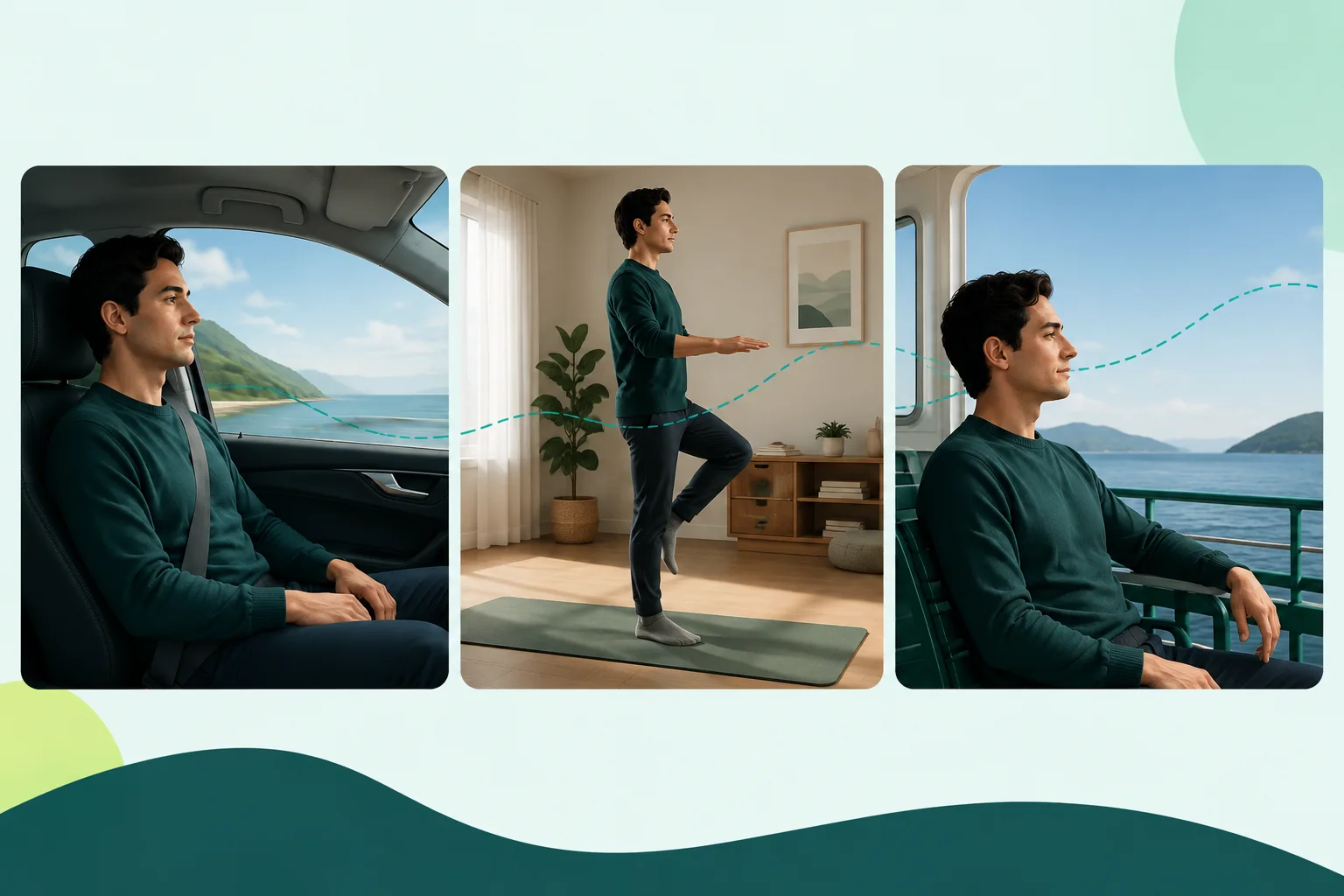
- Graded exposure. If cars are your trigger, take short passenger rides regularly rather than avoiding them entirely, slowly extending how long you read or look down, stopping before nausea peaks.
- Balance and gaze-stability practice. Balance is a vestibular skill, and it's trainable. Simple work, single-leg stands, head-turn drills while keeping your eyes on a target, gentle movement practice, strengthens the same system involved in motion sickness. AI-powered movement platforms like KinesteX can coach and assess balance and stability from a phone camera, which makes that kind of practice easier to do consistently at home.
- Stay generally active. Being comfortable with movement, sports, dance, anything that puts your body through varied motion, keeps your vestibular system well-calibrated.
- Prepare before trips. Sleep, hydration, a light (not empty) stomach and skipping alcohol all raise your threshold before you even set off.
Curious where you stand today? Our 2-minute susceptibility test gives you a baseline score you can re-check as you build tolerance.
| Week | Exposure | Progress rule |
|---|---|---|
| 1 | Three short sessions with the easiest version of your real trigger | Stop at early warmth, yawning or stomach awareness, before nausea peaks |
| 2 | Repeat the same trigger slightly longer or with one small added challenge | Increase only after two sessions that settle quickly |
| 3 | Add modest real-world variation, such as a few more turns or minutes | Change one variable at a time so you know what your system tolerated |
| 4 | Practice the trip pattern you actually need, still below severe symptoms | Keep the gain with periodic re-exposure rather than one punishing test |
What to do while you're still adapting
Training takes weeks, and no amount of it makes anyone bulletproof on a genuinely rough sea. So you still want the on-the-spot toolkit: face forward, fix your gaze on the horizon, get cool fresh air, put screens away, and breathe slowly. For fast, drug-free relief once symptoms start, including situations where looking at the horizon isn't possible, like a plane in turbulence or eyes-closed on a boat, sound therapy through headphones is one option that works with your eyes open or closed and doesn't leave you groggy. It pairs naturally with a longer-term habituation habit: relief now, adaptation over time.
Relief now, adaptation over time
Stop the nausea
Dizzout plays precisely calibrated audio through any headphones, wired or Bluetooth. Drug-free, no drowsiness, about 90 seconds. Use it on the trips you take while you build tolerance.
Free to download. Paid subscription for full access.
The realistic bottom line
Motion sickness isn't a fixed trait you're stuck with. It's a recalibratable response, and consistent, gradual exposure, supported by balance and movement practice, genuinely lowers it for most people over time. If your sensitivity is severe, appears without any motion, or comes with hearing changes, severe headaches or vertigo that lingers, that's worth a doctor's visit rather than a training plan. For everyone else: your inner ear is more coachable than you think.
Frequently asked questions
Can you build a tolerance to motion sickness?
Yes, partly. Repeated, gradual exposure to the motion that makes you queasy builds tolerance to it, a process called habituation that the CDC describes as the most effective motion-sickness countermeasure. It's how sailors get their sea legs and why pilots and figure skaters barely flinch. The tolerance is specific to the motion you train, it builds best through short, frequent sessions that stop before nausea peaks, and it fades gradually without continued exposure.
Can you actually get used to motion sickness?
For many people, yes, at least partly. Repeated, gradual exposure to the kind of motion that makes you queasy trains the brain to stop treating the sensory mismatch as an alarm, a process called habituation. Studies of vestibular and habituation training have measured real, lasting drops in motion sensitivity. It's the same thing sailors mean by 'getting your sea legs.'
How many people get used to motion sickness?
Many do, but not everyone, and not at the same pace. A 2019 review estimates that about 50% of people may succeed in habituating to seasickness, and that at least 5% of people with motion sickness show no sign of habituation. In a study of 179 navy recruits, 36% needed seasickness medication on at least one of their first 5 days at sea, and 17% were still poorly adapted on days 6 to 30. Among 376 student pilots, 34.8% got airsick in basic training and about 4% adapted slowly. Adaptation is specific to the motion you trained, and it can fade after a long break.
How long does it take to build motion tolerance?
It varies by person and by how steady the exposure is. On a ship, a few days of continued exposure are usually needed before adaptation is significant. Lab programmes can work faster: in one study, 5 days of visual-vestibular training removed motion sickness in 10 of 11 susceptible people two weeks later. Short, frequent, gradually increasing exposure tends to work better than occasional intense sessions.
Does being fit or doing balance training help with motion sickness?
It can. Balance and the vestibular system are tightly linked, and vestibular-rehabilitation-style exercises are used clinically to improve postural and gaze stability. General fitness won't make you immune, but training balance, gaze stability, and getting comfortable with movement all work on the same system that's involved in motion sickness.
What do I do while I'm still building tolerance?
Use the in-the-moment basics, face forward, fix your eyes on the horizon, get fresh air, and put screens down, and prepare before trips. For on-the-spot relief once symptoms start, a drug-free sound-therapy app like Dizzout is one option designed to help calm the response in about 90 seconds, without the drowsiness of pills.
Someone you know gets motion sick?
Send them this guide. It might be the trip it saves.
Your next question, probably
Ready to start training?
The graded exposure plan, week by week
If that is not your question:
About this article
by the Dizzout editorial team.
- CDC Yellow Book: Motion Sickness (2026 edition)
- Visual-vestibular habituation training: reductions persisting weeks to months
- Vestibular function training and motion sickness susceptibility (Frontiers in Neurology, 2025)
- Leung and Hon, Motion sickness: an overview (Drugs in Context, 2019)
- Park et al., Association of depression with susceptibility and adaptation to seasickness in the military seafarers (Journal of Korean Medical Science, 2022)
- Lucertini et al., Effects of airsickness in male and female student pilots: adaptation rates and 4-year outcomes (Aviation, Space, and Environmental Medicine, 2008)
This article is informational and not a substitute for medical advice. Product and company names are trademarks of their respective owners; Dizzout is not affiliated with or endorsed by them. Sources include peer-reviewed research on visual-vestibular habituation, vestibular function training and adaptation at sea and in flight training, linked above.