The short answer
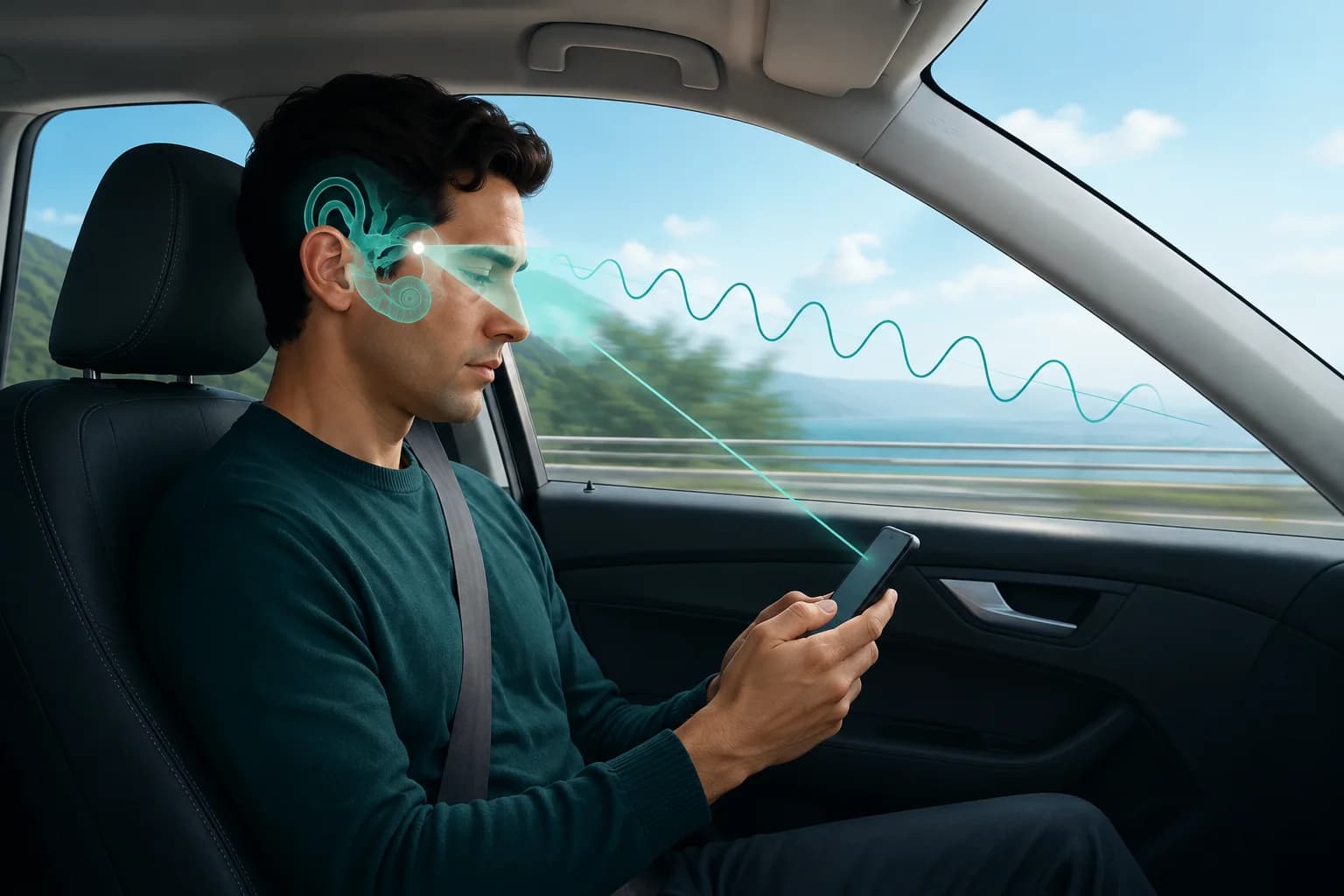
Your inner ear tracks every tilt and acceleration. Your eyes are supposed to agree. Look down at a phone in a moving car and they stop agreeing: the eyes report a still world while the inner ear reports motion. The brain reads that contradiction the way it has always read it, as a sign something toxic is on board, and triggers nausea. That is the whole mechanism, and it is involuntary.
Motion sickness really knows how to ruin a good trip. One second everything feels normal, the next your stomach is doing flips and you're hoping the world stops moving. I used to blame it on a weak stomach, until I learned what's actually going on inside.
Try Dizzout free. Drug-free, works after symptoms start, about 90 seconds on any headphones.Free · works with any headphones · no account to try
Free to try, no card needed. Or go straight to the App Store or Google Play.
Your inner ear vs. your eyes
Your inner ear has tiny fluid tubes and crystals that track every little movement. Your eyes are supposed to match that information. But sit in the back seat staring at your phone? Your eyes say "we're not moving" while your inner ear screams "we're flying down the road." Your brain gets confused, thinks something is wrong, and triggers the nausea.
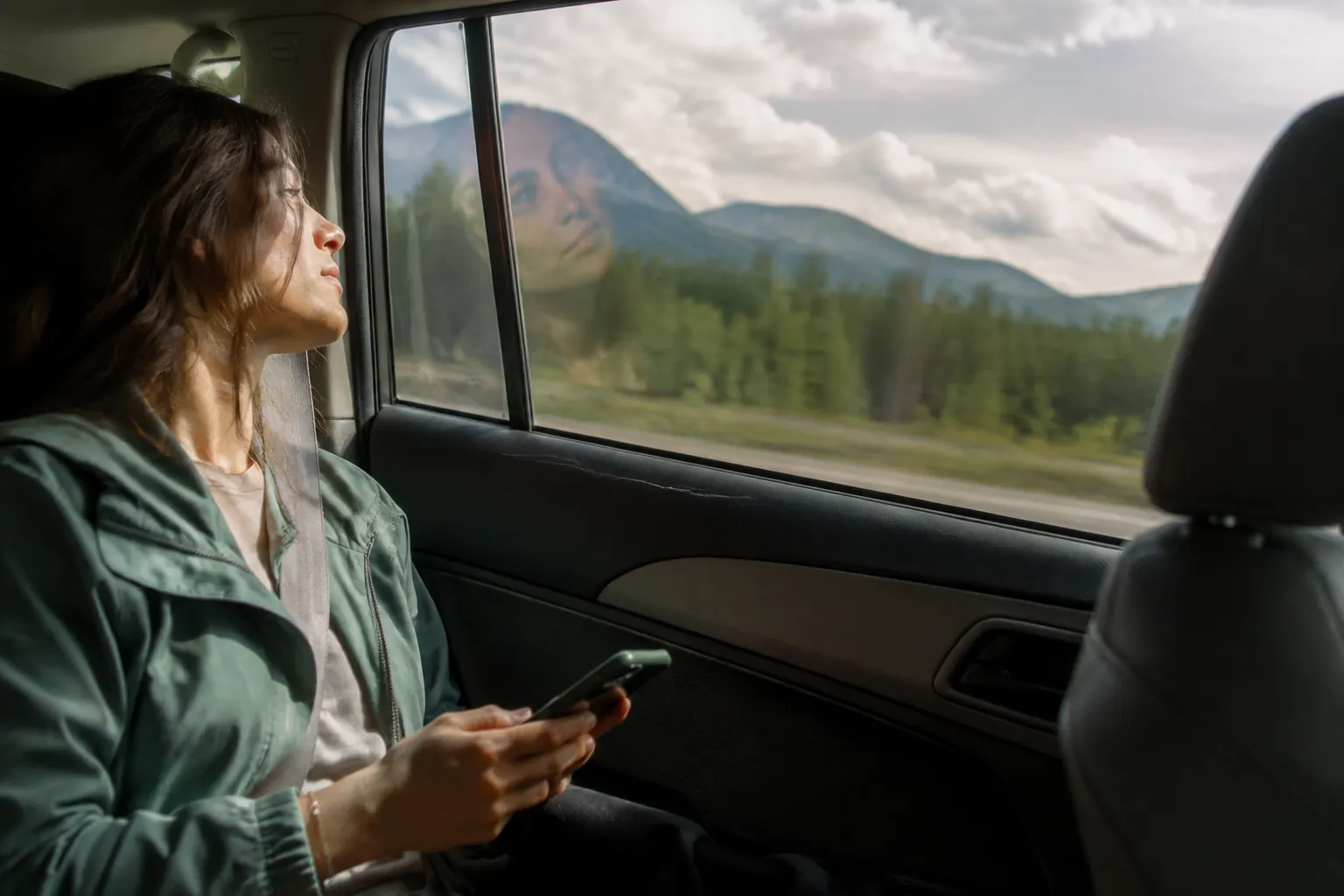
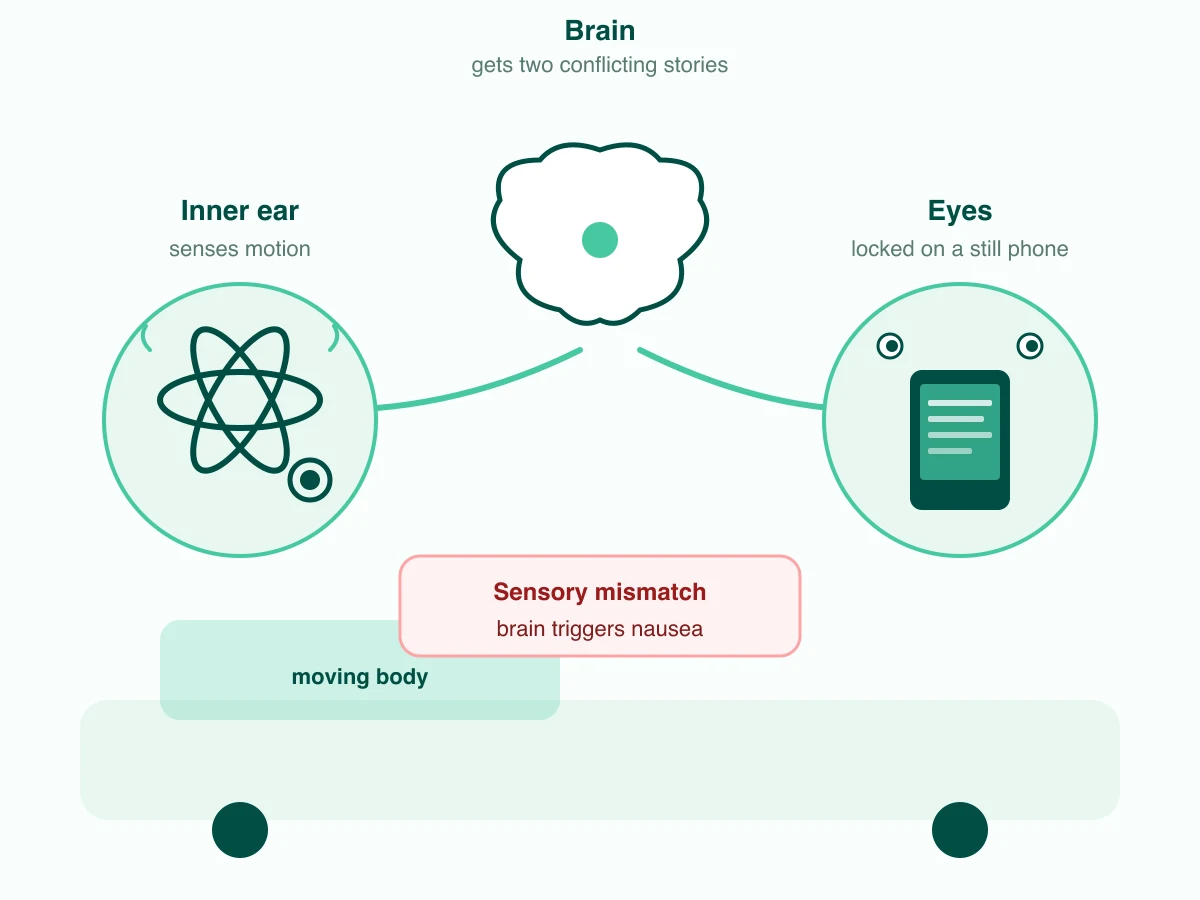
The vestibular-visual conflict account described in this article.
This is called a vestibular-visual conflict, and it's not a flaw, it's actually an ancient survival mechanism. For most of human history, if your senses were sending mixed signals like that, it meant you'd eaten something toxic. Nausea was your body's way of dealing with that. Modern vehicles just happen to trigger the exact same response.
Why some people get it much worse
Some people get hit way harder than others, and genetics play a big part. If your family always gets sick on boats or winding roads, chances are you will too. Women tend to feel it more. Kids under 12 are extra sensitive because their sensory systems are still developing. People with migraines or inner ear conditions also get it worse.
I still remember one mountain drive where a friend's girlfriend went pale within minutes. She kept saying it was all in her head, but her body was reacting to a very real neurological mismatch. That's the thing about motion sickness: it's completely involuntary. No amount of willpower stops it.
5x
how much more likely women are to experience motion sickness
The gap shows up across cars, ships, planes and VR rather than in any one vehicle.
Multiple studies, summarised in the sources below. See also /blog/motion-sickness-affects-women-more.
- Women, up to 5x more likely, due to hormonal factors
- Children under 12, developing vestibular systems
- Migraine sufferers, heightened sensory sensitivity
- Back-seat passengers, reduced visual anchor to the road
- Screen users, phone or book reading amplifies the conflict
Why screens make everything worse
Screens make everything tougher. Reading or scrolling cuts off the visual cues your eyes need to track real movement. Your eyes lock onto a static image while your vestibular system is detecting every bump, curve, and acceleration. The conflict intensifies, and symptoms come on faster.
Fresh air through an open window can help a bit: it gives your body a real-world sensory input and mild distraction. But it's not magic. You're still generating the same internal conflict. The air just softens it slightly.
Myth
Motion sickness is a weak stomach, or a lack of willpower.Fact: It is an involuntary response to conflicting sensory signals. Willpower has no channel through which to act on it.
Myth
It is all in your head.Fact: The mismatch is neurological and measurable, and the nausea that follows is an autonomic response, not a mood.
Myth
Fresh air fixes it.Fact: It softens the experience for some people. The underlying conflict between eyes and inner ear is still there.
Each fact restates a point made elsewhere in this article.
What actually fixes it
At the end of the day, it's not about being weak. It's your vestibular system working overtime in modern vehicles. The solution isn't to push through it, it's to resolve the mismatch directly.
Dizzout steps in with precisely calibrated sound that helps reset that mismatch. No pills, no drowsy feeling, just audio through your regular headphones. It sounds simple, but it works at the source: the conflict between what your inner ear feels and what your brain expects.
Next time your stomach starts acting up on a trip, you'll know exactly why it's happening. And the reset is about 90 seconds and a pair of headphones away.
Aimed at the mismatch itself
Stop the nausea
Closing your eyes removes half the conflict. Staring at the horizon needs a horizon. Dizzout plays precisely calibrated audio through any headphones instead. Drug-free, no drowsiness, about 90 seconds.
Free to try, no card needed. Or go straight to the App Store or Google Play.
 Scan to open on your phone
On a computer? Dizzout installs on your phone. Scan the code, or open dizzout.com/get on your phone and it'll take you straight to the right store.
Frequently asked questions
Why do I get motion sick in the back seat but not the front?
The front seat gives you a visual anchor: you can see the road ahead and anticipate turns. The back seat removes that anchor entirely, making the vestibular-visual conflict much worse.
Can you develop motion sickness as an adult even if you didn't have it as a kid?
Yes, it's very common. Hormonal changes, stress, medications, and inner ear sensitivity can all trigger motion sickness in adults who never experienced it before.
Does closing your eyes help with motion sickness?
Sometimes, it removes the visual conflict. But it doesn't resolve the underlying mismatch, so it often only delays or partially reduces symptoms rather than stopping them.
Why do drivers almost never get motion sick?
Drivers have full visual control of the road and can predict every movement before it happens. Their brain gets no surprises, so there's no mismatch to trigger nausea.
Someone you know gets motion sick?
Send them this guide. It might be the trip it saves.
Your next question, probably
Feeling it right now?
The 60-second protocol
If that is not your question:
About this article
- Park AH, Hu S. Gender differences in motion sickness history and susceptibility. Aviation, Space, and Environmental Medicine.
- Klosterhalfen S, Kellermann S, Pan F, et al. Effects of ethnicity and gender on motion sickness susceptibility. Aviation, Space, and Environmental Medicine.
- Cleveland Clinic. Motion sickness: symptoms, causes, treatment.
- NHS UK. Motion sickness overview.
This article is informational and not a substitute for medical advice. If dizziness happens without any movement at all, lasts for days, or comes with hearing changes or severe headaches, see a doctor.