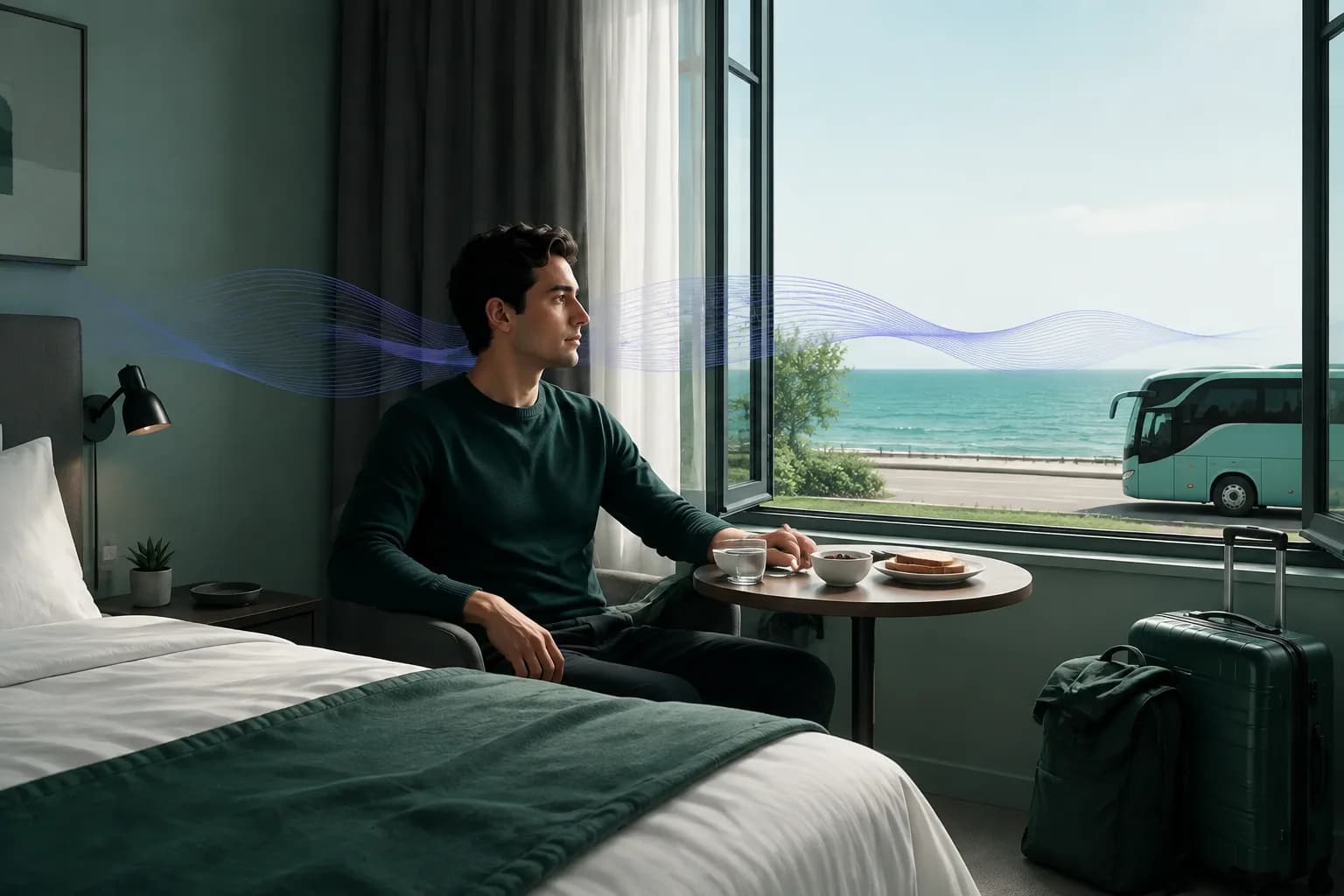
The short answer
The road home is the same road, so the thing that changed is you. After a trip you are usually short of sleep, eating differently, and travelling with a phone full of photos instead of a window full of somewhere new. Sleep loss is the part with real evidence behind it: travel medicine guidance lists being sleep deprived among the things that make motion sickness worse, and a controlled study reported additive or multiplicative effects when short sleep and motion were combined. The return leg is where those stack up, and most of the stack is decided before you set off.
It is a common complaint with no study behind it. The drive out was fine. Six days later, same car, same motorway, same seat, and forty minutes in you have the window down and your eyes shut.
Nothing happened to the road. Several things happened to you, and most are fixable before you leave.
Prone to motion sickness? Drug-free relief for the leg you cannot reschedule, on the headphones already in your bag. No drowsiness, about 90 seconds.Starts in your browser · works with any headphones
Get your personalized Dizzout plan. Paid subscription for full access.

On your phone? Scan to start there.
The pattern people report and nobody has measured
Ask around and the return leg keeps coming up: the ferry back, the flight back, the last two hours of a drive that started fine. Look for a study on it and there is nothing, because nobody has run one. Be suspicious of anyone quoting a percentage.
What exists is a list of things known to make motion sickness worse, and a journey home collects several of them in one vehicle. The answer is a stack, not a cause, and the best-supported item on it is sleep.
Motion also makes people sleepy, which has its own name and its own page. This post runs the other direction: arriving short of sleep, and what that does to the journey ahead.
Sleep debt is the input with the most evidence behind it
The CDC's travel guidance puts being sleep deprived on the list of things that worsen motion sickness, alongside age, sex and migraine history. The 2019 clinical overview in Drugs in Context says it in one line: sleep deprivation can increase susceptibility.
A 2017 study measured it rather than listing it. Four groups spent two nights on either normal eight-hour sleep or four-hour sleep, then were tested sitting still or during slow side-to-side motion. The paper reports additive or multiplicative relationships to motion sickness severity. In plain terms: the short-sleep group under motion fared worst, and the authors could not rule out the two inputs multiplying rather than merely stacking.
The second result matters more for a journey home than the first. Sleep loss also slowed the rate at which people adapted to the motion across repeated sessions. Adaptation is what rescues you on a long trip: give it long enough and the brain settles, and the drive gets easier. Short of sleep, that rescue arrives later, sometimes later than the drive is long.
The return leg is when you are most short of sleep
Now line that up with an ordinary holiday. The outbound leg follows a normal week in your own bed. The return leg follows late dinners, a strange mattress, thin curtains, children off their routine, and a last night that ran long. Then the flight is at seven and the alarm goes at four.
That is the asymmetry. Same road, same seat, one leg travelled rested and one on four hours.
Tiredness runs both ways, which is why the two get tangled. Motion produces fatigue as a symptom, covered on the fatigue page. Sleep debt makes the motion worse before the engine starts. Coming home you often get both at once.
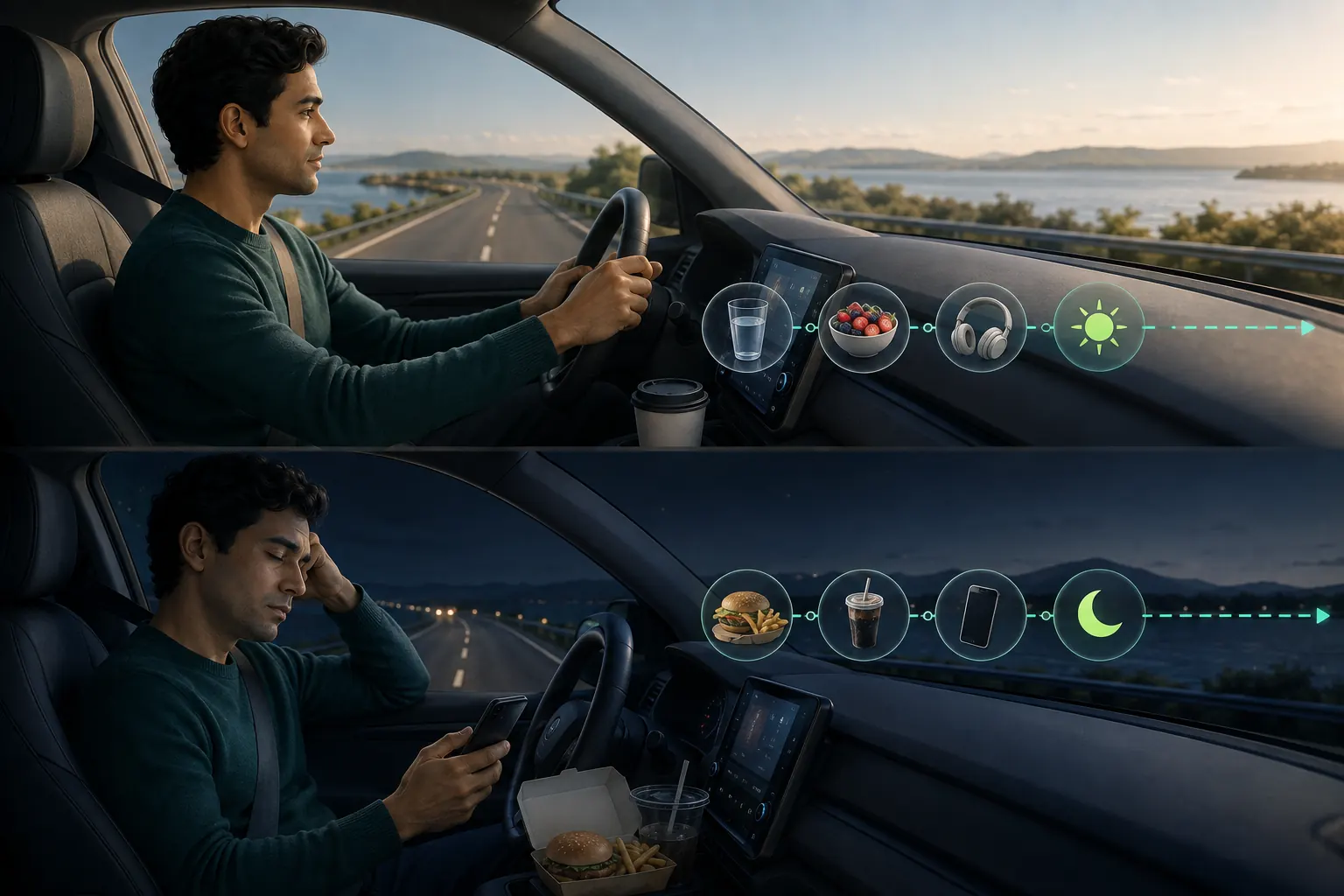
The meal you skipped on the way out and ate on the way back
Departure days run on coffee and nerves. Return days run on a farewell breakfast, a long lunch, and whatever was drunk the night before. The Drugs in Context overview lists a full stomach among the things that can aggravate nausea, next to a stuffy atmosphere and strong smells, so a heavy meal before a long leg is worth moving. Be careful with the rest of the food advice: the evidence for eating any particular thing before travel is thinner than the internet makes it sound, which is why our eating before travel verdict says untested and what to eat before a trip says so at length.
Leaving is exciting, coming back is not
The tidy version says excitement distracts you on the way out and boredom leaves you nothing coming back. The published work does not support that: the same overview lists fear and excitement together among the things that can aggravate nausea, so mood is not a clean protective factor.
What changes reliably is behaviour. On the way out you look at the road, the map, the place you have not seen. On the way home you look down: photos, the email that piled up, the seat back. Your eyes lock on to a screen in your lap while the vehicle keeps moving, which is the standard setup for the sensory mismatch. The problem is not that you have nothing to look forward to. You have stopped looking out.
Low sun, night driving and the light you travel in
Forward vision is one of the few parts of this measured at scale. Turner and Griffin surveyed 3,256 coach passengers alongside measurements of how the coaches moved. Twenty-eight percent said they felt unwell during coach travel. Stronger motion and poorer forward vision both correlated with illness, and passengers with a good view of the road ahead differed little whether the ride was rough or smooth. Prior sickness, how often people travelled and their age correlated more strongly still, which is the part of the picture you cannot change on the day.
Return legs are the ones that run into the evening. You leave after the last day, drive into a low sun, then into the dark. Nobody has surveyed night coaches against day coaches, so read what follows as reasoning rather than measurement, but it is short reasoning: darkness removes the forward view that survey found protective. A low sun in the windscreen does the same from the other end. Keeping the road ahead visible keeps the visual advantage the survey actually measured.
Night ferries, red eyes and sleeper trains
Here is the version people ask before booking: is an overnight crossing or a red eye a bad idea if you get motion sick? It stacks short sleep and motion into one night, which is the combination the 2017 study created on purpose.
It is not an automatic no. Lying supine is one of the few positions the clinical overview says may lower susceptibility, and a berth is the one form of travel where lying down is the plan rather than the emergency. So the booking carries the weight: a berth rather than a reclining seat, and away from the bow, which is the one position the CDC names as worth avoiding. Where to sit on a boat or ferry has the rest. A red eye gives you far less of that, so it is the leg to protect rather than the leg to schedule tightly around.
What to change before you set off home
Five moves, roughly in order of likely difference:
- Move the departure before you move anything else. An extra night, a later train, a mid-morning start instead of a dawn one. Whatever gets you into the vehicle less short of sleep is the change with the most evidence behind it, and the one nobody considers, because departure times feel fixed and are not.
- Take the seat with a view forward. Front seat in a car, forward-facing on a train, eyes on the road. Road trip nausea has the seat-by-seat version for a long drive back.
- Do the phone catch-up before you get in. Photos, email, receipts. Saving all of it for a moving vehicle is the trigger you hand yourself.
- Keep the last meal before a long leg light. A big farewell lunch before four hours of motorway is worth rescheduling. Past that, the food rules are less settled than they sound.
- Carry relief instead of leaving it at home. If it starts anyway, sound therapy through the headphones already in your bag is one option designed to help calm the response in about 90 seconds, with no drowsiness on top of the tiredness you are carrying.
Do
- Leave later, or add a night, if the alternative is a dawn start
- Book the seat with a view of the road ahead
- Clear the photos and the email before you get in
- Keep the last meal before a long leg light
- Have drug-free relief on the phone, not in a drawer at home
Don't
- Schedule the return for the end of the shortest night of the trip
- Save the holiday admin for the car
- Sit in the back with your head down for four hours
- Wait until the nausea peaks before doing anything
Practical strategies, not measured effects. Which ones matter most depends on your route and your body.
The way home is not cursed. It is the leg you plan last and travel worst, and the two best-evidenced inputs, sleep and what your eyes are doing, are settled before you get in. To score a return leg before you book it, the trip predictor takes the vehicle, the route and your history. If you are reading this from the passenger seat, open the 60-second protocol instead.
One caveat. If dizziness or nausea turns up with no travel involved, or comes with hearing changes or vertigo that lingers for days, that is a question for a doctor rather than a seating plan.
For the leg you cannot reschedule
Stop the nausea
Some journeys home are fixed: the flight is booked, the alarm is at four, the drive is four hours. Dizzout plays precisely calibrated audio through any headphones, one option designed to help calm the response in about 90 seconds. Drug-free and no drowsiness, which matters most on a day you are already short of sleep. Free to download on iOS and Android, subscription for full access.
Get your personalized Dizzout plan. Paid subscription for full access.
30,000+ travelers in 30+ countries · How we count

On your phone? Scan to start there.
Comparing apps first? See how the motion sickness apps compare
Frequently asked questions
Why do I get car sick on the way home but not on the way there?
Because the road is the same and you are not. The journey home usually follows a week of short sleep, a heavier last meal, and a habit of looking down at photos and email instead of out at the road. Sleep deprivation is listed by travel medicine guidance as something that makes motion sickness worse, and a 2017 study reported additive or multiplicative effects when short sleep and motion were combined. No study has looked at return legs specifically, so read this as a stack of known factors rather than a measured effect.
Does being tired make motion sickness worse?
Yes, and it is one of the better-supported factors. The CDC's travel guidance lists being sleep deprived among the things that worsen motion sickness, and a 2017 study that put people through two nights of restricted sleep before testing them during slow motion found the two had additive or multiplicative effects on motion sickness severity. The same study found sleep loss slowed the rate at which people adapted to the motion, so the settling-down that usually rescues a long trip arrives later.
Is motion sickness worse at night?
There is no survey of night travel against day travel, so nobody can give you a clean yes. What is known is that forward vision matters: in a survey of 3,256 coach passengers, poorer forward vision correlated with feeling unwell, and passengers with a good view of the road ahead differed little in illness whether the ride was rough or smooth. Darkness takes that view away, and night trips also tend to be the ones you travel most tired.
Why is the return flight worse than the outbound?
Usually the same reasons as a car, minus the window. Return flights are more often early departures or red eyes at the end of a trip that already cost you sleep, and there is less to look at, so people read, scroll or work through the whole thing. If you can, protect the sleep before a return flight rather than the seat on it, and keep the screen work for the terminal.
Does sleeping well before a trip help motion sickness?
It removes a known amplifier, which is not the same as a proven prevention. Nobody has run a trial that tells people to sleep well and measures how much less travel sickness they get. What has been shown is the other side of it: sleep deprivation makes motion sickness worse and slows adaptation to motion. So arriving less short of sleep is a sensible thing to plan for, alongside the seat, the view and a backup remedy.
Someone you know gets motion sick?
Send them this guide. It might be the trip it saves.
Your next question, probably
Will this particular trip make you sick?
Vehicle, route and your own history
Not your question? Which remedy fits the journey home?Driving back tonight?Which app is worth having on the phone?
About this article
- CDC Yellow Book: Motion Sickness (risk factors, including sleep deprivation)
- Kaplan J, et al. The influence of sleep deprivation and oscillating motion on sleepiness, motion sickness, and cognitive and motor performance. Autonomic Neuroscience, 2017;202:86-96
- Turner M, Griffin MJ. Motion sickness in public road transport: the relative importance of motion, vision and individual differences. British Journal of Psychology, 1999;90:519-530
- Leung AKC, Hon KL. Motion sickness: an overview. Drugs in Context, 2019;8:2019-9-4
This article is informational and not a substitute for medical advice. Talk to your doctor or pharmacist before taking any medication for motion sickness, and see a doctor about dizziness or nausea that happens without travel or that lingers for days.