Sopite Syndrome: Why Motion Makes You Sleepy (and How to Stay Alert)
If long car rides, flights, or boat trips leave you yawning, foggy, and unable to keep your eyes open, even without any nausea, you may be experiencing sopite syndrome, a drowsiness-dominant form of motion sickness. Researchers Graybiel and Knepton named it in 1976 to describe the profound sleepiness, apathy, and low mood that motion can trigger, sometimes as the only symptom. The good news: the same drug-free habits that calm classic motion sickness can help, and Dizzout's calibrated sound therapy is one option many travelers find helpful even after the heavy-eyed feeling sets in.
First thing to do: Get fresh, cool air. Open a window, turn an air vent toward your face, or step outside at the next stop to help shake off the heaviness.
Try Dizzout free. Drug-free calibrated sound through any headphones, designed to help once symptoms have started.Free · works with any headphones · no account to try
Free to try, no card needed. Or go straight to the App Store or Google Play.
What it feels like
Sopite syndrome is the "sleepy" face of motion sickness. Instead of the queasy stomach most people expect, it shows up as profound drowsiness, repeated yawning, a disinclination to work or talk, withdrawal from people around you, irritability, low mood, and trouble concentrating. The drowsiness can feel disproportionate to how much sleep you got the night before, which is part of what makes travel fatigue so confusing. What sets it apart is that it can be the sole sign of motion sickness, appearing entirely without nausea or vomiting, and it can linger for hours or even days after the trip ends. It is most often provoked by either a brief burst of very intense motion or long stretches of gentle, monotonous motion, such as a steady highway drive, a calm flight, or a slow-rolling boat. Because it looks like ordinary tiredness, it is frequently overlooked, but it is a recognized clinical entity, not just "being a bad traveler."
Why motion sickness causes drowsiness (sopite syndrome)
Motion sickness arises when the signals your brain receives about movement disagree. Your inner ear (the vestibular system) senses motion, your eyes report a different picture, and your body's position sensors add a third account. When these do not match the pattern your brain expects, this sensory conflict sets off a cascade of involuntary, autonomic responses. In classic motion sickness that cascade produces nausea and cold sweats; in sopite syndrome it tips the nervous system toward sedation instead. The leading explanation is that sustained sensory conflict dampens the brain's arousal and alertness systems, lowering vigilance and promoting sleepiness and apathy as a kind of protective "power-down." The vestibular system is central to this: people without a functioning vestibular system are essentially immune to motion sickness, which underscores that the inner ear is driving the response. Low-frequency, repetitive motion, the kind common in vehicles, is an especially strong trigger for the drowsy reaction.
How to ease it now
- 1
Get fresh, cool air. Open a window, turn an air vent toward your face, or step outside at the next stop to help shake off the heaviness.
- 2
Lock your eyes onto the horizon or a stable point far ahead. Giving your eyes motion information that matches what your inner ear feels reduces the sensory conflict driving the symptom.
- 3
Stop reading, scrolling, or watching screens. Close-up visual tasks deepen the mismatch and can intensify the drowsy, foggy feeling.
- 4
Sit where the motion is gentlest and most predictable, and where possible face forward. In a car, the front seat; on a boat, the middle and lower decks; on a plane, over the wing.
- 5
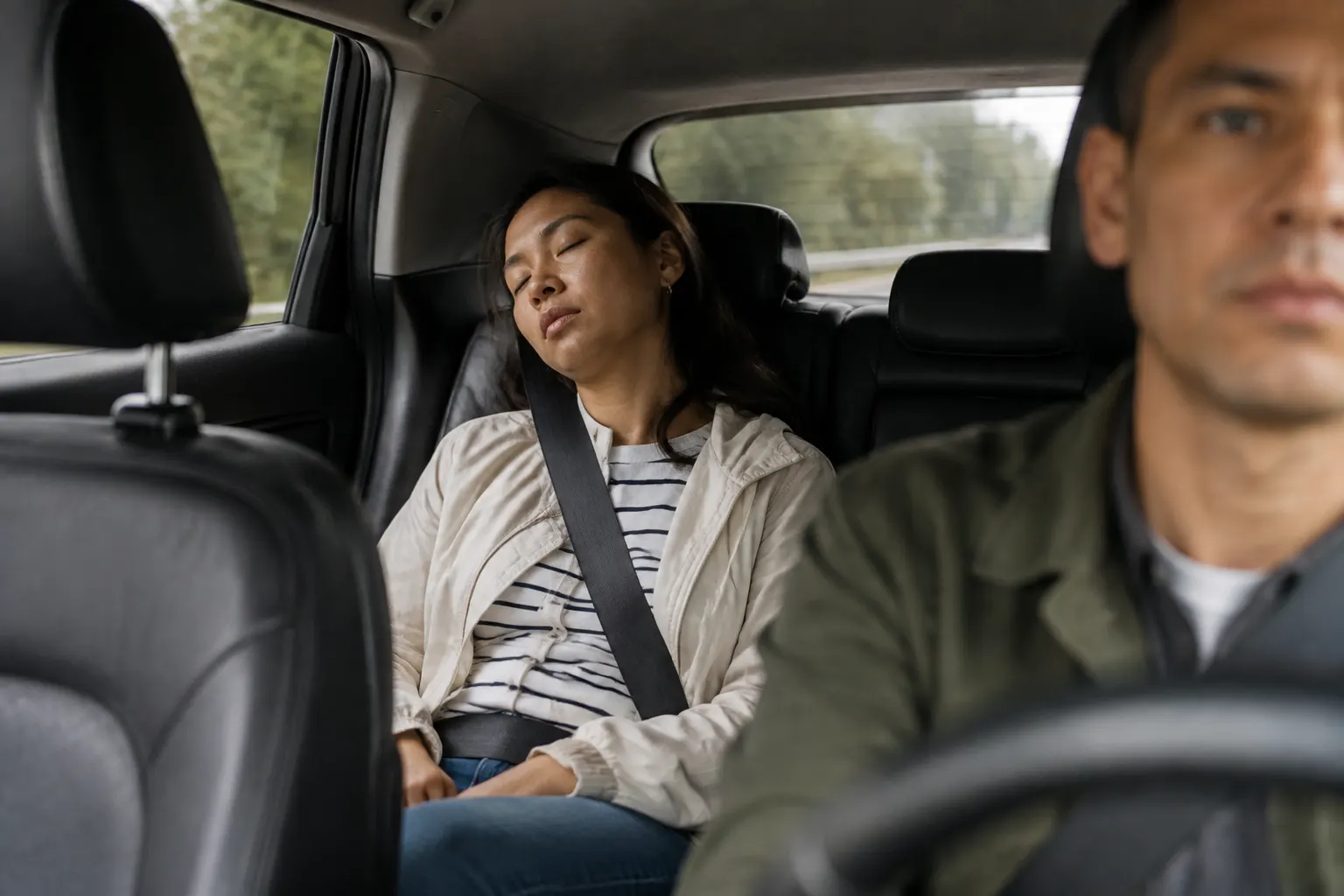
If you are the one feeling it and not driving, a short rest with your eyes closed or a brief planned nap can be safer than fighting heavy eyelids. Never drive or operate anything while you feel this drowsy.
- 6
Try a drug-free option you can use after symptoms begin, such as Dizzout's calibrated sound therapy through any headphones, which many users find helpful when the sleepy, sluggish feeling sets in mid-trip.
A drug-free option that works after symptoms start
Try Dizzout free
Dizzout is a free-to-try, drug-free app that uses calibrated sound on any headphones. It's one of the few options designed to help once you already feel sick. Most people feel better in about 90 seconds.
Free to try, no card needed. Or go straight to the App Store or Google Play.
 Scan to open on your phone
On a computer? Dizzout installs on your phone. Scan the code, or open dizzout.com/get on your phone and it'll take you straight to the right store.
How to prevent it
- Build up gradually. Repeated, incremental exposure to the kind of travel that affects you (habituation) is the most effective long-term approach and, unlike sedating medicines, does not add to drowsiness.
- Choose the most stable seat before you set off, and keep your head still and supported, for example against a headrest, rather than moving it around.
- Skip in-trip reading and screens, and look out at the moving scenery or the horizon instead.
- Be careful with common anti-motion-sickness pills. Antihistamines like dimenhydrinate or meclizine and scopolamine patches can themselves cause drowsiness and may worsen sopite-type sleepiness; ask a pharmacist or doctor what fits your situation.
- Some people use ginger or acupressure bands; evidence is mixed, so treat them as low-risk extras rather than guaranteed fixes, and ask a pharmacist if unsure.
- Start trips rested and well hydrated, and avoid heavy meals and alcohol beforehand, since baseline tiredness stacks on top of motion-induced drowsiness.
When to see a doctor
Sopite-syndrome drowsiness should ease once you are off the moving vehicle and back to normal routines. See a doctor if severe sleepiness, apathy, or mood changes appear without any motion, last well beyond your trip, or keep returning, since persistent fatigue and low mood have many other medical causes that deserve evaluation. Treat as urgent any drowsiness paired with neurological red flags, such as a severe or sudden headache, confusion, fainting, weakness or numbness, or changes in vision, speech, or balance, and seek emergency care. Also get prompt help for prolonged vomiting with signs of dehydration. And never drive or operate machinery while you feel this heavy-eyed; pull over and rest. This page is general information, not a diagnosis or medical advice.
Common questions
Why does traveling make me so sleepy even when I'm not nauseous?
Motion can trigger a drowsiness-dominant form of motion sickness called sopite syndrome. The same inner-ear and sensory conflict that causes queasiness in some people instead tips the nervous system toward sedation in others, producing yawning, heavy eyes, and apathy, sometimes with no nausea at all.
Is sopite syndrome the same as just being tired?
No. It is a recognized form of motion sickness named by Graybiel and Knepton in 1976, and it tends to be out of proportion to how rested you are. Ordinary tiredness improves with sleep, while sopite-related drowsiness is provoked by motion and can persist for hours after the trip ends.
How long does the drowsiness last after I stop moving?
It often fades once you are off the vehicle, but it can linger for hours or, after prolonged exposure, even longer. If heavy sleepiness or low mood persists well beyond your trip or shows up without any travel, it is worth getting checked by a clinician.
Do motion sickness pills help or make the sleepiness worse?
Common options like antihistamines (for example dimenhydrinate or meclizine) and scopolamine patches can themselves cause drowsiness, so they may not be ideal when sleepiness is your main problem. Ask a pharmacist or doctor which approach suits you; non-drug strategies such as a horizon view, fresh air, and avoiding screens may be a better first step.
Can I do anything once the heavy, foggy feeling has already started?
Yes. Fresh air, fixing your gaze on the horizon, stopping screen use, and resting if you are not driving can all help. Some travelers also use a drug-free option like Dizzout's calibrated sound therapy, which is designed to be used after symptoms begin.
Sources
- Lackner JR. Motion sickness: more than nausea and vomiting. Experimental Brain Research (NCBI/PMC)
- Cleveland Clinic - Motion Sickness: Causes, Symptoms & Treatment
- Takov V, Tadi P. Motion Sickness. StatPearls, NCBI Bookshelf
- Graybiel A, Knepton J. Sopite syndrome: a sometimes sole manifestation of motion sickness. Aviat Space Environ Med, 1976 (PubMed)
Related symptoms & guides
This page is informational and is not a substitute for professional medical advice. If symptoms are severe, persistent, or occur without any motion trigger, see a qualified clinician.