
The short answer
The world's roughest air sits in predictable places: over long mountain ranges, under strong jet streams, and inside tropical storm country. Ranking data reported by CNN puts the short Andes hop between Mendoza and Santiago at the top of the world list, with the routes around Denver, the Alps and Japan close behind, and research finds severe clear-air turbulence over the North Atlantic rose 55% between 1979 and 2020. None of this makes those flights unsafe, but for an airsick prone passenger it changes the plan: book over the wing, keep the belt on, and have a rescue ready for the twenty bumpy minutes instead of dreading the whole flight.
Turbulence feels random from seat 23F. It is not. Pilots and meteorologists know exactly where the atmosphere gets rough, because the causes sit on the map: a mountain range that folds the wind into waves, a jet stream with sharp edges, a belt of afternoon thunderstorms. Forecasters even model it daily.
That predictability is good news if you get airsick. You cannot flatten the Andes, but you can know in advance which legs of a trip will bounce, pick the seat that moves least, and time your countermeasures for the phase of flight that actually gets rough. Here are ten corridors with a reputation, what earned it, and the plan for each.
Airsick when the bumps start? Drug-free relief in about 90 seconds, on any headphones, at any altitude.Starts in your browser · works with any headphones
Ease plane sickness. Get your personalized Dizzout plan. Paid subscription for full access.

On your phone? Scan to start there.
+55%
Severe clear-air turbulence over the North Atlantic, 1979 to 2020
Annual duration of severe clear-air turbulence at a typical North Atlantic point, with significant rises also found over the continental US, Europe and the South Atlantic.
AGU press release for Prosser et al. 2023, Geophysical Research Letters. Full link below.
The mountain wave corridors
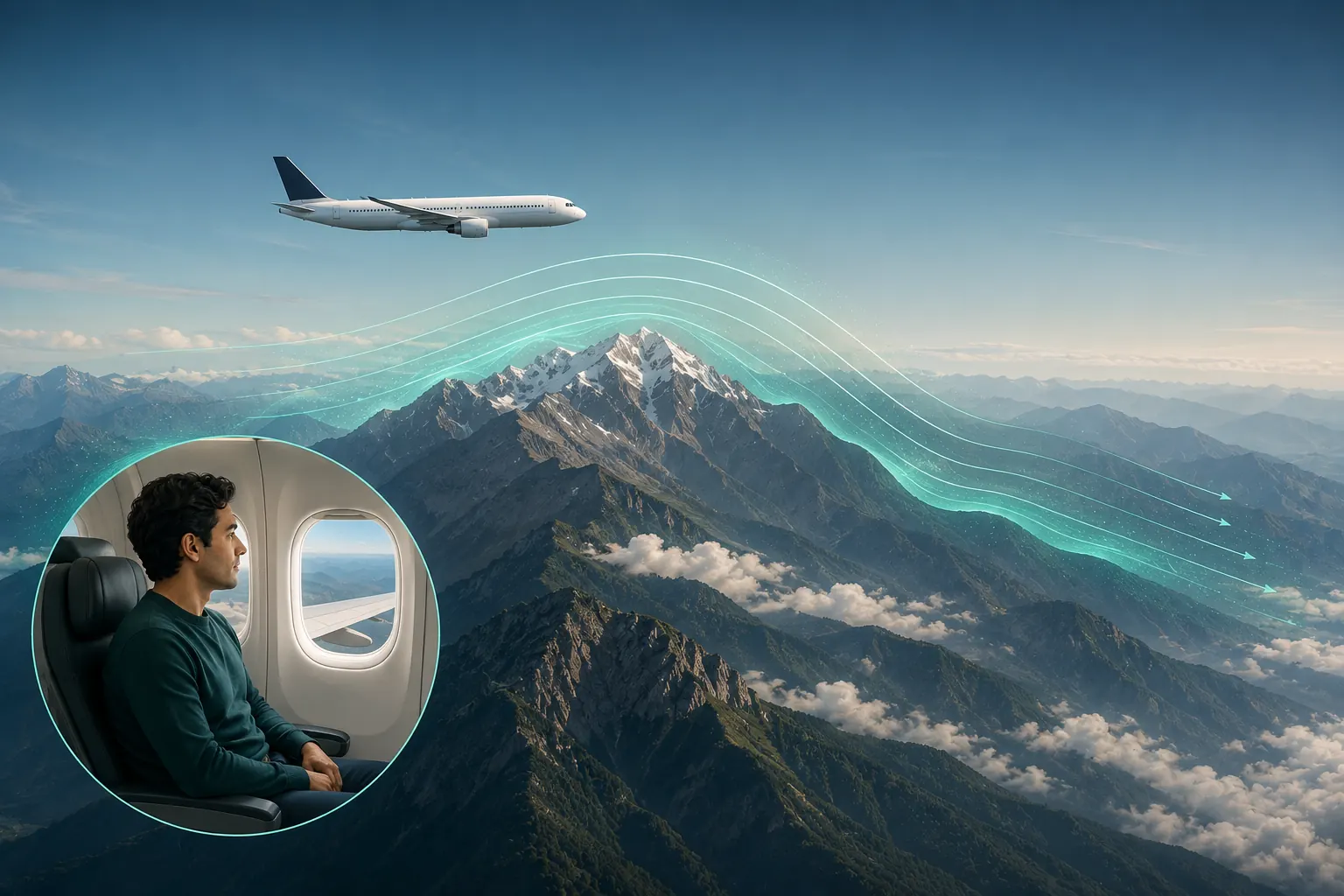
Wind that hits a long mountain range does not stop. It rises, spills over, and keeps oscillating downstream in huge invisible waves that can break like surf. Aviation forecasters treat mountain-wave turbulence as its own category, and the majority of the world's ten roughest routes cross mountains.
1. Mendoza to Santiago, and every Andes crossing
The 120 mile hop between Mendoza in Argentina and Santiago in Chile crosses the Andes at their full height, and CNN's reporting of Turbli's route rankings puts it first in the world for turbulence. The mechanism is pure mountain wave: westerly wind forced up and over the longest land mountain chain on Earth. Longer crossings between Chile and Argentina or Brazil ride the same air.
The airsick plan: the flight is short, so treat the whole leg as the bumpy phase. Sit over the wing, skip the pre-flight coffee, start a Dizzout session at the gate rather than after the first drop, and keep your eyes out the window at the horizon, not on a phone.
2. Denver, Salt Lake City and the Rockies
CNN's route rankings show the bumpiest US routes are dominated by flights crisscrossing the Rocky Mountains to and from Denver and Salt Lake City. Local aviation reporting from Denver explains why: air flowing over the Rockies behaves like water flowing over rocks in a stream, so approaches can be rough even on days without extreme wind, and strong downslope wind days bring widespread moderate to severe reports. This is home turf for United's Denver routes.
The airsick plan: the roughest stretch is usually the descent into the terrain, so prepare at the top of descent: vent open, screen away, belt snug, session ready. An over-wing window seat gives you the horizon when the bumps start.
3. The Alps between France, Italy and Switzerland
Many of Europe's most turbulent routes are the short hops over the Alps between France, Italy and Switzerland, per the same ranking data. Short sectors mean the climb and descent, the phases most affected by terrain, make up most of the flight.
The airsick plan: same as the Andes, scaled down. On a 60 to 90 minute hop there is no long calm cruise to recover in, so board prepared instead of planning to cope later.
4. The Himalayan corridors
The world's highest range earns its place in the world's roughest ten: CNN notes the top routes involve the Andes and the Himalayas. Flights into Kathmandu and across the high ranges of South and Central Asia deal with mountain effects on a scale no other corridor matches.
The airsick plan: approaches here can be bumpy low down, where you cannot see a horizon through cloud. Closed eyes, a still head against the headrest, and audio you have queued in advance beat trying to read your way through it.
The jet stream corridors
Jet streams are narrow bands of strong wind around 30,000 feet, blowing west to east, and NOAA notes they are strongest in winter, exactly the altitude band where jets cruise. Their edges produce clear-air turbulence: invisible, hard to forecast, and the reason the seatbelt sign sometimes comes on out of a clear sky.
5. The North Atlantic, New York to London
The corridor between North America and Europe sits where jet streams are strongest, a UK Met Office scientist told CNN, and it is the corridor with the best-documented trend: severe clear-air turbulence at a typical North Atlantic point rose 55% between 1979 and 2020. Winter crossings, when the jet peaks, are the bumpiest season. British Airways and every transatlantic carrier live on this air.
The airsick plan: clear-air turbulence arrives without warning, so make the belt permanent and do the eating, queueing and bathroom trips in the calm stretches. A window seat over the wing plus the overhead vent covers the physical side; a queued session covers the rest.
6. Japan and the North Pacific
Japan has a particularly strong jet stream, fed by Siberian cold meeting warm Pacific air, and a 2023 study in the Journal of Applied Meteorology and Climatology found large amounts of mountain-wave turbulence over Japan's ranges in autumn and winter, when the jet flows overhead. Transpacific approaches ride the same winter jet, which is why our ANA and JAL guides flag the Tokyo to North America legs.
The airsick plan: if your dates are flexible, the calmer season for this corridor is late spring through summer. If they are not, expect the bumps in the last hours into Japan and set up before them rather than during.
The storm corridors
7. The Caribbean and the Gulf in storm season
The Atlantic hurricane season runs June 1 to November 30, peaking around September 10, and covers the Atlantic, the Caribbean Sea and the Gulf, per NOAA's National Hurricane Center. Outside named storms, NOAA's severe storms lab notes thunderstorms cluster in the warm months and, along the Gulf Coast and the Southeast, in the afternoon. Pilots route around storm cells, but the detours and the leftover convection make summer afternoons the bouncy slot.
The airsick plan: in season, book the morning departure when you can. Storms you can see out the window are storms the crew is already avoiding, so the bumps are usually brief: belt, vent, horizon, session, and let the detour happen.
8. The Bay of Bengal and Southeast Asia
Thunderstorm turbulence is most pronounced near the equator, and the corridor between Europe and Singapore crosses some of the most convective air on Earth. The severe turbulence encounter on a London to Singapore flight in 2024 happened amid storms over Myanmar, CNN notes. Our Singapore Airlines guide flags the tropical convective legs for the same reason.
The airsick plan: this is the corridor where the belt matters most, worn low and snug whenever you are seated. Nausea-wise, treat the stretch between the Bay of Bengal and the equator as your alert window on a Europe to Southeast Asia flight.
The famous approaches
9. Hong Kong
Hong Kong International sits just north of Lantau Island, and the Hong Kong Observatory reports that winds crossing the Lantau mountains create windshear and turbulence on the approach: about 1 in 500 flights reports significant windshear and about 1 in 2,500 significant turbulence, mostly terrain driven and predominantly in late spring. Cathay Pacific's home approach is the textbook case.
The airsick plan: the rough part is the final minutes, which is the easiest kind of turbulence to plan for. Finish food and screens 30 minutes out, aim the vent, and ride the approach with eyes on the horizon or closed.
10. Wellington
New Zealand's capital is one of the world's windiest airports, per NIWA, because wind funnels through the Cook Strait gap between the North and South Islands and accelerates on the Wellington side. In May 2025, RNZ reported flights aborting landings there in gusts around 102 km/h, with passengers describing an unusual sideways motion in the final minutes.
The airsick plan: like Hong Kong, the reputation lives in the approach, not the cruise. Short exposure, sharp motion: brace your head against the headrest, breathe out slowly, and remember an aborted landing is the crew choosing the smooth option, not an emergency.
| Corridor | Why it is bumpy | Roughest window | Seat plan |
|---|---|---|---|
| Mendoza to Santiago (Andes) | Mountain waves off the Andes | Year round | Over the wing, session from the gate |
| Denver and Salt Lake (Rockies) | Mountain waves, downslope winds | Windy days, descent | Over the wing, prep at top of descent |
| Alpine hops (France, Italy, Switzerland) | Mountain waves over the Alps | Year round, short sectors | Board prepared, no calm cruise to recover in |
| Himalayan corridors | Mountain effects at extreme scale | Approach phases | Eyes closed, head still, audio queued |
| North Atlantic (NY to London) | The strongest jet stream corridor | Winter | Belt always, act in the calm stretches |
| Japan and the North Pacific | Strong jet plus mountain waves | Autumn and winter | Set up before the descent into Japan |
| Caribbean and Gulf | Storm season convection | June to November, afternoons | Book the morning departure |
| Bay of Bengal and Southeast Asia | Equatorial thunderstorms | Convective season | Belt low and snug, alert window mid route |
| Hong Kong approach | Terrain windshear off Lantau | Late spring | Wrap up screens 30 minutes out |
| Wellington approach | Cook Strait wind funnel | Windy days, final minutes | Head braced, slow exhales, short exposure |
What actually helps an airsick flyer
The corridor list changes where the bumps come, not what to do about them. Airsickness is ordinary motion sickness: your inner ear feels the drops and jolts while your eyes see a still cabin, and the mismatch reads as nausea. Everything that helps attacks that mismatch or the reflex behind it.
The seat does the first half. A window seat over the wing sits closest to the aircraft's pivot point, so it moves least, and the window gives your eyes the horizon, the one reference that agrees with your inner ear. The FAA's passenger advice adds the part people skip: keep the seat belt fastened whenever you are seated, because the injuries in turbulence happen to the unbelted.
The rescue does the second half. Medication is prevention, not rescue: antihistamines need 30 to 60 minutes of lead time, which is no help when clear air turns rough at hour six. The drug-free option built for after onset is sound therapy through any headphones: a Dizzout session brings relief in about 90 seconds, with no drowsiness, which matters when you land with a day ahead of you.
Ticks are kept for this browser tab only, and are never sent anywhere.
An honest note on forecasts
A page like this is geography, not a forecast. NOAA publishes daily graphical turbulence guidance covering clear-air, mountain-wave and storm turbulence, pilots reroute around the worst of it, and researchers told CNN that about three quarters of turbulence is now forecastable. So a notorious corridor can be glass smooth on your day, and a mild one can bounce. Plan for the corridor, pack the rescue, and let the crew handle the map. If flying reliably makes you sick regardless of route, start with the air sickness guide and the susceptibility test rather than the route map.
A rescue that fits in the seatback pocket
Stop the nausea
Dizzout plays precisely calibrated audio through any headphones, wired or Bluetooth. Drug-free, no drowsiness, relief in about 90 seconds. Free to download before your next rough corridor.
Get your personalized Dizzout plan. Paid subscription for full access.
30,000+ travelers in 30+ countries · How we count

On your phone? Scan to start there.
Comparing apps first? See how the motion sickness apps compare
Not travelling yet? Remind me the day before my trip
Frequently asked questions
What is the most turbulent flight route in the world?
By ranking data reported by CNN in 2025, the short Andes crossing between Mendoza, Argentina and Santiago, Chile, driven by mountain waves off the highest terrain in the Americas. Most of the world's roughest routes involve mountain ranges, with the Andes, Rockies, Alps and Himalayas all represented.
When is turbulence worst on flights to Japan?
Autumn and winter. Japan sits under a particularly strong jet stream, and a 2023 study of turbulence reports over Japan found mountain-wave turbulence concentrated in autumn and winter, when the jet flows over the country's ranges. Transpacific approaches ride the same winter jet.
Does turbulence cause airsickness?
It is the most common trigger, because it produces exactly the mismatch behind all motion sickness: your inner ear feels drops and jolts while your eyes see a still cabin. The fixes are the standard ones, a window seat over the wing, eyes to the horizon, cool air, and a rescue that works after onset rather than pills that needed an hour of lead time.
Can pilots avoid turbulence?
Often. Storm turbulence is visible on radar, so crews route around cells, and NOAA publishes daily turbulence guidance that flight planning uses. Clear-air turbulence near jet streams is the hard case because there is nothing to see, which is why the belt advice exists and why some bumps arrive without warning even on well-planned flights.
Is severe turbulence dangerous?
Aircraft are built and tested for it, and the FAA's consistent message is that the injury risk sits with unbelted passengers, not with the aircraft. If you are belted, turbulence is an unpleasant ride, not an emergency. The airsick passenger's problem is the nausea, and that part you can actually plan for.
Someone you know gets motion sick?
Send them this guide. It might be the trip it saves.
Your next question, probably
How does your airline handle it?
Seats, fleets and routes, airline by airline
Not your question? Which seat should you book?Want the full flying guide?Queasy right now?
About this article
by the Dizzout editorial team.
- CNN (2025): Turbulence is getting worse. Here are the planet's bumpiest flight routes.
- AGU press release: Hazardous clear-air turbulence up 55% from 1979 (Prosser et al. 2023, Geophysical Research Letters).
- NOAA JetStream: The jet stream (altitude, west-to-east flow, strongest in winter).
- NOAA: Improved aviation forecasts, including clear-air and mountain-wave turbulence categories.
- Journal of Applied Meteorology and Climatology (2023): Statistical analysis of aviation turbulence over Japan.
- NOAA National Hurricane Center: Atlantic hurricane season climatology (June 1 to November 30, peak September 10).
- NOAA NSSL: When thunderstorms are most likely (warm months, afternoons and evenings).
- FAA: Turbulence, staying safe (causes, and seat belt guidance for passengers).
- Hong Kong Observatory: Terrain-induced windshear and turbulence over Hong Kong International Airport.
- NIWA: Fear of flying into Wellington (Cook Strait wind funnelling).
- RNZ (May 2025): Flights abort landings into Wellington Airport as 100 km/h winds blow.
- Denver7: Why landing at Denver International Airport can be extra turbulent.
This article is informational and not a substitute for medical or safety advice. Turbulence conditions vary daily; follow your crew's instructions and keep your seat belt fastened when seated.