Funicular motion sickness: the tilt, the illusion and what helps
In short
Face uphill, keep your head vertical, and stand up if the leaning feeling starts. The speed never changes: the tilt is the whole trick.
Zones of motion sickness probability
Prone to motion sickness? Dizzout is drug-free sound therapy through any headphones, with relief in about 90 seconds.Starts in your browser · works with any headphones
Get your personalized Dizzout plan. Paid subscription for full access.

On your phone? Scan to start there.
Why motion sickness happens on a funicular
A funicular is one of the most predictable vehicles you can board: two cars counterbalance each other on one cable, so it runs at a constant, usually slow speed with no surprise braking. Classic motion sickness is rare on it. What gets riders is the tilt. The car climbs a slope steeper than anything a road vehicle manages, your body reclines with it, and your eyes start insisting the world outside is leaning. On Hong Kong's Peak Tram the effect is reliable enough to have been studied and named: the skyscrapers outside appear to tilt and fall toward the track, and the published work found the illusion is stronger on the way down and weaker when you stand.
Which way to face on a funicular
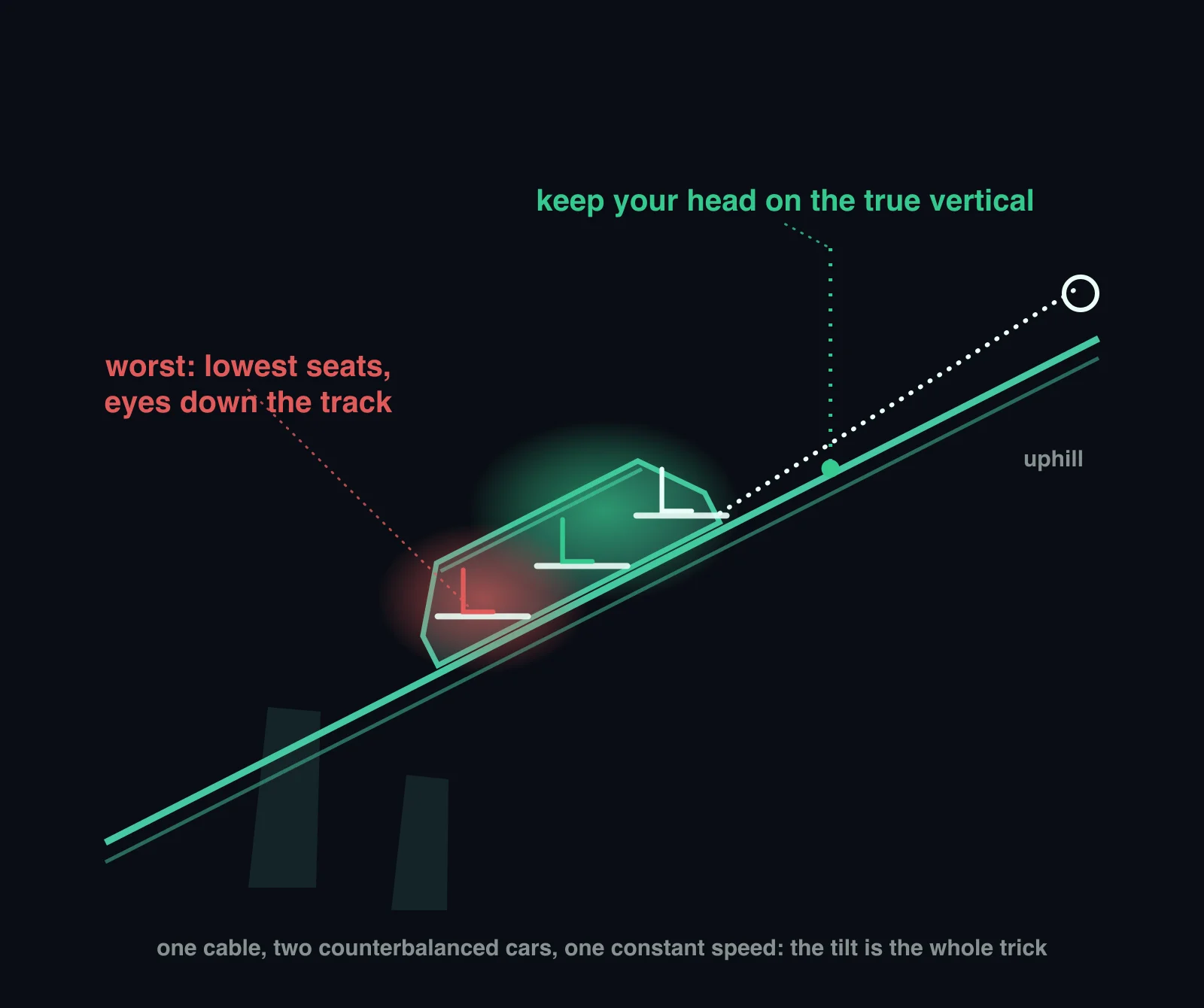
The middle of the car, seated on the level part of a stepped cabin, facing uphill. Facing up the slope keeps your back against the seat in both directions of travel and keeps the steepest downward view out of your line of sight.
If the tilt itself is what bothers you, standing genuinely helps: in the Peak Tram research the leaning-world illusion shrank by up to 40 percent when observers stood. Hold a rail and keep your head upright to the true vertical rather than leaning with the car.
Avoid: Descending in the lowest seats while staring straight down the track, or reading on the slope. A downhill run with your eyes on a phone combines the recline, the tilted window frame and a near focus, which is everything that feeds the illusion at once.
Best place to sit on a funicular
Sit mid car facing uphill, keep your head vertical instead of tilting back with the seat, and look across the slope at the view rather than straight down the rails. On the steepest modern lines the problem is engineered away: the Stoosbahn in Switzerland, the world's steepest funicular at a 110 percent grade, rotates its barrel-shaped cabins so the floor stays level the whole way.
🎧 Before you travel: Pre-Conditioning mode
Listen to the Dizzout Pre-Conditioning Sound for about 90 seconds before you start moving, while you still feel fine.
Know someone who dreads this trip?
Send them this guide before they board: seats, settings and what to do if it starts.
Already feeling sick on the funicular
Early signs often come before nausea: yawning, pale skin, extra saliva, a cold sweat, burping and loss of appetite.
Stand up if the car allows it, hold the rail, and level your head to the true horizon rather than the car's angle. Give your eyes a real vertical to work with: a building edge, a mast, the far station. Rides last only a few minutes and the speed never changes, so the feeling fades quickly once your eyes and inner ear agree again.
Feeling it right now? Get the 60-second protocol →
Already feeling sick?
Open Dizzout in 'I'm feeling sick' mode and listen. Dizzout states relief in about 90 seconds. Drug-free, works on any headphones.
What about motion sickness medication?
Some travelers use over-the-counter options like dimenhydrinate (Dramamine) or meclizine (Bonine); the common trade-off reported on their labels is drowsiness, and they're generally taken before travel rather than after symptoms start. Our plain-English medication guide covers what each one is, side effects, and who should check with a doctor or pharmacist first (it's educational, not medical advice). Prefer to skip pills? Dizzout is a drug-free option that works through any headphones: see how it works.
Frequently asked questions
Why do I get motion sickness on a funicular?
A funicular is one of the most predictable vehicles you can board: two cars counterbalance each other on one cable, so it runs at a constant, usually slow speed with no surprise braking. Classic motion sickness is rare on it. What gets riders is the tilt. The car climbs a slope steeper than anything a road vehicle manages, your body reclines with it, and your eyes start insisting the world outside is leaning. On Hong Kong's Peak Tram the effect is reliable enough to have been studied and named: the skyscrapers outside appear to tilt and fall toward the track, and the published work found the illusion is stronger on the way down and weaker when you stand.
What is the best seat to avoid motion sickness on a funicular?
Sit mid car facing uphill, keep your head vertical instead of tilting back with the seat, and look across the slope at the view rather than straight down the rails. On the steepest modern lines the problem is engineered away: the Stoosbahn in Switzerland, the world's steepest funicular at a 110 percent grade, rotates its barrel-shaped cabins so the floor stays level the whole way.
How do I stop motion sickness once it starts?
Stand up if the car allows it, hold the rail, and level your head to the true horizon rather than the car's angle. Give your eyes a real vertical to work with: a building edge, a mast, the far station. Rides last only a few minutes and the speed never changes, so the feeling fades quickly once your eyes and inner ear agree again. Sound therapy through the Dizzout app is a drug-free option, and Dizzout states relief in about 90 seconds.
Why do buildings look like they are falling from a funicular?
It is a documented visual illusion, studied on Hong Kong's Peak Tram, where high-rises outside the window appear to slant and fall toward the mountain. The research points to a combination of your reclined body, the tilted frame of the tram window and the motion itself, and it measured the illusion getting stronger on descents and weaker when observers stood up or rode by day. Knowing it is an illusion helps, and so does standing, holding the rail and keeping your head aligned with true vertical.
Are funiculars bad for motion sickness?
They are among the gentlest vehicles there are. The cable hauls two counterbalanced cars at one constant speed, there is no stop and go and no weaving, and each ride lasts only a few minutes. What riders feel is the steep tilt and the leaning-world illusion that comes with it, which is visual rather than a true motion conflict, and it settles almost as soon as the car docks.
Related guides
- Cable car and gondola motion sickness
Why hanging cabins swing, and where to put your eyes for the crossing.
- Train motion sickness: best seats
Choosing a window seat facing travel, with alternatives when the layout changes.
- Vertigo vs motion sickness: which one is it?
How to tell a leaning-world feeling from true vertigo, and why the difference matters.