
How rough is a Baltic cruise? Season by season
The Baltic is one of the gentlest seas a cruise ship sails in summer. It is enclosed, brackish and short on fetch, and Finnish Meteorological Institute records put open sea monthly mean wave heights at roughly 0.4 to 0.5 metres from April to July, against about 0.8 metres in January. The cruise season sits squarely on the calm months, so a typical May to September Baltic itinerary is a low motion week. Late autumn storms are real, but almost no cruise ships are out in them.
Baltic Sea, the Danish straits and the Gulf of Finland · The season runs May to September, peaking June to August.
- Low
- Moderate
- High
- Very high
The band summarises a typical in-season sailing for this region, not a forecast. The month table below is where the season detail lives.
Key facts
- A typical in-season sailing here sits in the low motion band. The season runs May to September, peaking June to August.
- The waters involved: Baltic Sea, the Danish straits and the Gulf of Finland.
- Open water is usually at its calmest in April, May, June, July and August.
- Conditions are typically roughest in January, November and December.
Sailing on a Baltic cruise? Dizzout is drug-free sound therapy you can start anywhere on the ship, with relief in about 90 seconds.Starts in your browser · works with any headphones
Stop seasickness on your cruise. Get your personalized Dizzout plan. Paid subscription for full access.

On your phone? Scan to start there.
When a Baltic cruise is calmest, month by month
| Roughest water in Jan | Roughest water in Feb | Roughest water in Mar | Roughest water in Apr | Roughest water in May | Roughest water in Jun | Roughest water in Jul | Roughest water in Aug | Roughest water in Sep | Roughest water in Oct | Roughest water in Nov | Roughest water in Dec |
|---|---|---|---|---|---|---|---|---|---|---|---|
| Rough | Mixed | Mixed | Calm | Calm | Calm | Calm | Calm | Mixed | Mixed | Rough | Rough |
Typical seasonal pattern, not a forecast. Any month can deliver a calm crossing or a bad one. Check the marine forecast for your sailing date. Select a month to see every sea and ferry crossing ranked for it.
Levels follow our Baltic Sea page, built on Finnish Meteorological Institute wave statistics. The cruise season occupies the calm half of the strip; the rough months mostly belong to ferries, not cruise ships.
Why it gets rough here
Waves need distance to grow, and the Baltic does not offer much: it is a chain of basins and archipelagos where the longest open stretches run a few hundred kilometres. Summer high pressure keeps winds light, and the approach to several ports threads archipelago water, the Stockholm approach alone giving hours of shelter. Autumn and winter storms can still whip up short steep seas fast, which is the Baltic's rough face, but that season sits outside the cruise calendar.
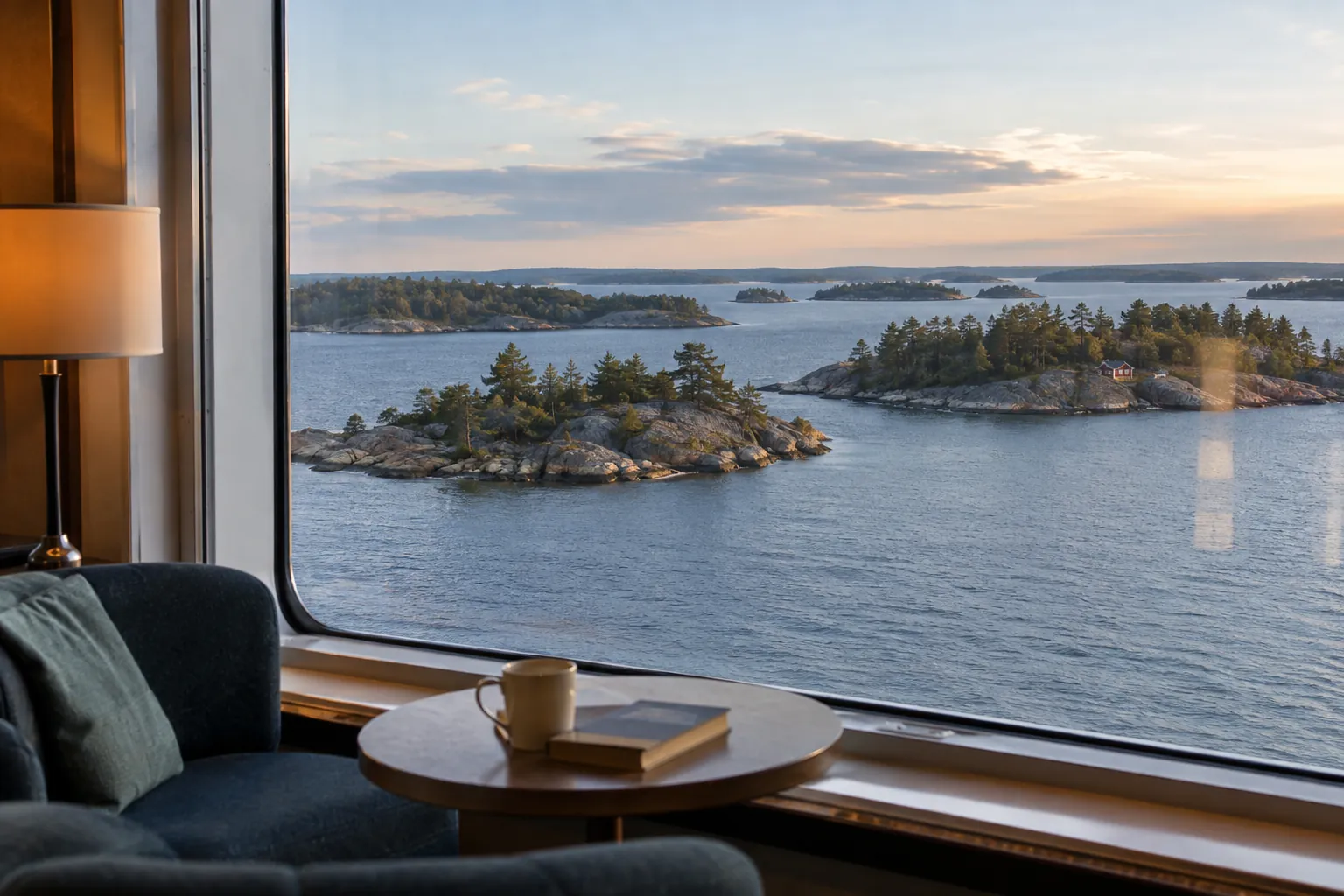
Archipelagos do the sheltering
Baltic itineraries are port dense: Copenhagen, the German coast, Tallinn, Helsinki, Stockholm, with short overnight hops between them. Several approaches run through archipelago water that is sheltered by geography. The most exposed legs are the Danish straits and Skagerrak on the way in, especially from the UK, and the central basin crossing toward the Gulf of Finland; in season neither is usually more than a night.
When do you sail?
Get a day-by-day prep checklist that unlocks as departure gets closer. Free, stays on your device.
Keep each part of the kit separate
Once your travel documents are put away, prepare Dizzout with your ordinary headphones. Keep the phone and audio case together in a separate pocket.
Free to download. Paid subscription for full access.
30,000+ travelers in 30+ countries · How we count

On your phone? Scan to start there.
Comparing apps first? See how the motion sickness apps compare
Not travelling yet? Remind me the day before my trip

Cabin choice for this region
Cabin position matters less here than on any Atlantic facing itinerary. If you are very motion sensitive, midship low remains the safe default for the open basin nights, and it costs nothing to choose. The general rule behind it is the same everywhere, midship and low, and the ship guide explains why that spot moves least.
The ships, and what size buys you here
Baltic regulars include Mein Schiff Relax, one of TUI's newest ships, and large Northern Europe based vessels such as AIDAnova and MSC Virtuosa rotate through the same waters. In practice, in season Baltic water asks little even of mid size ships.
- Mein Schiff RelaxTUI Cruises · 160,000 GT · motion guide
- AIDAnovaAIDA Cruises · 183,858 GT · motion guide
- MSC VirtuosaMSC Cruises · 181,541 GT · motion guide
Know someone who gets motion sick?
Send them the app that helps stop it, drug-free, in about 90 seconds, works with any headphones. Free to download.
The waters on this route, rated
Each body of water on this region's itineraries has its own page with a month by month strip, the mechanism behind its reputation, and where to be on board while crossing it.
- Is the Baltic Sea rough?Short steep chop, no ocean swell
- Is the Skagerrak rough?North Sea swell funneled into a narrowing strait
- Is the North Sea rough?Shallow basin, short steep wind chop
Frequently asked questions
Will I feel the ship move on a Baltic cruise?
+
Mostly no. In the May to September season, open sea mean wave heights run about half a metre by Finnish Meteorological Institute statistics, and much of a typical itinerary is spent in archipelago or coastal water calmer still. A large ship in that water reads as almost stationary.
When is a Baltic cruise calmest?
+
May through August. September is still usually fine but marks the turn: autumn lows start crossing more often, and by October the season is over for most ships anyway.
Which part of a Baltic cruise is roughest?
+
The entry and the open middle: the Skagerrak and Danish straits on the way in, especially on itineraries from the UK that also cross the North Sea, and the central basin crossing toward the Gulf of Finland. Each is usually a night or less in season.
Do Baltic cruises get cancelled for storms?
+
In season, weather disruption is uncommon and usually means a skipped port rather than a rough sea day. The Baltic's storm season, late autumn and winter, sits outside the cruise calendar.
Other regions
Related guides
Sources & further reading
Conditions described here are typical seasonal patterns drawn from published climatology and operator information as of September 2026, not a forecast: any month can deliver a calm sailing or a rough one, and itineraries change. Route and operator names are trademarks of their respective owners; Dizzout is not affiliated with or endorsed by them. Seasickness sensitivity varies from person to person; this page is informational and not medical advice.