
How to Stop Seasickness Mid-Cruise
Seasickness that starts on day one of a cruise feels like it's going to ruin the whole trip. It usually doesn't: most people's bodies adapt within a couple of days. Here's how to get through the rough patch, starting with the next ten minutes.
Try Dizzout free. Drug-free calibrated sound through any headphones, designed to help once symptoms have started.Free to download · works with any headphones
Free to download. Paid subscription for full access.
Step by step
- 1
Get up on deck
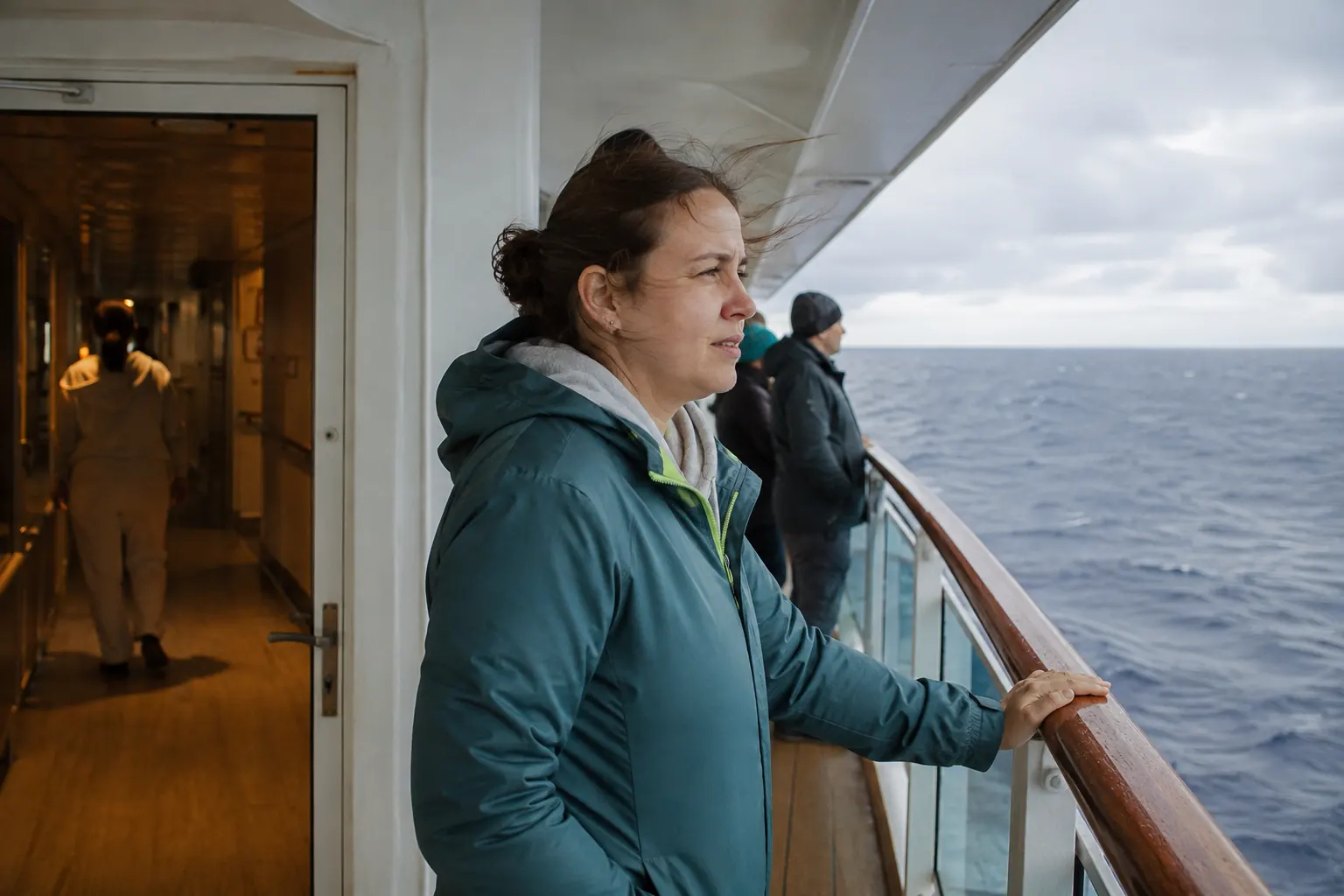
Head for fresh air and a horizon view: hold something fixed on the way and stay back from the rail. A windowless inside cabin is the worst place to ride out a wave of seasickness.
- 2
Lock your eyes on the horizon
Fix your gaze where sea meets sky and keep it there. It gives your eyes the same motion story your inner ear is telling, and the conflict shrinks.
- 3
Stay midship, face forward
The middle of the ship moves least: the bow and stern pitch the most. Face the direction of travel, stand with soft knees or sit braced.
- 4
Slow your breathing, sip water
Long slow exhales for a minute or two, plus small sips of water. Skip alcohol and heavy meals until you're steady: both lower your threshold.
- 5
Use sound therapy in your cabin
When you have to be inside, at night, in a windowless cabin, the Dizzout app is built for exactly that: calibrated sound through any headphones, designed to help once symptoms have started, eyes open or closed.
Why this works
A ship gives you two real levers: put yourself where the motion is smallest (midship, low), and give your senses agreement (horizon, fresh air). The steps buy your vestibular system time to do what it does naturally on multi-day sailings: habituate. That adaptation is what sailors mean by sea legs, and for most passengers it arrives within one to three days.
Common mistakes to avoid
- Retreating to a windowless inside cabin and closing your eyes to 'sleep it off' immediately: without a horizon reference or fresh air first, the spiral often gets worse before sleep helps.
- Standing at the rail and staring straight down at the water: the near water surface moves chaotically; the far horizon is the stable reference.
- Drinking through it: alcohol reliably makes seasickness worse and delays adaptation.
- Skipping meals entirely: an empty stomach is nearly as bad as an overloaded one; keep small, plain snacks going.
Already on the ship and feeling sick?
Stop Seasickness Now
Open Dizzout, plug in headphones, tap play. Relief in about 90 seconds.
Free to download. Paid subscription for full access.
Frequently asked questions
How long does seasickness last on a cruise?
For most people, seasickness goes away within the first 24 to 72 hours of a cruise: the body adapts and the symptoms fade as you get your sea legs. Rough weather can bring a wave of it back temporarily. If severe symptoms persist beyond a few days, the ship's medical center is the right call.
What's the best cabin to book if I get seasick?
Midship, on a lower deck, as close to the ship's centerline as possible: that's the pivot point of the ship's roll and pitch. Avoid the very front, the very back, and high decks, which swing the most.
Should I go to the ship's doctor for seasickness?
If you can't keep fluids down, feel faint, or symptoms don't ease after a couple of days, yes: dehydration on top of seasickness is worth treating. Ships' medical centers handle it constantly.