
Is the Baltic Sea rough? What to expect on the crossing
Rarely rough in the ocean sense, but often uncomfortable. The Baltic is shallow, brackish and almost tideless, and it has no ocean swell running through it. What it produces instead is short, steep, closely spaced chop that arrives quickly when the wind gets up and disappears almost as quickly when it drops. Autumn and winter are the difficult months.
Crossing the Baltic Sea this week? Dizzout is drug-free sound therapy you can start in your seat on the crossing, with relief in about 90 seconds.Starts in your browser · works with any headphones
Stop seasickness. Get your personalized Dizzout plan. Paid subscription for full access.

On your phone? Scan to start there.
Sea · Northern Europe · Reputation among passengers: mixed: commonly reported as uncomfortable in the wrong conditions.
- Low
- Moderate
- High
- Very high
Roughness summarises typical reported conditions for this crossing, not a forecast for any given sailing.
Short steep chop, no ocean swell
In the Nausea Index table of the 121 sea crossings we cover, the Baltic Sea is rated manageable, one of 81 in that band, with 40 rated higher. Full table: the roughest sea crossings, ranked.
Key facts
- The Baltic Sea is a sea, and passenger reports place it in the moderate roughness band.
- The mechanism behind that reputation: Short steep chop, no ocean swell.
- Conditions are reported roughest in January, November and December.
- The calmest months are usually April, May, June, July and August.
- It is also known as Östersjön / Itämeri / Läänemeri.
Why does the Baltic Sea get rough?
Fetch and depth are both limited. The Baltic averages about 55 m deep and is nearly enclosed, connected to the North Sea only through the narrow Danish straits, so the tidal range is a matter of centimetres and no Atlantic swell gets in. Waves therefore have to be built locally by the wind, and in shallow water they come out short and steep. Periods run 4-6 seconds in the Baltic Proper and 3-4 seconds in coastal areas, against much longer periods in the North Sea.
When is the Baltic Sea roughest?
Autumn and winter. Monthly mean wave height runs about 0.4 to 0.5 metres from April to July and around 0.8 metres in the open sea in January, with wave activity highest in January and October to December close behind. Wave events above 7 metres have all been recorded between September and April, and 84% of extreme events fall in November to January. From January to March the northern basins ice over.
| Roughest water in Jan | Roughest water in Feb | Roughest water in Mar | Roughest water in Apr | Roughest water in May | Roughest water in Jun | Roughest water in Jul | Roughest water in Aug | Roughest water in Sep | Roughest water in Oct | Roughest water in Nov | Roughest water in Dec |
|---|---|---|---|---|---|---|---|---|---|---|---|
| Rough | Mixed | Mixed | Calm | Calm | Calm | Calm | Calm | Mixed | Mixed | Rough | Rough |
Typical seasonal pattern, not a forecast. Any month can deliver a calm crossing or a bad one. Check the marine forecast for your sailing date. Select a month to see every sea and ferry crossing ranked for it.
Where to be on board
Front to back
- Bow (front)Avoid
- MidshipBest
- Stern (aft)OK
The crossing: About 17 hours
Roughest stretch: The open middle: Åland Sea and Baltic Proper
Choose a low, midship cabin. The chop is quick, so the difference between decks is very noticeable.
Get your read
A few quick questions about you, then your trip. Nothing is saved or sent.
Step 1: about you
How you usually react to travel is the single best signal. These come from the validated MSSQ.
Step 2: your trip
Pick the kind of trip you are planning.
Prepare for a seated crossing break
Keep your headphones where you can find them without unpacking your luggage. Dizzout uses your phone and that ordinary pair.
Free to download. Paid subscription for full access.
30,000+ travelers in 30+ countries · How we count

On your phone? Scan to start there.
Comparing apps first? See how the motion sickness apps compare
Not travelling yet? Remind me the day before my trip

Know someone who gets motion sick?
Send them the app that helps stop it, drug-free, in about 90 seconds, works with any headphones. Free to download.
The crossings that cross it
| Route | Typical duration | What to know |
|---|---|---|
| Stockholm to Helsinki | About 17 hours | Overnight sailing via Mariehamn, operated by Tallink Silja and Viking Line. Much of it is inside archipelago waters. |
| Stockholm to Tallinn | About 16.5 hours | Overnight crossing, calling at Mariehamn, with the open Baltic Proper in the middle. |
| Helsinki to Tallinn | about 2 hours | Short Gulf of Finland shuttle on very large ships; one of the gentler international crossings. |
| Turku to Stockholm | about 10.5 to 11 hours | Mostly inside the Turku and Stockholm archipelagos, with one short open stretch across the Åland Sea. |
What helps on this crossing
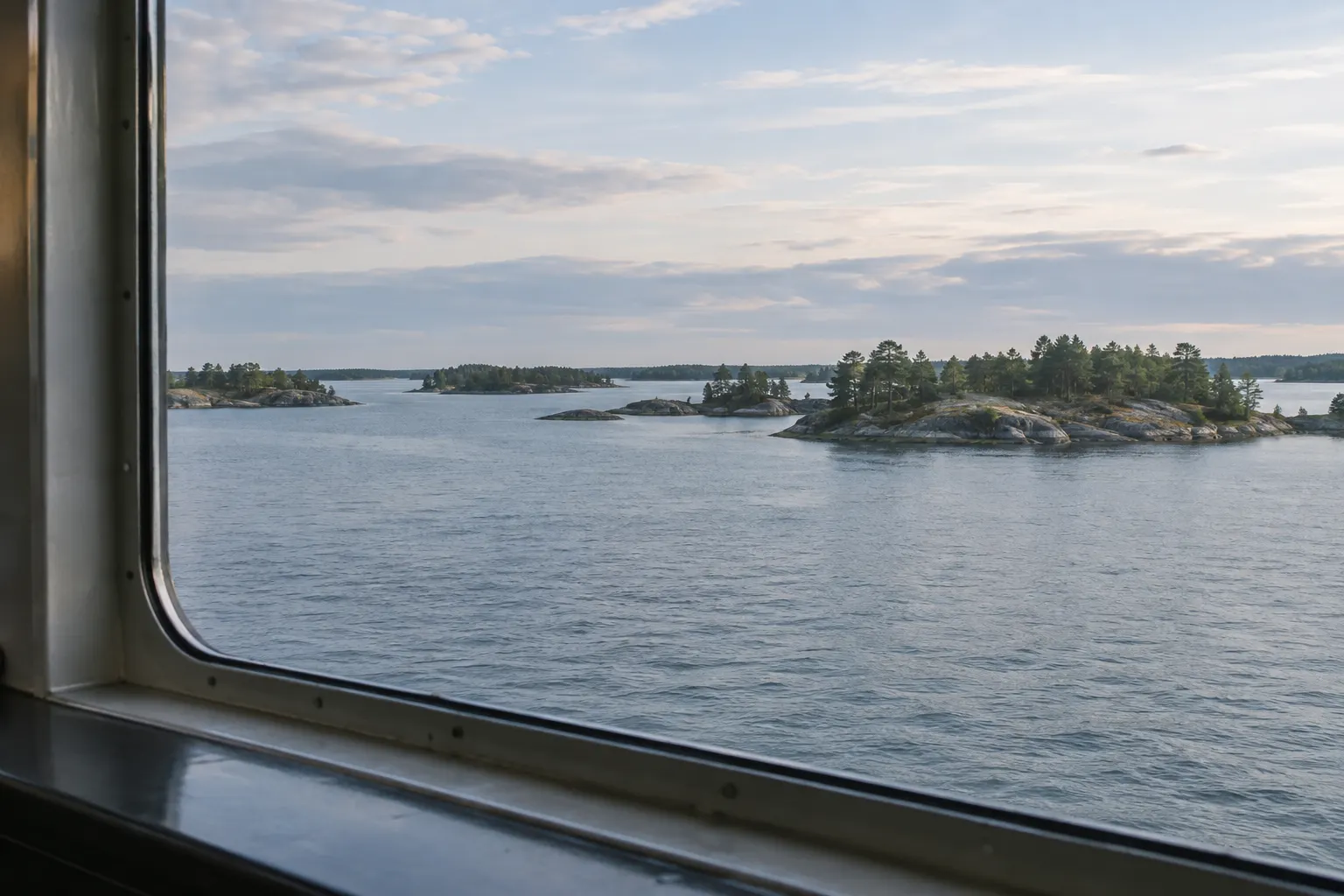
- Sail from Stockholm in the evening. The first hours run through the archipelago, which is sheltered, so you are asleep before the open water.
- Baltic chop is quick and jerky, not slow and rolling. Lying flat in a bunk works better here than trying to walk it off.
- Because there is no underlying swell, the sea drops away within hours of the wind easing. A delayed departure often means a much better crossing.
- Book an outside cabin with a window. On a 17-hour overnight crossing, a fixed reference point matters more than on a short hop.
- In deep winter the ships work through ice. That removes the waves but replaces them with a steady grinding vibration through the hull.
For the full toolkit see the seasickness guide, or what to do once it has already started. For what the trials actually say about the oldest trick on that list, see the verdict on looking at the horizon. If the rocking follows you ashore afterwards, that is land sickness, which is normal, and it passes.
Frequently asked questions
Is the Baltic Sea rough?
Less rough than the open Atlantic, but choppier than its wave heights suggest. Significant wave heights exceed a metre in the open Baltic Proper and reach only 0.6-0.8 metres in the semi-sheltered gulfs. The discomfort comes from the shape of the waves rather than their size: short, steep and close together.
Is the Stockholm to Helsinki ferry rough?
Often not, because a large part of it is sheltered. The route runs through the Stockholm archipelago and the Finnish archipelago at either end, with the open Åland Sea in the middle. The crossing takes about 17 hours including a short stop in Mariehamn, and the exposed section is only part of that.
Does the Baltic Sea have big waves?
Rarely, by ocean standards. The highest significant wave height ever measured in the Baltic was 8.2 metres, during a storm in the northern Baltic Proper in December 2004, with a highest individual wave of 14 metres. Those figures stand out precisely because conditions like that are so unusual here.
What is the Baltic Sea like in winter?
Windy early on, then icy. November to January carry most of the extreme wave events. Ice starts forming along the northern coasts in October or November, the Bay of Bothnia usually freezes in early January and the Gulf of Finland in late January, with maximum extent in February or March. Ferries keep running with icebreaker support.
Why does the Baltic feel worse than the wave height suggests?
Because the wave period is short. In the Baltic Proper periods run 4-6 seconds, dropping to 3-4 seconds nearer the coast, while ocean swell can run three or four times longer. A short period means the vessel is being moved more often, and rapid repeated motion is what most people find hardest.
Other crossings
Sources & further reading
Sea conditions described here are typical patterns drawn from published marine and operator information as of July 2026, not a forecast: conditions on any given sailing depend on the weather that day, and any month can deliver a calm crossing or a bad one. Route and operator names are trademarks of their respective owners; Dizzout is not affiliated with or endorsed by them. Seasickness sensitivity varies from person to person; this page is informational and not medical advice.