
Is the Strait of Gibraltar rough? What to expect on the crossing
It depends on the wind, and in this strait the wind is everything. The Strait of Gibraltar sits between two mountain ranges that squeeze every passing breeze into something stronger, so the crossing can be glassy one day and cancelled the next. The biggest seas come with winter Atlantic depressions, but the easterly levanter can blow hard for days in any month, including midsummer. The saving grace is that the ferry ride is short: about 1 to 2 hours.
Strait · Spain and Morocco · Reputation among passengers: mixed: commonly reported as uncomfortable in the wrong conditions.
- Low
- Moderate
- High
- Very high
Roughness summarises typical reported conditions for this crossing, not a forecast for any given sailing.
Wind funneled between two mountain ranges
Key facts
- The Strait of Gibraltar is a strait, and passenger reports place it in the moderate roughness band.
- The mechanism behind that reputation: Wind funneled between two mountain ranges.
- Conditions are reported roughest in January, February, March, November and December.
- The calmest months are usually April, May, June, July, August, September and October.
- It is also known as Estrecho de Gibraltar / Madiq Jabal Tariq.
Try Dizzout free. Put it on your phone before you go, so it is there when you need it. Drug-free, any headphones.Free · works with any headphones · no account to try
Stop seasickness. Free to try, no card needed. Or go straight to the App Store or Google Play.
Why the Strait of Gibraltar gets rough
Wind funneling. The strait is the only gap between the Atlantic and the Mediterranean, about 14 km wide at its narrowest, with the Spanish sierras on one side and the Moroccan Rif on the other. Air squeezes through the gap the way water does, so the local winds, the easterly levanter and the westerly poniente, routinely blow two or three Beaufort forces harder than the general forecast, and gusts near the Rock have been recorded at 40 to 50 knots. Under the surface, Atlantic water flows constantly eastward into the Mediterranean. When a levanter blows against that inflow and the tide, the waves stand up short and steep: classic wind-over-current chop rather than ocean swell.
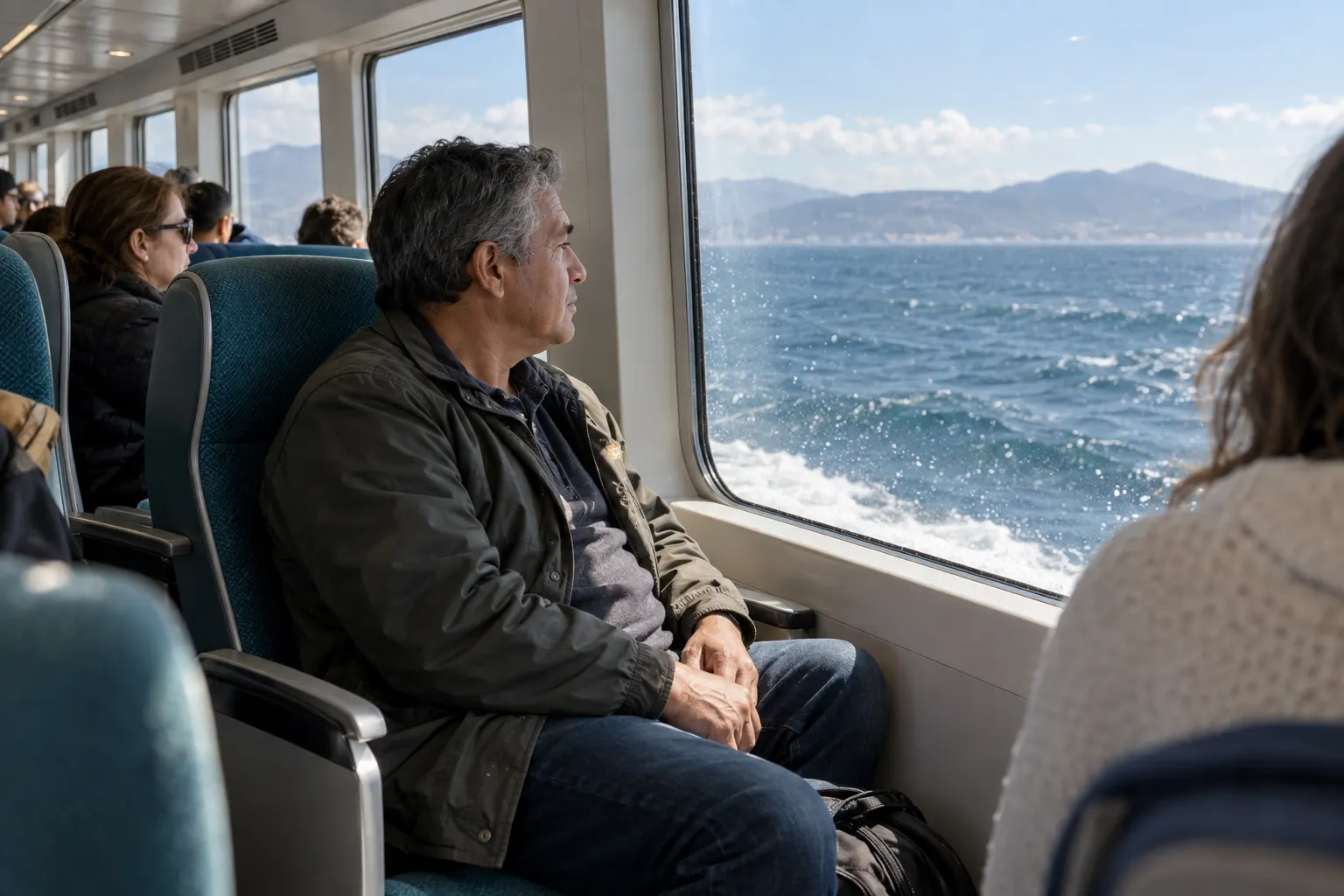
When it's worst, month by month
Winter is roughest overall: from about October to March, Atlantic depressions pass close enough to drive westerly gales and real swell in from the ocean side. The levanter is the wild card. It is most frequent from late spring to autumn, and a strong episode can bring days of steep chop and cancelled fast ferries in the middle of summer. No month is truly safe from wind here, so the forecast for your sailing matters more than the calendar.
| Jan | Feb | Mar | Apr | May | Jun | Jul | Aug | Sep | Oct | Nov | Dec |
|---|---|---|---|---|---|---|---|---|---|---|---|
| Rough | Rough | Rough | Mixed | Mixed | Mixed | Mixed | Mixed | Mixed | Mixed | Rough | Rough |
Typical seasonal pattern, not a forecast. Any month can deliver a calm crossing or a bad one. Check the marine forecast for your sailing date.
Where to be on board
Front to back
- Bow (front)Avoid
- MidshipBest
- Stern (aft)OK
The crossing: 1 to 2 hours
Roughest stretch: Mid-strait off Tarifa, where the funnel is narrowest
On a fast catamaran, sit low, central and facing forward; the bow rows slam hardest in levanter chop.
Get your read
A few quick questions about you, then your trip. Nothing is saved or sent.
Step 1: about you
How you usually react to travel is the single best signal. These come from the validated MSSQ.
Step 2: your trip
Pick the kind of trip you are planning.
Pack the kit before boarding
Prepare your phone and headphones while you have a seat in the terminal. Keep them packed during boarding, then consider Dizzout once safely seated on board.
Booked a crossing? Check it before you sail
Check your tripFree, two minutes, and it scores the trip you actually have ahead.
Free to download. Paid subscription for full access. Or go straight to the App Store or Google Play.

 Scan to open on your phone
On a computer? Dizzout installs on your phone. Scan the code, or open dizzout.com/get on your phone and it'll take you straight to the right store.
Know someone who gets motion sick?
Send them the app that helps stop it, drug-free, in about 90 seconds, works with any headphones. Free to try.
The crossings that cross it
| Route | Typical duration | What to know |
|---|---|---|
| Tarifa to Tangier Ville | about 1 hour | Fast ferries operated by Balearia and AML; the shortest route, crossing near the strait's narrowest point. |
| Algeciras to Tanger Med | about 1.5 to 2 hours | Larger ships and many more daily sailings; DFDS and Balearia both operate here. |
| Algeciras to Ceuta | about 1 hour | Stays on the Mediterranean side of the strait; often the fallback when a hard levanter disrupts Tarifa. |
What helps on this crossing
- Check the Tarifa wind forecast before you choose a sailing; the strait's own wind matters more than the general weather map.
- If a strong levanter is blowing, the bigger ships from Algeciras to Tanger Med usually ride it better than the Tarifa fast ferries.
- Sit low and central. On a one-hour catamaran crossing, seat choice does more than anything you pack.
- Morning sailings are often the gentler pick; the wind through the strait tends to build during the day.
- Keep your eyes on the horizon through the windows; the crossing is short enough that the worst rarely lasts an hour.
- Book a flexible ticket if you can: operators reshuffle sailings around wind here as a matter of routine.
For the full toolkit see the seasickness guide, or what to do once it has already started. For what the trials actually say about the oldest trick on that list, see the verdict on looking at the horizon. If the rocking follows you ashore afterwards, that is land sickness, which is normal, and it passes.
Frequently asked questions
Is the Strait of Gibraltar rough?
Often, but in a wind-driven way rather than an ocean-swell way. The strait funnels wind between the mountains of Spain and Morocco, so the local levanter and poniente blow noticeably harder than the surrounding forecast. On a windy day the crossing is short, steep chop; on a calm day it is a flat one-hour ride. The state of the wind on your sailing day is almost the whole story.
When is the Strait of Gibraltar calmest?
There is no reliably calm season, which is unusual. Winter brings the biggest seas, when Atlantic depressions add swell to the wind. Summer removes the swell but not the levanter, which can blow hard for several days at a time in July as easily as January. Your best odds are on settled days in late spring and early autumn, and the practical answer is to check the Tarifa wind forecast rather than the month.
What is the levanter wind?
The levanter is the strait's easterly wind, funneled and accelerated by the gap between the Spanish and Moroccan mountains. It can reach gale force in the narrows even when the wider region is only breezy, and it blows against the surface current flowing into the Mediterranean, which makes the waves short and steep. Strong episodes last from a day to most of a week and are the usual reason Tarifa fast-ferry sailings get cancelled.
Is Tarifa to Tangier or Algeciras to Tanger Med the calmer crossing?
Tarifa is shorter, about an hour on a fast catamaran, but it crosses the narrowest part of the funnel and the small fast ferries feel the chop most. Algeciras to Tanger Med takes about 1.5 to 2 hours on much larger ships, starts in the shelter of a bay, and keeps sailing in wind that stops the Tarifa boats. Short and sharp versus longer and steadier: in strong easterlies, the bigger ship usually wins.
How long is the ferry from Spain to Morocco?
About 1 hour from Tarifa to Tangier Ville on the fast ferries, and about 1.5 to 2 hours from Algeciras to Tanger Med. Algeciras to Ceuta, the Spanish enclave, is also about an hour. Crossings run year-round with multiple sailings a day, though strong wind episodes can delay or cancel individual departures, most often on the Tarifa route.
Other crossings
Sources & further reading
- https://skybrary.aero/articles/levant-wind
- https://blog.noforeignland.com/transiting-the-straits-of-gibraltar/
- https://www.directferries.com/tarifa_tangier_ferry.htm
- https://www.dfds.com/en/passenger-ferries/ferry-crossings/spain-and-morocco-routes
- https://www.balearia.com/en/routes-timetables/ferry-tarifa-tanger-ville
Your next question, probably
Where on the ship should you be?
Which cabins move least, and what to do if you already booked one
If that is not your question:
Sea conditions described here are typical patterns drawn from published marine and operator information as of July 2026, not a forecast: conditions on any given sailing depend on the weather that day, and any month can deliver a calm crossing or a bad one. Route and operator names are trademarks of their respective owners; Dizzout is not affiliated with or endorsed by them. Seasickness sensitivity varies from person to person; this page is informational and not medical advice.