
ScreenX and motion sickness: what it really does
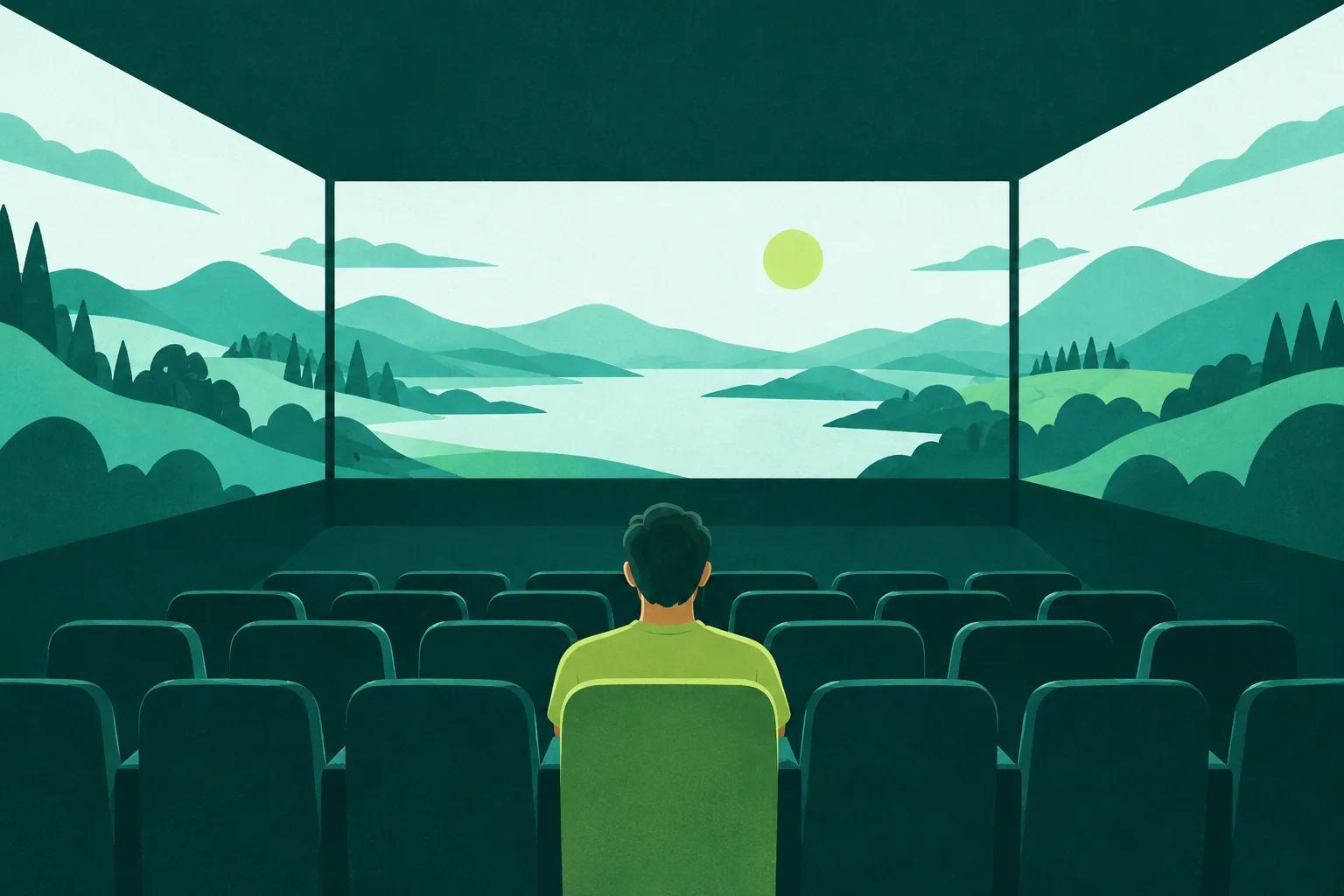
ScreenX extends the picture onto the auditorium's side walls, a 270-degree image that fills peripheral vision by design. That makes it the purest visual-only amplifier among the premium formats: no seat motion, no 3D glasses, just more of your visual field occupied by whatever moves. No operator motion sickness warning for ScreenX surfaced in our research, and this page says so plainly rather than implying one exists.
270-degree projection onto the side walls · No seat motion
Key facts
- ScreenX: 270-degree projection onto the side walls.
- ScreenX adds no seat motion; what changes is what your eyes take in.
- What helps depends on the film as much as the format; the examples below show the range.
Prone to motion sickness? Dizzout is drug-free sound therapy through any headphones, with relief in about 90 seconds.Starts in your browser · works with any headphones
Get your personalized Dizzout plan. Paid subscription for full access.

On your phone? Scan to start there.
What ScreenX actually is
Developed by CJ 4DPLEX, the company behind 4DX, ScreenX uses additional projectors to extend selected sequences onto the left and right walls, wrapping the image around 270 degrees. Industry coverage counts 370+ auditoriums across dozens of countries, with growth reported through 2025. Films are mastered specially for it, and the wrap typically activates for set pieces rather than the whole runtime.
What is actually on record
The attributable record for ScreenX and sickness is thin: no operator warning surfaced, and the discourse lives in scattered viewer discussions rather than press or policy. What is well documented is the mechanism it maximizes: motion presented in peripheral vision is the established channel for visually induced motion sickness, per the general literature cited on our screens pages.
Films to read alongside this
- F1: The Movie
What helps in ScreenX
- The side-wall image is the point and the risk: sit centrally, where the wrap is symmetrical, rather than near a wall where one side dominates your periphery.
- The wrap activates for set pieces; if a sequence starts to swim, look to the main screen center and let the walls blur.
- Fast-motion films (racing, flying) in ScreenX are the maximum visual-only dose on sale; calmer titles use the walls for vistas.
- If peripheral motion reliably gets you, the standard presentation of the same film removes the mechanism entirely.
- If you leave swimmy, settle your eyes on a still, level scene; a drug-free sound-therapy app like Dizzout is designed to help once symptoms have started.
The mechanism common to every format, and the seat advice that follows from it, is on the shaky cam and 3D movies guide.
Booking a ScreenX showing? Set up before you go
Put it on your phone before you go
Sorting this out at home beats sorting it out in the dark once the film has started. Dizzout is a drug-free app that plays precisely calibrated audio through any headphones you already own, wired or Bluetooth, with relief in about 90 seconds. Free to download.
Get your personalized Dizzout plan. Paid subscription for full access.
30,000+ travelers in 30+ countries · How we count

On your phone? Scan to start there.
Comparing apps first? See how the motion sickness apps compare
Know someone who gets motion sick?
Send them the app that helps stop it, drug-free, in about 90 seconds, works with any headphones. Free to download.
Frequently asked questions
Does ScreenX cause motion sickness?
No operator warning says so, and we found none to quote, but the format works by filling peripheral vision, which is the established trigger channel for visually induced motion sickness. In practice the outcome depends on the film: wrapped racing footage is a strong dose, wrapped landscapes are gentle. Your history with large screens is the best predictor.
Is ScreenX or 4DX worse for motion-sensitive viewers?
They differ in kind: ScreenX amplifies visual motion only, while 4DX physically moves your seat, and its operators publish suitability warnings naming motion-sick-prone viewers. Someone triggered by visual flow should be more careful with ScreenX; someone triggered by real movement, more careful with 4DX. Standard screenings avoid both mechanisms.
Sources & further reading
- https://en.wikipedia.org/wiki/ScreenX
- https://www.screendaily.com/features/how-cj-4dplex-is-transforming-the-cinema-experience-with-immersive-screenx-and-4dx-theatres/5215649.article
- https://www.prnewswire.com/news-releases/cj-4dplexs-premium-formats-outperform-market-delivering-double-digit-growth-in-2025-302688139.html
Your next question, probably
Which films are the known cases?
The honest list, film by film
Not your question? Why do moving screens get you at all?How prone are you, really?
Format mechanics and suitability guidance are drawn from the operators' own pages and the press coverage cited above, as checked in September 2026; policies and installations change, so the operator's current page is the final word. Format, venue and film names are trademarks of their respective owners; Dizzout is not affiliated with or endorsed by them. Sensitivity varies from person to person; this page is informational and not medical advice.