
IMAX and motion sickness: what it really does
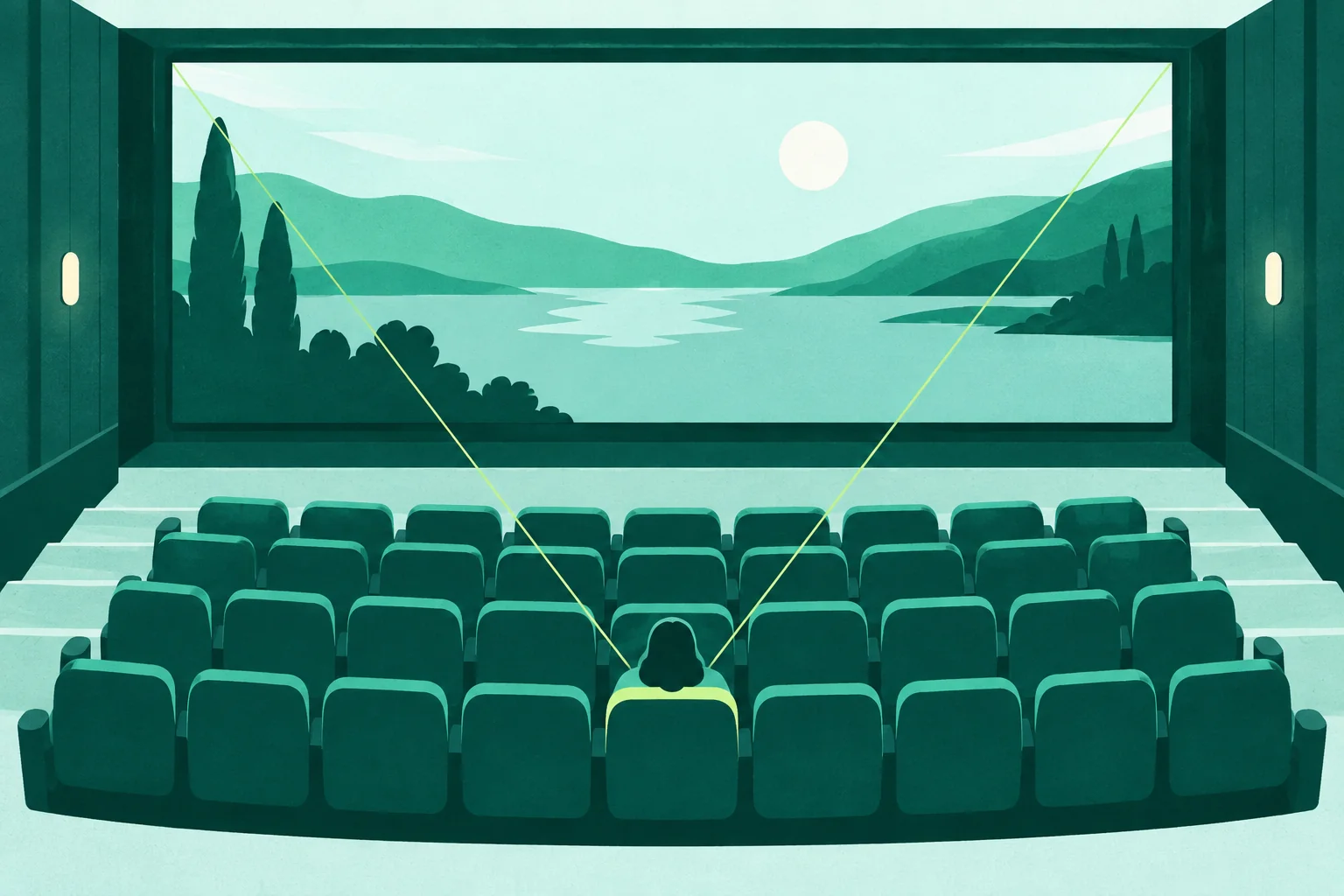
IMAX does not move your seat; it moves your eyes' whole world. The format's geometry is designed to fill your visual field, with taller aspect ratios and screens running to roughly 30 meters wide, and peripheral vision filled with motion is the classic channel for visually induced motion sickness. Whether an IMAX showing affects you depends almost entirely on what the film does with that field of view.
Screens engineered to fill your field of view · No seat motion
Key facts
- IMAX: screens engineered to fill your field of view.
- IMAX adds no seat motion; what changes is what your eyes take in.
- What helps depends on the film as much as the format; the examples below show the range.
Prone to motion sickness? Dizzout is drug-free sound therapy through any headphones, with relief in about 90 seconds.Starts in your browser · works with any headphones
Get your personalized Dizzout plan. Paid subscription for full access.

On your phone? Scan to start there.
What IMAX actually is
IMAX pairs large-format projection, 1.90:1 on digital screens and up to 1.43:1 on film, with auditorium geometry that seats you closer to a much taller screen than standard cinemas. Format explainers document screens to roughly 30 meters wide. The effect is immersion by field-of-view: the image extends toward the edges of where you can see, which is exactly where your balance system reads motion.
What is actually on record
The question has its own community record: an Ask MetaFilter thread titled How do I know IMAX won't make me sick, an AVS Forum thread asking whether IMAX makes you dizzy, and parent-forum discussions of the same. Live Science's explainer on why some movies make people hurl and the Health effects of 3D literature document the mechanism: motion in peripheral vision drives visually induced motion sickness.
Films to read alongside this
- 1917
- Interstellar
- Dunkirk
- The Odyssey
- First Man
- F1: The Movie
What helps in IMAX
- Sit farther back and center: the single biggest lever, because it shrinks how much of your peripheral vision the screen occupies. This matches our screens-cluster advice.
- Judge the film, not the format: Oppenheimer's locked cameras carry no motion case; 1917's continuous tracking and Dunkirk's cockpit rolls do.
- For IMAX 3D showings, the 3D layer adds the vergence demand; the 2D IMAX version of the same film is the gentler pick.
- Arrive early enough to choose your seat rather than taking the front section that is left.
- If a showing leaves you woozy, a still horizon and slow breathing settle it; a drug-free sound-therapy app like Dizzout is designed to help once symptoms have started.
The mechanism common to every format, and the seat advice that follows from it, is on the shaky cam and 3D movies guide.
Pack before leaving for the cinema
Keep your phone and ordinary headphones together before leaving home. Prepare Dizzout during a seated break outside the screening.
Free to download. Paid subscription for full access.
30,000+ travelers in 30+ countries · How we count

On your phone? Scan to start there.
Comparing apps first? See how the motion sickness apps compare

Know someone who gets motion sick?
Send them the app that helps stop it, drug-free, in about 90 seconds, works with any headphones. Free to download.
Frequently asked questions
Can IMAX cause motion sickness?
It can amplify it: IMAX screens are engineered to fill your field of view, and motion in peripheral vision is the classic trigger for visually induced motion sickness. The format adds no seat motion, so the outcome depends on the film: a locked-camera drama plays as still pictures at scale, while continuous-tracking or cockpit films deliver their motion into your periphery.
Where should I sit in an IMAX theater to avoid feeling sick?
Back and center. Distance shrinks the share of your visual field the screen occupies, which directly reduces the peripheral-motion signal, and a central seat keeps the image geometry symmetrical so your eyes do less compensating. The front section of an IMAX house is the maximum-dose position.
Is IMAX 3D worse than regular IMAX for motion sickness?
It stacks a second mechanism on top: the vergence-accommodation conflict of stereoscopic 3D, where your eyes converge on depths while focusing at one screen distance. A film offered in both is gentler in 2D IMAX, and gentler still on a standard screen; the choice is a dose dial, not a binary.
Sources & further reading
- https://www.engadget.com/2220571/differences-between-imax-70mm/
- https://www.livescience.com/9916-3-movies-people-hurl.html
- https://en.wikipedia.org/wiki/Health_effects_of_3D
- https://ask.metafilter.com/51846/How-do-I-know-IMAX-wont-make-me-sick
- https://www.avsforum.com/answers/does-imax-make-you-dizzy/
- https://www.dcurbanmom.com/jforum/posts/list/742241.page
Your next question, probably
Which films are the known cases?
The honest list, film by film
Not your question? Why do moving screens get you at all?How prone are you, really?
Format mechanics and suitability guidance are drawn from the operators' own pages and the press coverage cited above, as checked in September 2026; policies and installations change, so the operator's current page is the final word. Format, venue and film names are trademarks of their respective owners; Dizzout is not affiliated with or endorsed by them. Sensitivity varies from person to person; this page is informational and not medical advice.