
Dolby Cinema and motion sickness: what it really does
Dolby Cinema is the premium format with nothing to warn about on the motion front: dual laser projection and Dolby Atmos sound in a dedicated auditorium, standard screen geometry, no motion hardware. For viewers who react to moving seats or wall-filling screens, it is the honest safe pick among the premium tiers: the upgrade is picture and sound, not vestibular.
Laser projection and Atmos sound, no motion hardware · No seat motion
Key facts
- Dolby Cinema: laser projection and atmos sound, no motion hardware.
- Dolby Cinema adds no seat motion; what changes is what your eyes take in.
- What helps depends on the film as much as the format; the examples below show the range.
Prone to motion sickness? Dizzout is drug-free sound therapy through any headphones, with relief in about 90 seconds.Starts in your browser · works with any headphones
Get your personalized Dizzout plan. Paid subscription for full access.

On your phone? Scan to start there.
What Dolby Cinema actually is
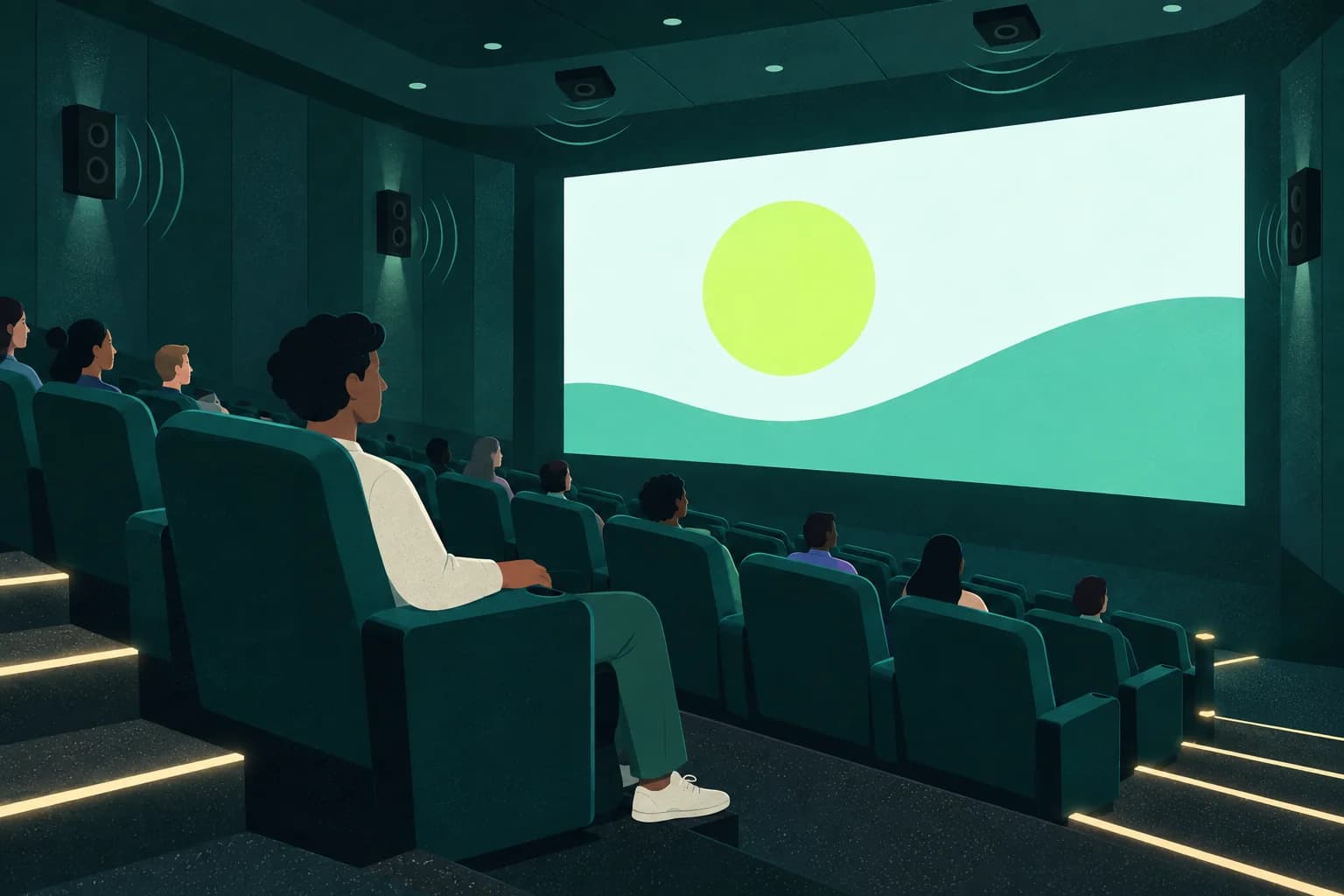
Dolby's cinema format pairs Dolby Vision dual-laser projection, high brightness and contrast on a conventionally proportioned screen, with Dolby Atmos immersive audio, in purpose-designed auditoriums. Dolby's own pages and the format documentation describe picture and sound engineering; there are no motion seats and no wall projection. The auditorium layout is a standard raked house.
What is actually on record
There is no sickness discourse to report for the format itself, which is the finding: the premium-format threads about dizziness and nausea attach to IMAX's field of view, 3D's depth demands and 4DX's motion seats, not to Dolby auditoriums. Films shown in Dolby Cinema can of course still carry their own camera-motion load; the format neither adds to it nor amplifies it beyond ordinary screen size.
Films to read alongside this
- Avatar: The Way of Water
- Avatar: Fire and Ash
- Top Gun: Maverick
- Mission: Impossible - The Final Reckoning
What helps in Dolby Cinema
- If premium formats have burned you before, this is the tier to try: the upgrades are brightness, contrast and sound.
- A film's own camera style still applies; check the film's page here for that, independent of the auditorium.
- 3D showings in Dolby Cinema still carry standard 3D considerations; the 2D sessions are the fully quiet option.
- Standard seat advice holds: center of the house for symmetric viewing.
The mechanism common to every format, and the seat advice that follows from it, is on the shaky cam and 3D movies guide.
Booking a Dolby Cinema showing? Set up before you go
Put it on your phone before you go
Sorting this out at home beats sorting it out in the dark once the film has started. Dizzout is a drug-free app that plays precisely calibrated audio through any headphones you already own, wired or Bluetooth, with relief in about 90 seconds. Free to download.
Get your personalized Dizzout plan. Paid subscription for full access.
30,000+ travelers in 30+ countries · How we count

On your phone? Scan to start there.
Comparing apps first? See how the motion sickness apps compare
Know someone who gets motion sick?
Send them the app that helps stop it, drug-free, in about 90 seconds, works with any headphones. Free to download.
Frequently asked questions
Is Dolby Cinema safe for people who get motion sick at IMAX or 4DX?
It removes both of those formats' mechanisms: no motion seats, and a conventionally proportioned screen rather than a field-of-view-filling one. The picture and sound are the premium. A motion-heavy film is still motion-heavy anywhere, but the auditorium itself adds nothing, which cannot be said of the other premium tiers.
Does Dolby Cinema's brighter laser picture affect sensitive viewers?
Brightness and contrast are image-quality upgrades, and we found no sickness discourse attached to them; no eye-strain claim about the format appears in our sources, so none is made here. Viewers sensitive to 3D specifically should simply pick the 2D sessions, which Dolby houses run in parallel.
Sources & further reading
Your next question, probably
Which films are the known cases?
The honest list, film by film
Not your question? Why do moving screens get you at all?How prone are you, really?
Format mechanics and suitability guidance are drawn from the operators' own pages and the press coverage cited above, as checked in September 2026; policies and installations change, so the operator's current page is the final word. Format, venue and film names are trademarks of their respective owners; Dizzout is not affiliated with or endorsed by them. Sensitivity varies from person to person; this page is informational and not medical advice.