
Ferry vs cruise ship: which is worse for seasickness?
They are not the same experience, and the ferry is usually the rougher one. A ferry is a working vessel on a fixed short route: it sails its schedule in almost any weather, often across shallow, wind-funnelled straits that build steep chop, and it is smaller than a modern cruise ship by an enormous margin. A cruise ship is vastly heavier, carries active stabilizers that damp rolling, and its captain can often reroute around bad weather in a way a ferry timetable never allows. Feeling wretched on a ferry crossing does not mean a cruise will treat you the same way.
A very common story: someone gets badly seasick on a ferry, concludes the sea is not for them, and writes off the cruise their family wants. The two experiences share water and not much else. Ferries and cruise ships differ in size, hull design, stabilization, routing freedom and the seas they typically cross, and every one of those differences leans the same direction.
This page lays out why the ferry is usually the harsher ride, where the exceptions live, and what your ferry track record actually predicts about a week on a cruise ship.
Whichever option you pick, Dizzout is a drug-free backup for the moment nausea starts: precisely calibrated sound on any headphones, free to try on iOS and Android.
Free to try, no card needed. Or go straight to the App Store or Google Play.
Ferry vs cruise ship for a seasickness-prone traveller
| Factor | Ferry | Cruise ship |
|---|---|---|
| Size and mass | Small to mid-size working vessel | Among the largest passenger ships afloat |
| Stabilizers | Limited or none on many routes | Active fin stabilizers standard |
| Typical waters | Shallow straits and channels, steep chop | Chosen itineraries, weather routing |
| Sails in rough weather? | Usually yes, schedule first | Often reroutes around it |
| Your options on board | Lounge seat, maybe a deck | Cabin to lie down, low decks, outside air |
| Exposure pattern | Short but intense when rough | Long but mostly mild, broken by port days |
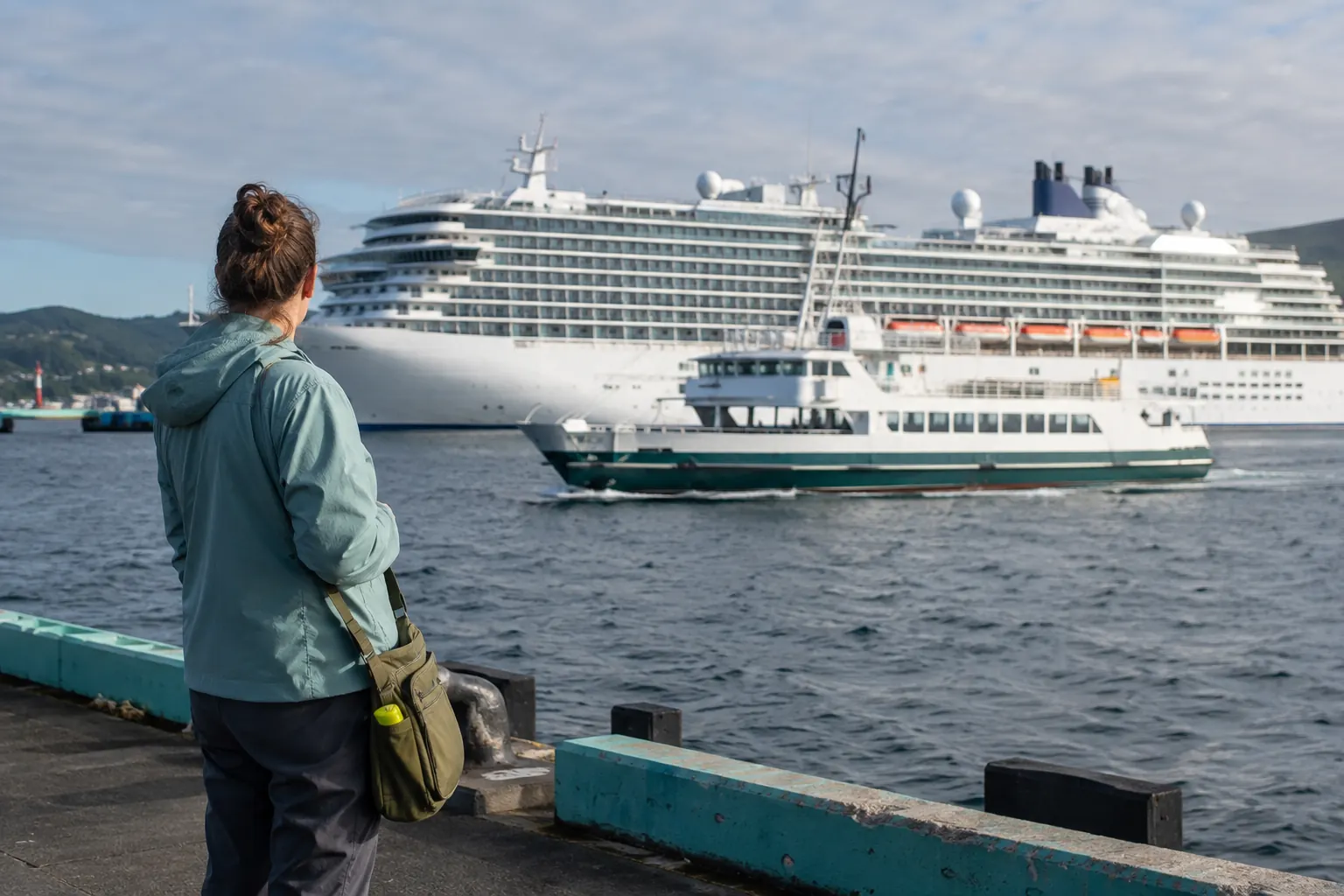
Size, mass and stabilizers
A large modern cruise ship displaces many times what a typical ferry does, and sheer mass is the first line of defence against wave motion: the heavier the ship relative to the waves, the less each wave moves it. On top of that, cruise ships carry active fin stabilizers, retractable underwater wings that push against rolling as it starts. The result on most sailings is motion you notice mainly as a slow, gentle sway, if at all.
Ferries are built to load fast, cross fast and turn around fast. Many are excellent ships, but they are lighter, sit shallower, and prioritise schedule over serenity. The same sea state that a cruise ship shrugs off is an active experience on a ferry deck.
Where and how each one sails
Ferries run fixed short routes, and many of the famous ones cross exactly the waters that generate steep chop: shallow straits and channels where wind builds short waves quickly. They sail in nearly all weather because the timetable is the product; cancellations happen, but a lively crossing is just Tuesday. Passengers are aboard for one to a few hours, usually seated in lounges without a horizon view.
Cruise ships choose their water. Itineraries favour seasons and seas that sell well, captains get weather routing and can put extra miles between the ship and a storm, and port days break up exposure. None of that makes a cruise motion-proof: open-ocean crossings and bad-luck weather exist, and a big ship in a real storm moves. But across a typical week, the hours of provocative motion on a cruise are a fraction of what a rough ferry crossing delivers in ninety minutes.
What your ferry experience predicts
If ferries reliably make you sick, you are motion-susceptible at sea, and that information transfers. What does not transfer is the intensity: most ferry-sick travellers report a cruise as a far milder experience, and many feel nothing at all for days at a time. The sensible move is not to pretend you are immune but to plan the cruise like a susceptible person: pick a calmer itinerary and season, and go in with remedies you already know work for you.
Choosing the ship and cabin wisely helps too, and that is its own topic: our guide to choosing a cruise when you get seasick covers itineraries, ships and cabin position properly, and the cruise cabin picker tool narrows it to a deck and zone.
When to use which
Use ferries the way you would use any short sharp exposure: check the wind forecast, prefer the larger conventional vessel where routes offer a choice, and keep your eyes on the horizon rather than the lounge. Consider a cruise even if ferries have burned you, but plan it as a susceptible traveller: calmer seasons and itineraries, a sensible cabin, and remedies aboard from day one rather than sourced in a panic at sea. If you are weighing a specific crossing, our sea-by-sea guides tell you what that stretch of water is actually like through the year.
Try drug-free motion sickness relief
Try Dizzout Free
Free to try on iOS and Android · ~90 seconds · works on any headphones.
Frequently asked questions
I get seasick on ferries. Will a cruise be just as bad?
Usually not. Cruise ships are enormously heavier, carry active stabilizers, and often route around weather that a ferry would plough straight through, so the motion aboard is milder most of the time. Your ferry experience does mean you should plan like a susceptible traveller: calmer itinerary, sensible cabin, remedies with you. But writing off cruising because a ferry crossing went badly is the most common over-correction in seasickness, and it is rarely justified.
Why do ferries feel so much rougher than big ships?
Three stacked reasons. Ferries are far lighter, so the same waves move them more. They often cross shallow, wind-funnelled water that builds short, steep chop, the wave shape inner ears hate. And they sail on schedule in weather a cruise line would route around, because the timetable is the product. Add lounges with no horizon view and you get a concentrated dose of everything that causes seasickness in ninety minutes.
Can a cruise ship still get rough?
Yes. Open-ocean crossings, certain seas in certain seasons, and plain bad luck can put real motion into any ship, stabilizers or not. The difference is frequency and intensity: across a typical cruise the rough hours are few, and you have a cabin to lie down in, which health guidance lists among the most effective positions when motion hits. Picking the itinerary and season with care is the biggest lever, and our cruise planning guide covers it.
A ferry is a short, honest dose of the sea; a cruise ship is engineered to hide the sea from you. If the ferry has your number, board it with a plan and a horizon. And do not let it cancel the cruise: on the water, size and stabilizers change the story more than most stomachs expect.
Related comparisons
- Choosing a cruise when you get seasick
- How rough is that sea? Crossing-by-crossing guides
- River cruise vs ocean cruise
- How to stop seasickness mid-cruise
- All motion sickness comparisons
This page is general travel information, not medical advice; reactions to sea motion vary by person, ship and day. Ship specifications, routes and conditions vary and change, so check operators for anything you are booking around.