
River cruise vs ocean cruise: which is gentler?
This is the most lopsided comparison in cruising: river cruises are about as close to motion-free as travel on water gets. Rivers have no swell and no fetch for waves to build, the ship is never out of sight of land, and most of what you feel is engine hum and the occasional nudge entering a lock. Ocean cruises are usually comfortable too, thanks to size and stabilizers, but they cross real seas that can move a ship for hours or days. If motion sickness has kept you off cruises entirely, a river itinerary is the version built for you.
People who get seasick tend to lump all cruising together and decline the lot. That throws away the one format practically designed around their problem. A river ship on the Danube, Rhine or Douro spends its whole itinerary on flat, protected water where waves have no room to form, docking in town centres most days. The classic seasickness scenario, hours of rolling swell far from land, simply does not exist on the route.
Ocean cruising has its own answers to motion, and modern ships are impressively steady. But the honest comparison is not close, and knowing why helps you pick the right trip rather than avoiding both.
Whichever option you pick, Dizzout is a drug-free backup for the moment nausea starts: precisely calibrated sound on any headphones, free to try on iOS and Android.
Free to try, no card needed. Or go straight to the App Store or Google Play.
River cruise vs ocean cruise for motion-sensitive travellers
| Factor | River cruise | Ocean cruise |
|---|---|---|
| Waves and swell | None to ripples; no fetch to build waves | Real seas possible, route dependent |
| Typical felt motion | Engine hum, lock bumps, gentle turns | Mostly mild sway; rolling in weather |
| Distance from land | Metres; docks in town centres | Can be days from port |
| Weather effect on comfort | Minimal | The main variable |
| Ship size and facilities | Small, quiet, scenery-first | Resort scale, entertainment, sea days |
| Fit for the highly susceptible | The safest cruising format | Doable with planning |
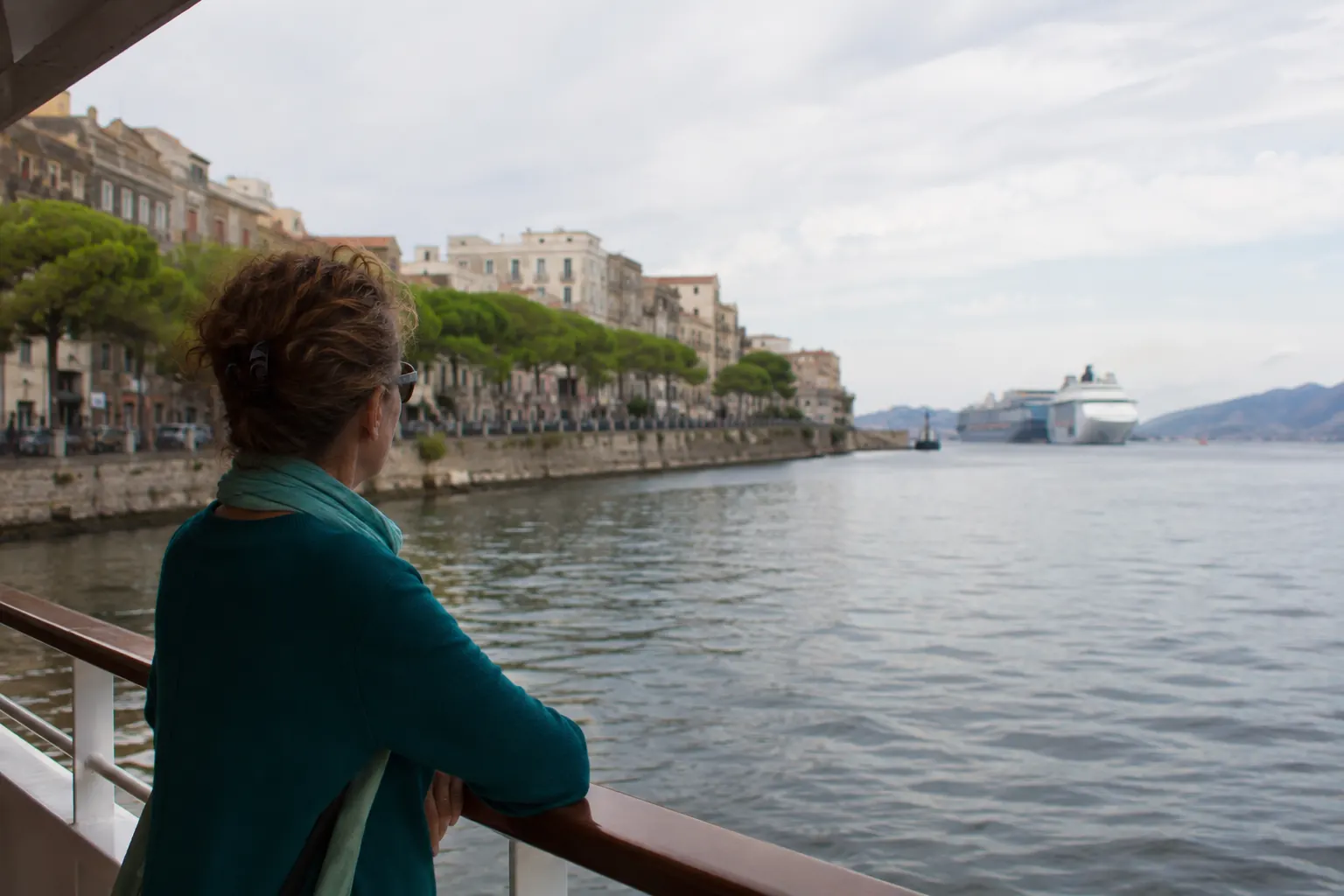
Why rivers barely move a ship
Ocean waves are built by wind blowing across open distance, what sailors call fetch. A river offers wind a few hundred metres at most, so the surface never develops more than ripples and small chop. There is no swell arriving from storms a thousand miles away, no crossing of exposed headlands, no deep-water rollers. The motion that remains is the ship's own: engine vibration, gentle turns following the channel, a bump and squeeze through locks, and the odd wake from passing barges.
For an inner ear, that profile is unremarkable in the best way. Symptoms need sustained, repetitive motion to build, and a river never supplies it. Even travellers with strong susceptibility routinely report river cruises as a non-event, which is exactly what you want a holiday to be.
What an ocean cruise asks of you
A modern ocean ship is a formidable piece of stabilisation engineering, and most hours of most itineraries feel nearly still. But the sea keeps veto power. Open-water days, exposed crossings and weather systems can put genuine rolling and pitching into the ship, sometimes for a day or more, and there is no pulling over. Susceptible cruisers manage this well with itinerary choice, cabin position and remedies, and our cruise planning guide covers those levers.
The point is not that ocean cruising is risky; it is that it carries a nonzero motion budget that varies with route and season. A river itinerary's motion budget is close to zero every day, and the difference is structural, not luck.
The trade-offs beyond motion
River and ocean cruises are different holidays, not just different water. River ships are small, typically well under two hundred passengers, with a handful of lounges rather than a resort deck; days are port-heavy and scenery-driven, and there are no sea days. Ocean ships offer scale: entertainment, pools, multiple restaurants, and routes a river cannot reach. Prices per night often run higher on rivers.
One caveat worth knowing: a few itineraries badge coastal or estuary sailing as river cruising, and wide tidal stretches near a river mouth can pick up real chop on windy days. If motion is your deciding factor, read the route map, not just the brochure category, and check where the ship actually sails.
When to use which
Book the river cruise when motion sickness has previously ruined or vetoed sea travel, when you want a first cruise with essentially no motion gamble, or when the itinerary you love happens to run through Europe's rivers anyway. Book the ocean cruise when the destination demands it or the resort experience is the point, and manage it like a susceptible traveller: calmer season and route, a sensible cabin, remedies packed. If you are between the two, weigh how much a bad sea day would cost you: for most queasy travellers the river's near-zero motion budget is worth more than the bigger ship's bigger everything.
Try drug-free motion sickness relief
Try Dizzout Free
Free to try on iOS and Android · ~90 seconds · works on any headphones.
Frequently asked questions
Can you get seasick on a river cruise at all?
It is rare. Rivers cannot build meaningful waves, so the classic trigger, sustained rolling motion, is missing. A small number of people notice the engine vibration or the visual oddity of a slowly turning shoreline, and wide tidal stretches near river mouths can add chop on windy days. But river cruising is widely regarded as the gentlest way to travel on water, and operators themselves report motion sickness as a non-issue for the vast majority of guests.
Are river cruise ships stabilized like ocean ships?
They generally do not need to be. Stabilizers exist to counter rolling caused by waves and swell, and rivers do not produce them. River ships are long, shallow-draft vessels designed for locks and bridges, and their stability challenge is navigation, not passenger comfort. The absence of stabilizers is a clue to the whole comparison: the water they sail simply does not move ships the way the sea does.
I still felt rocking after my cruise ended. Is that the same problem?
That aftereffect, feeling like you are still swaying on solid ground after a boat trip, is a related but distinct phenomenon often called land sickness, and it can follow ocean sailing in particular. It usually fades within hours to days. If you have had it before, a river cruise gives it much less to work with, since the motion aboard is minimal. Our land sickness guide covers what it is and when it warrants a doctor.
If the sea has veto power over your holidays, take the vote away from it: the rivers of Europe move ships less in a week than some straits manage in an hour. Save the ocean for when the route earns it, plan that one properly, and enjoy the fact that cruising has a version with the motion dialled almost to zero.
Related comparisons
- Ferry vs cruise ship for seasickness
- Choosing a cruise when you get seasick
- Land sickness: the rocking after the boat
- Cruise cabin picker tool
- All motion sickness comparisons
This page is general travel information, not medical advice; reactions to motion vary by person and itinerary. Routes and ship details vary by operator and change, so verify where a specific itinerary sails before booking around motion concerns.