The short answer
Yes. A stopped boat is not a still boat. At anchor or alongside it lies where the wind and current put it, often side on to a swell it would have steered around under way, so what is left is a slow roll that repeats the same lean with no forward motion to steady it. Your inner ear feels that movement while your eyes see a fixed dock or shoreline. The gap between those two reports is what makes you sick.
People brace for the crossing. Then the engines go quiet, the anchor goes down for lunch or for fishing, and somebody on board goes grey. The run out was fine. The stop did it.
Here is why a stopped boat moves, which hulls settle best, and what to ask before you book.
Seasick on the water? Something for the hours you cannot get off the boat. Drug-free, relief in about 90 seconds, works with any headphones.Starts in your browser · works with any headphones
Stop seasickness on the water. Get your personalized Dizzout plan. Paid subscription for full access.

On your phone? Scan to start there.
A stopped boat is not a still boat
The boat stops. The water does not. The National Weather Service defines swell as wind-generated waves that have travelled out of the area where the wind made them, with smoother, more regular crests and a longer period than wind waves. That is why a bay can look glassy and still be working underneath. It defines wave period as the time in seconds between consecutive crests passing a fixed point. A boat at anchor is close to being that fixed point.
The CDC's Yellow Book describes motion sickness as a mismatch between incoming balance, visual and body-position signals and the pattern your brain expected. Stopping sharpens that mismatch. Your eyes lock onto a dock that is plainly going nowhere while your inner ear reports a floor that is moving. That is ordinary nausea on a boat, and it needs no journey to arrive.
Why at anchor is often worse than under way
Under way, four things quietly protect you. Stopping removes all four.
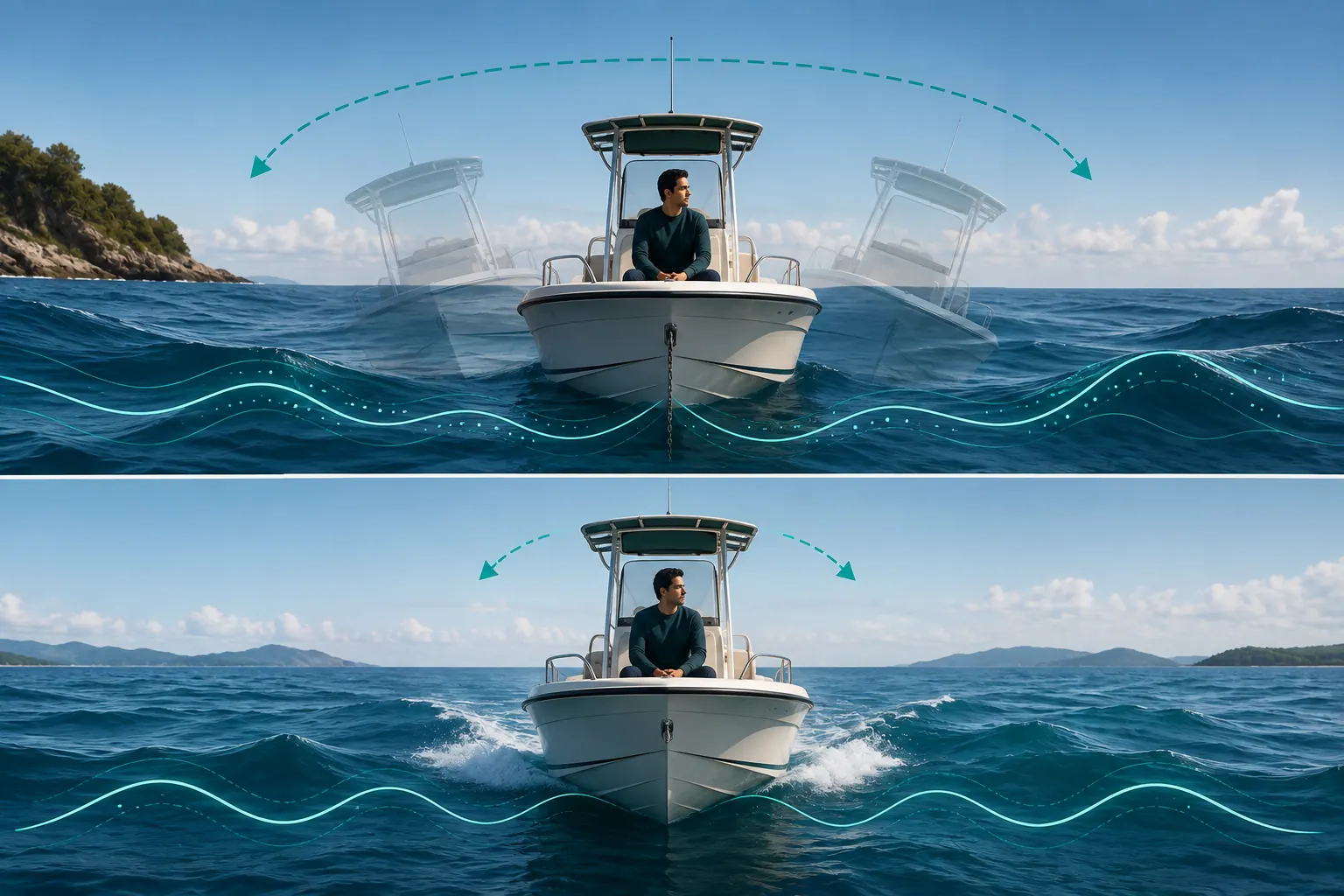
- You lose the choice of angle. Under way a skipper picks a heading against the sea and softens a bad one by altering course. At anchor the boat lies to the wind and takes whatever swell arrives.
- The motion stops being predictable. Under way the hull meets the waves in a rhythm you learn without noticing. At anchor the boat wanders across her chain, so the roll keeps no schedule.
- Slow, repeated motion is the provoking kind. A 2001 study in Aviation, Space, and Environmental Medicine put twelve volunteers selected for high susceptibility through horizontal back-and-forth motion at three speeds. The middle speed, about one cycle every five seconds, brought all twelve to moderate nausea, and the average time on the motion was 11.2 minutes, against 18.0 and 20.2 minutes at the slower and faster settings.
- Everyone stops looking out. Anchoring is when the tackle, the lunch and the phones come out, and the horizon is the steadiest reference a boat has.
Beam on to the swell: the position that does it
Beam on means the swell arrives on the side of the boat rather than the bow. What it produces is roll, and roll keeps setting itself up again: the boat leans, recovers, and the next crest leans it back.
Wind and swell often disagree. Your anchor holds the bow to the wind while the swell runs in from weather far over the horizon, which is how a bay that looks calm from the beach produces a boat that will not stop rocking.
Alongside and in port: surge, wash and swell that works into a berth
Tying up feels like the end of the motion. It is not.
- Surge. Swell bends around breakwaters into harbours, and the boat works forward and back against her lines. A harbour wall stops waves, not everything.
- Wash. Every ferry, workboat and tender that passes sends its wake down the berths.
- Wind. A boat against her fenders lifts and knocks with each gust.
Alongside is where the conflict is widest: a pontoon, a wall and parked cars all insisting the world is bolted down, while your balance organs report a shifting deck. People who were fine at sea can come apart at the dock.
Hull shape when you are not moving
The hull that felt best on the way out is often the worst to sit in once it stops. A deep-V cuts chop at speed by giving the water a narrow, angled hull to push against. The deeper that deadrise, the narrower the shape the boat sits on once the speed is gone, and the more easily it rolls.
Width resists roll. Two hulls set well apart, twin catamaran hulls or a pair of pontoon tubes, give the sea a wider base to lift, so the boat swings through a smaller angle in the same swell. Three limits:
- Wider is not still. A catamaran anchored in beam swell still rocks, through a smaller angle than a monohull.
- The motion changes character, not only size. A wide platform moves quicker and flatter than a monohull's long roll, and some people find that harder.
- No hull decides how one person will feel. Geometry changes the input. That is all it does.
Sailing boats run their own version: loaded sails damp the roll and the heel is a steady angle rather than a swing, so a sailing monohull is often steadier moving than parked.
Day boats and fishing charters: the anchored hours are the risk
A deep-sea fishing charter is the hardest case in the boats guide: half an hour offshore, then the whole day over structure, anchored or drifting, eyes down on bait and reels with the dock too far to quit. Dive boats have the same shape.
If the sickness starts at anchor, getting under way again is the usual fix on the water. No controlled study has compared anchored against under way, so read that as practical advice rather than a measured result. Either way, say something early. The boat can only act on what it hears.
What to ask the skipper before you book
Most people asking this are asking for somebody else, which makes it a booking decision. A phone call answers more of it than any review.
- How much of the trip is spent stopped, and how long is the longest stop? A half day with one hour at anchor is a different day from a full day with six.
- Will you angle the boat to the swell if it gets rolly? A yes here matters more than the size of the boat.
- Where can a passenger stand with a clear horizon, out of the exhaust? Midships and on deck is the answer you want.
- Can we come back early? On a shared charter the answer is often no, worth knowing before you pay.
- Is there a calmer version of the same trip? A wider platform, a shorter day, a sheltered anchorage. If the person has never tested this, the motion sickness test gives you a susceptibility band to plan around.
What to do when it starts and you cannot leave
What separates a stopped boat from a car is that leaving is not an option. The rest of the playbook is in how to not get sick on a boat.
- Get on deck and find the horizon. The CDC's Yellow Book lists a visual horizon reference among the countermeasures that work, and notes it is often impossible below deck. Look at the line where sea meets sky, not the water alongside.
- Move to the middle. The centre swings through the smallest arc. The same guidance says to avoid the bow of a ship, which swings through the largest.
- Put the close work down. Bait, phone, camera, book. That is what turned the stop into the problem.
- Ask to move, or to get under way. If the roll at anchor is doing it, the boat can often do something about it.
- Take medication before, not after. MedlinePlus says to take the first dose of dimenhydrinate 30 minutes to an hour before you travel or the motion starts, and drowsiness is on the label. Check with your doctor or pharmacist first.
- Carry something drug-free for the hours you cannot leave. Sound therapy through the headphones already in your bag is one option, built for relief in about 90 seconds. You can use it with your eyes shut, which is the state you want when there is no horizon worth looking at.
Do
- Move to the middle of the boat and stay on deck
- Fix your eyes on the far horizon, not the nearby water
- Ask the crew to angle the boat to the swell or get under way
- Say something at the first queasy sign, not at hour three
Don't
- Go below to lie down where there is nothing to look at
- Keep your eyes on bait, a phone or a camera
- Sit at the bow, which swings through the widest arc
- Take a first dose of a travel medicine after nausea has set in
Practical strategies, not measured effects. Which ones help most is personal.
The stop is what catches the people who were fine on the way out. Ask how long the stops are. Pick the wider platform. Keep everyone on deck. Dizziness that turns up with no boat involved, or that comes with hearing changes, is a doctor's question.
For the hours you cannot get off the boat
Stop the nausea
At anchor there is often no horizon worth looking at and no way back to the dock. Dizzout plays precisely calibrated audio through any headphones, one option among several, built for relief in about 90 seconds. Drug-free, no drowsiness, iOS and Android. Free to download.
Get your personalized Dizzout plan. Paid subscription for full access.
30,000+ travelers in 30+ countries · How we count

On your phone? Scan to start there.
Comparing apps first? See how the motion sickness apps compare
Not travelling yet? Remind me the day before my trip
Frequently asked questions
Why do I get seasick when the boat is anchored?
Because anchoring removes the things that were steadying you. Under way the skipper picks an angle against the sea and the motion falls into a rhythm you learn without noticing. At anchor the boat lies to the wind and current, takes swell from whatever direction it arrives, and rolls side to side in a slow repeating swing. Anchoring is also when people put their eyes down on fishing tackle, gear or a phone, which removes the horizon at the worst possible moment.
Can you get seasick in port?
Yes, and for some people the berth is the worst part of the day. Swell bends around breakwaters into harbours, passing boats send wash down the row, and wind knocks a moored boat against its fenders. On top of that, the view alongside is a dock, a wall and parked cars, all of it insisting the world is fixed while your inner ear reports a shifting deck. That is the sensory mismatch at its widest.
Which boats are most stable at anchor?
Width is what resists roll when the boat has stopped. Two hulls or two pontoon tubes set well apart give the sea a wider base to lift, so the boat swings through a smaller angle than a narrow single hull in the same swell. A deep-V hull that cuts chop beautifully at speed tends to rock more once it stops, because the deeper the deadrise, the narrower the shape it sits on at rest. No hull shape settles the question for one particular person, though: it changes the input, not the passenger.
Is a catamaran better at anchor?
Generally it moves through a smaller angle than a monohull in the same conditions, which is the point of the hull form. It is not immune. Anchored in beam swell a catamaran still rocks, and its motion is quicker and flatter than a monohull's long roll, which some passengers find harder rather than easier.
Why is fishing at anchor worse than the ride out?
Because the ride out is short, steady and interesting, and the fishing is long, rolly and eyes-down. Once the boat stops over structure it tends to lie across the swell and roll, and the fishing itself keeps your gaze on bait, rigs and reels for minutes at a time, which is exactly when the horizon would help most. If somebody is struggling at anchor, getting under way again is the usual suggestion on the water, though no controlled study has compared the two.
Does a boat have to be moving to make you seasick?
No. It only has to be moving relative to what your eyes are telling you, and a boat at anchor or alongside is still lifting, rolling and surging with the water under it. In some ways being stopped makes it worse, because there is usually a dock, a shoreline or a nearby boat in view, and a fixed reference sharpens the conflict rather than settling it.
Someone you know gets motion sick?
Send them this guide. It might be the trip it saves.
Your next question, probably
Which boat are you actually getting on?
Thirteen boat types, ranked by how they move
Not your question? Shopping for a steadier hull?What should you pack for a day on the water?Is your sea a rough one this month?Want something on your phone before you go?
About this article
- NOAA National Weather Service: marine definitions (swell, wave period)
- CDC Yellow Book: Motion Sickness (sensory mismatch, horizon reference, avoiding the bow)
- Golding JF, Mueller AG, Gresty MA. Aviat Space Environ Med 2001;72(3):188-92. Twelve susceptible subjects, horizontal oscillation at three speeds
- MedlinePlus: Dimenhydrinate (dosing before travel, drowsiness)
This article is informational and not a substitute for medical advice. Talk to your doctor or pharmacist before taking any medication for motion sickness, and see a doctor if dizziness or a spinning feeling happens away from boats or comes with hearing changes. Brand names are trademarks of their respective owners.