
Nausea on a Boat: Calm Your Stomach on the Water
Boat nausea builds differently from car sickness: instead of sharp turns, it's the slow, continuous roll and pitch that your inner ear feels relentlessly, often while your eyes see a deck that appears still. Small boats hit hardest because they react to every wave. The playbook: get your eyes on the horizon, stay low and central, and act at the first queasy wave, because seasickness escalates quickly once it starts.
Try Dizzout free. Drug-free calibrated sound through any headphones, designed to help once symptoms have started.Free · works with any headphones · no account to try
Free to try, no card needed. Or go straight to the App Store or Google Play.
Why this happens on a boat
On the water there's no escaping the motion: you can't pull over. That makes timing everything. The rolling is also lower-frequency than road vibration, which is precisely the kind of motion the human vestibular system tolerates worst. Below deck is the danger zone: your body feels everything while your eyes see a stable cabin.
What to do right now
- 1
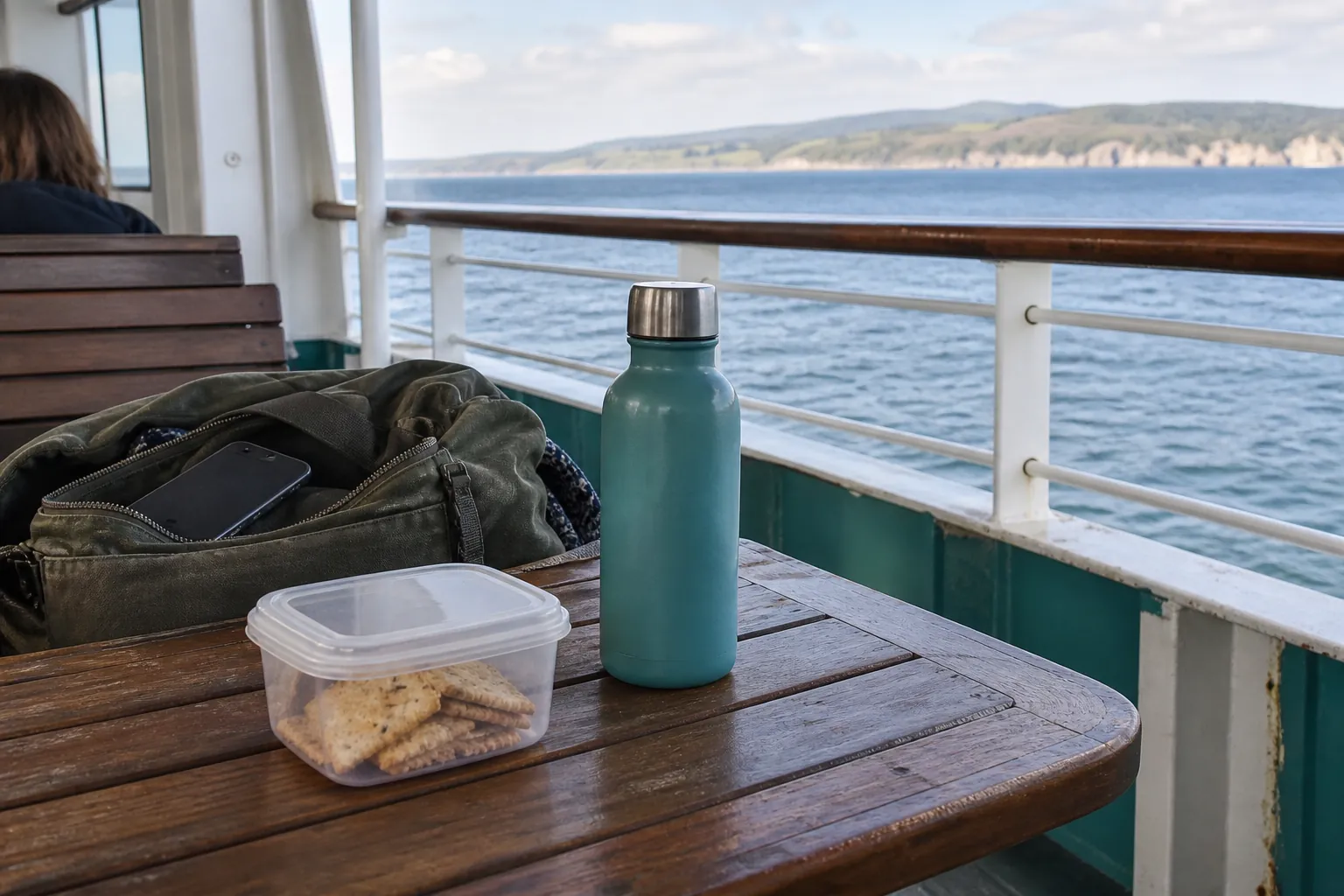
Get up on deck into fresh air and fix your eyes on the horizon, the one thing that stays level.
- 2
Move toward the middle of the boat, low down, where pitching is smallest.
- 3
Brace your head against something stable to cut extra movement.
- 4
Play a Dizzout session through any headphones; most users feel the wave ease in about 90 seconds.
- 5
Sip water slowly: avoid alcohol entirely until you're back on land.
Already feeling it?
Open Dizzout, plug in any headphones, tap play. Drug-free, no drowsiness. Most users feel relief in about 90 seconds.
Heading out on the water? Check the trip first
Check your tripFree, two minutes, and it scores the trip you actually have ahead.
Stop the nausea now
Free to try, no card needed. Or go straight to the App Store or Google Play.
 Scan to open on your phone
On a computer? Dizzout installs on your phone. Scan the code, or open dizzout.com/get on your phone and it'll take you straight to the right store.
Preventing it next time
- Eat a light, plain meal before boarding: toast, crackers, or a banana beat a greasy breakfast.
- Use Dizzout's Pre-Conditioning Mode for about 90 seconds before you leave the dock.
- Take the helm if you can: people who steer rarely get sick because they anticipate the motion.
- Avoid going below deck or staring at a phone or fish finder for long stretches.
When to see a doctor
Most boat nausea resolves within an hour of reaching steady ground. If you still feel rocking, nausea, or imbalance days after the trip, that may be mal de débarquement syndrome, uncommon but real, and worth discussing with a doctor, especially after long voyages.
Common questions
Why do small boats make me more nauseous than big ships?
Small boats respond to every single wave, so the motion is faster, sharper, and less predictable. Large ships ride over swells slowly and have stabilizers, which is why a cruise liner can feel almost still while a fishing boat in the same water has you green in minutes.
What should I do the moment boat nausea starts?
Move to fresh air, lock your eyes on the horizon, and start a sound-therapy session through headphones. On a boat, speed matters: seasickness compounds quickly, and acting in the first minute or two is far more effective than fighting it at full strength.
Does being in the cabin make seasickness worse?
Almost always. In a cabin your inner ear feels the full roll of the boat while your eyes see a room that looks stationary, the exact conflict that drives nausea. Topside with a horizon view is the better place to recover.
Related guides
Medically informational; not a substitute for a doctor's advice. Persistent or unusual symptoms deserve a clinical evaluation.