
Is the Cook Strait rough? What to expect on the crossing
Yes, Cook Strait is commonly reported as rough, and its reputation is really about how fast it changes. The ferry operator itself describes it as one of the most changeable stretches of water in the world, able to go from light swell to rough in a matter of hours. Most of the sailing is sheltered, though. Only the middle stretch is genuinely exposed.
Crossing the Cook Strait this week? Dizzout is drug-free sound therapy you can start in your seat on the crossing, with relief in about 90 seconds.Starts in your browser · works with any headphones
Stop seasickness. Get your personalized Dizzout plan. Paid subscription for full access.

On your phone? Scan to start there.
Strait · New Zealand · Reputation among passengers: has a long-standing reputation for rough passages.
- Low
- Moderate
- High
- Very high
Roughness summarises typical reported conditions for this crossing, not a forecast for any given sailing.
Wind against a 5-knot tidal stream
In the Nausea Index table of the 121 sea crossings we cover, the Cook Strait is rated rough, one of 34 in that band, with 6 rated higher. Full table: the roughest sea crossings, ranked.
Key facts
- The Cook Strait is a strait, and passenger reports place it in the high roughness band.
- The mechanism behind that reputation: Wind against a 5-knot tidal stream.
- Conditions are reported roughest in October and November.
- The calmest months are usually January, February, March and December.
- It is also known as Te Moana-o-Raukawa.
Why is the Cook Strait so rough?
New Zealand sits across the Roaring Forties, and the strait narrows to 22 km between two mountainous islands, so westerly wind is squeezed and accelerated through the gap. The tides make it worse. High water on the Pacific side arrives about five hours before high water on the Tasman side, and that difference drives tidal streams of up to about 5 knots across the strait, and as much as 7 knots off headlands such as Cape Terawhiti and Karori Rock, which the ferries pass. When strong wind runs against that stream over an uneven seabed averaging 128 m deep, the swell stands up short and steep.
When is the Cook Strait roughest?
Spring, roughly September to November, is the windiest time around Wellington, and winter brings deep southerly lows across the lower North Island. Those systems are the main cause of rough sailings and cancellations. Midsummer is usually the settled part of the year, but no month is reliably calm here, because a front can change the strait inside a day.
| Roughest water in Jan | Roughest water in Feb | Roughest water in Mar | Roughest water in Apr | Roughest water in May | Roughest water in Jun | Roughest water in Jul | Roughest water in Aug | Roughest water in Sep | Roughest water in Oct | Roughest water in Nov | Roughest water in Dec |
|---|---|---|---|---|---|---|---|---|---|---|---|
| Mixed | Mixed | Mixed | Rough | Rough | Rough | Rough | Rough | Rough | Roughest | Roughest | Mixed |
Typical seasonal pattern, not a forecast. Any month can deliver a calm crossing or a bad one. Check the marine forecast for your sailing date. Select a month to see every sea and ferry crossing ranked for it.
Where to be on board
Front to back
- Bow (front)Avoid
- MidshipBest
- Stern (aft)OK
The crossing: About 3.5 hours
Roughest stretch: The open strait in the middle, about 75 minutes
Stay on a low deck near the middle of the ship; the upper decks exaggerate the roll.
Get your read
A few quick questions about you, then your trip. Nothing is saved or sent.
Step 1: about you
How you usually react to travel is the single best signal. These come from the validated MSSQ.
Step 2: your trip
Pick the kind of trip you are planning.
Keep the outside view available
Put your phone aside after arranging your headphones. Dizzout uses ordinary audio equipment while you stay seated with the window in view.
Free to download. Paid subscription for full access.
30,000+ travelers in 30+ countries · How we count

On your phone? Scan to start there.
Comparing apps first? See how the motion sickness apps compare
Not travelling yet? Remind me the day before my trip

Know someone who gets motion sick?
Send them the app that helps stop it, drug-free, in about 90 seconds, works with any headphones. Free to download.
The crossings that cross it
| Route | Typical duration | What to know |
|---|---|---|
| Wellington to Picton | About 3.5 hours | Operated by Interislander and Bluebridge; roughly 75 minutes of it is open strait. |
| Picton to Wellington | About 3.5 hours | Sheltered sounds first, exposed strait in the middle, harbour at the end. |
What helps on this crossing
- Check the operator's own Cook Strait sailing conditions page before you leave; it publishes an indicative swell and wind forecast for the crossing.
- The sheltered legs are Wellington Harbour and the Marlborough Sounds. Save eating, reading and phone use for those parts, not the open strait.
- Sailing north out of Picton, the calm Queen Charlotte Sound leg comes first, so settle yourself before the ship reaches open water.
- Book a sailing on a settled, light-wind day if your plans allow. The strait can turn rough within hours of a front arriving.
- Both operators offer private cabins on many sailings. Lying flat in a cabin is easier than fighting the motion upright in a seat.
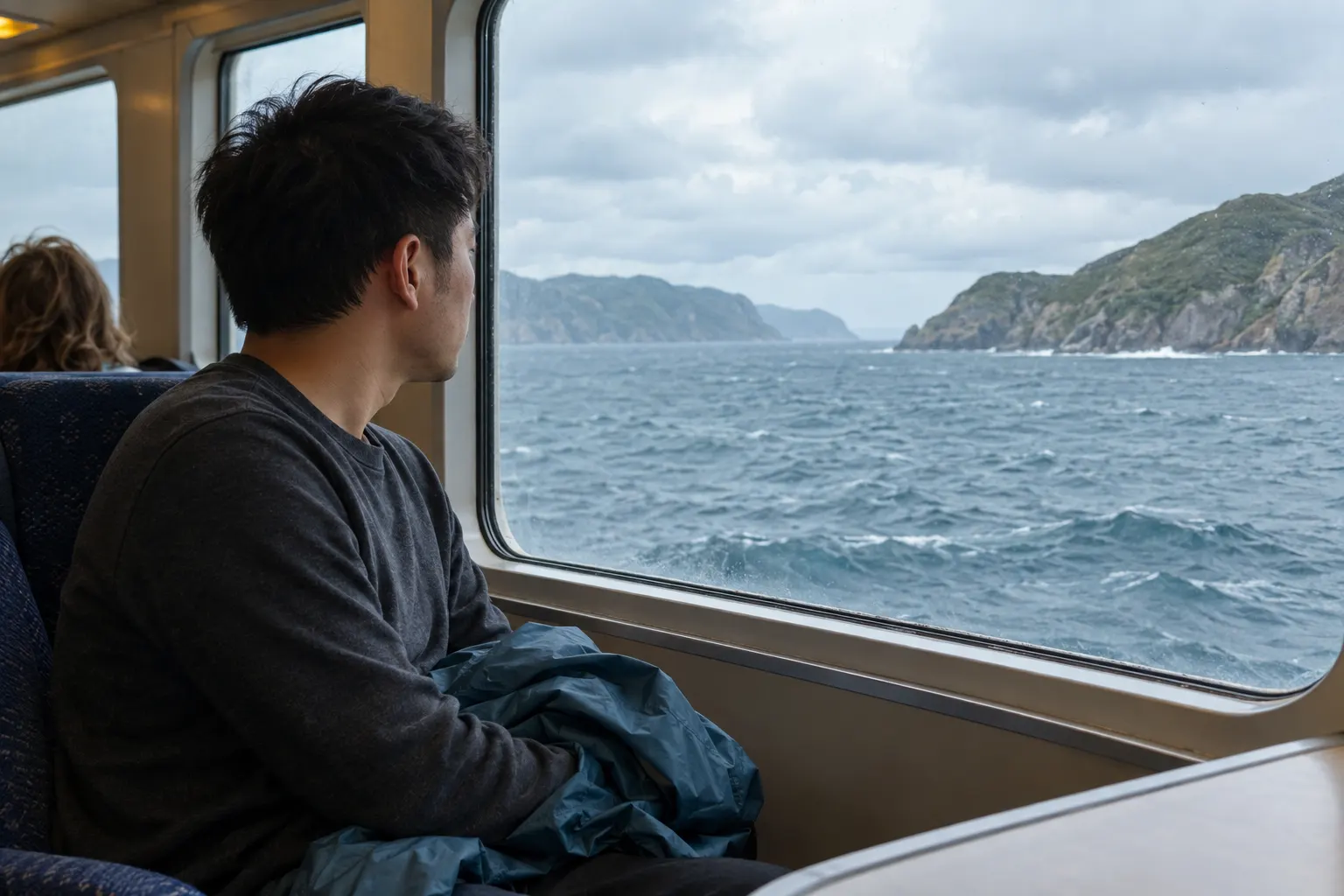
- Face forward and keep the horizon in view from a low, midship lounge window rather than watching the deck or a screen.
For the full toolkit see the seasickness guide, or what to do once it has already started. For what the trials actually say about the oldest trick on that list, see the verdict on looking at the horizon. If the rocking follows you ashore afterwards, that is land sickness, which is normal, and it passes.
Frequently asked questions
Is Cook Strait always rough?
No. Plenty of crossings are calm, and much of the route is sheltered water. What Cook Strait has a reputation for is changeability. The ferry operator describes it as one of the most changeable stretches of water in the world, able to go from light swell to rough in a matter of hours. A calm forecast is worth checking again on the day.
Which part of the Cook Strait crossing is roughest?
The open strait itself, which is roughly 75 minutes of a 3.5-hour sailing. Wellington Harbour at one end and Queen Charlotte Sound at the other are both sheltered, and the operator notes those sections are calmer than the strait. Sailing from Picton you get the sheltered leg first; from Wellington the harbour leg comes first.
Why is Cook Strait so windy?
New Zealand lies across the Roaring Forties, and the strait narrows to about 22 km between two mountainous islands. That gap squeezes and speeds up westerly wind. Pressure differences between the Tasman Sea and the Pacific add to it, which is why the middle of the strait can be windy while both ports look calm.
When is Cook Strait calmest?
Midsummer, broadly December to February, is usually the settled part of the year. Spring, September to November, is the windiest around Wellington, and winter southerly lows are the main cause of rough sailings and delays. Within any month, a light-wind day is far more comfortable than a windy one.
Should I take something for seasickness on the Cook Strait ferry?
That is a question for a pharmacist or doctor, who can advise on what suits you. One thing worth knowing generally: most options are intended to be taken before travel rather than after symptoms start. Given the crossing is only about 3.5 hours, timing matters, and deciding once you already feel unwell leaves very little of it.
Is the Cook Strait rough in winter?
Usually, yes. Winter there runs from June to August. In a typical year, June, July and August are all rated rough. Its roughest months are usually October and November. This is the typical pattern, not a forecast for any sailing.
Other crossings
Sources & further reading
- https://www.interislander.co.nz/plan/sailing-conditions
- https://en.wikipedia.org/wiki/Cook_Strait
- https://ferryweather.com/cook-strait/wellington-picton/
- https://niwa.co.nz/climate-and-weather/regional-climatologies/wellington
- https://www.linz.govt.nz/products-services/tides-and-tidal-streams/tidal-stream-predictions/cook-strait
Sea conditions described here are typical patterns drawn from published marine and operator information as of July 2026, not a forecast: conditions on any given sailing depend on the weather that day, and any month can deliver a calm crossing or a bad one. Route and operator names are trademarks of their respective owners; Dizzout is not affiliated with or endorsed by them. Seasickness sensitivity varies from person to person; this page is informational and not medical advice.