
Is the Bass Strait rough? What to expect on the crossing
Yes, Bass Strait is commonly reported as rough, and it is unusual in one way: the crossing is normally overnight, so you meet the motion lying in a bunk rather than sitting in a lounge. Bass Strait is well known for choppy conditions, and every crossing is different: some are smooth, others quite rough and juddering. It is shallow water taking Southern Ocean swell.
Crossing the Bass Strait this week? Dizzout is drug-free sound therapy you can start in your seat on the crossing, with relief in about 90 seconds.Starts in your browser · works with any headphones
Stop seasickness. Get your personalized Dizzout plan. Paid subscription for full access.

On your phone? Scan to start there.
Strait · Southern Australia · Reputation among passengers: has a long-standing reputation for rough passages.
- Low
- Moderate
- High
- Very high
Roughness summarises typical reported conditions for this crossing, not a forecast for any given sailing.
Ocean swell shortening over a 60 m shelf
In the Nausea Index table of the 121 sea crossings we cover, the Bass Strait is rated rough, one of 34 in that band, with 6 rated higher. Full table: the roughest sea crossings, ranked.
Key facts
- The Bass Strait is a strait, and passenger reports place it in the high roughness band.
- The mechanism behind that reputation: Ocean swell shortening over a 60 m shelf.
- Conditions are reported roughest in June, July and August.
- The calmest months are usually January, February, March and December.
Why is the Bass Strait so rough?
Bass Strait is shallow, around 60 m on average, against thousands of metres in the Southern Ocean to the west. Swell built by the Roaring Forties over open ocean runs into that shelf, slows, and shortens. The energy has to go somewhere, so it goes upward: waves become steeper and closer together rather than long and rolling. Cold fronts crossing the strait then pile local wind sea on top of the swell already arriving.
When is the Bass Strait roughest?
Winter and spring are generally the roughest. That is when the westerly low-pressure systems and their cold fronts track furthest north, straight across the strait; they arrive several times a month through the colder half of the year and are rare in midsummer. December to February is the settled stretch. Autumn and spring bring the Roaring Forties at their most active.
| Roughest water in Jan | Roughest water in Feb | Roughest water in Mar | Roughest water in Apr | Roughest water in May | Roughest water in Jun | Roughest water in Jul | Roughest water in Aug | Roughest water in Sep | Roughest water in Oct | Roughest water in Nov | Roughest water in Dec |
|---|---|---|---|---|---|---|---|---|---|---|---|
| Mixed | Mixed | Mixed | Rough | Rough | Roughest | Roughest | Roughest | Rough | Rough | Rough | Mixed |
Typical seasonal pattern, not a forecast. Any month can deliver a calm crossing or a bad one. Check the marine forecast for your sailing date. Select a month to see every sea and ferry crossing ranked for it.
Where to be on board
Front to back
- Bow (front)Avoid
- MidshipBest
- Stern (aft)OK
The crossing: About 9-11 hours
Roughest stretch: The middle of the night, mid-strait and furthest from land
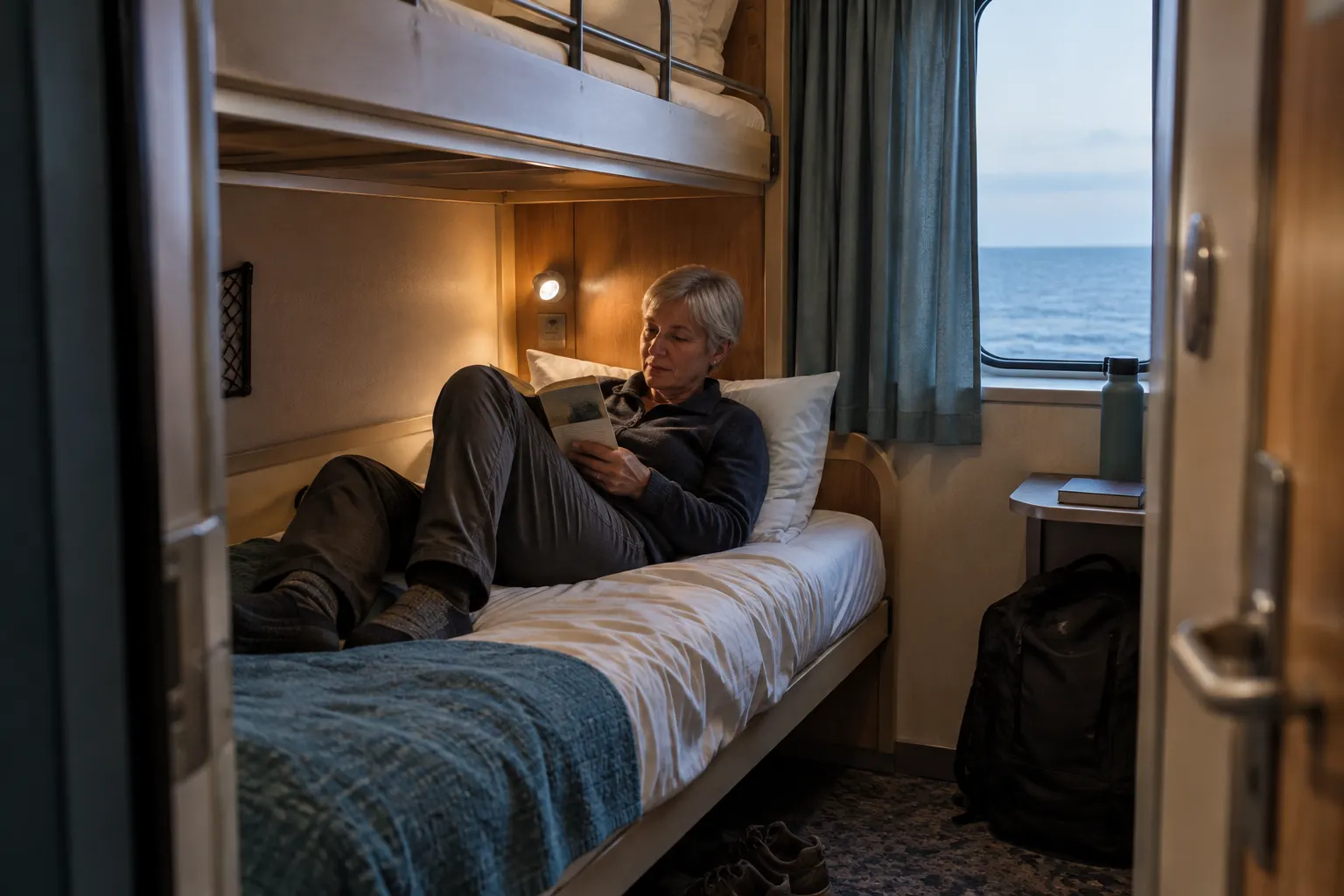
Pick a cabin low down and near midship; motion in a bunk is worst high up and at the ends of the ship.
Get your read
A few quick questions about you, then your trip. Nothing is saved or sent.
Step 1: about you
How you usually react to travel is the single best signal. These come from the validated MSSQ.
Step 2: your trip
Pick the kind of trip you are planning.
Keep your audio kit within reach
Arrange your phone and headphones before settling into the berth. Dizzout uses ordinary equipment that can stay together on the fixed shelf.
Free to download. Paid subscription for full access.
30,000+ travelers in 30+ countries · How we count

On your phone? Scan to start there.
Comparing apps first? See how the motion sickness apps compare
Not travelling yet? Remind me the day before my trip

Know someone who gets motion sick?
Send them the app that helps stop it, drug-free, in about 90 seconds, works with any headphones. Free to download.
The crossings that cross it
| Route | Typical duration | What to know |
|---|---|---|
| Geelong to Devonport | About 9 to 11 hours | Operated by Spirit of Tasmania from Geelong; about 448 km, normally sailed overnight, around 11 hours on a single sailing, closer to 9 on a double. |
| Devonport to Geelong | About 9 to 11 hours | Same water northbound. Daytime sailings also run in some months between September and April. |
What helps on this crossing
- Book a cabin rather than a recliner if you can. Lying flat, low down and near midship is the most tolerable position for an overnight crossing.
- Many passengers find lying with their head towards the bow, rather than across the ship, makes the roll easier to sleep through.
- Eat before you board or early in the sailing. Once the ship is mid-strait and moving, walking to the cafeteria is the unpleasant part.
- The first stretch out of Geelong is inside Port Phillip Bay. The ship only meets the strait after passing through The Rip at Port Phillip Heads, between Point Lonsdale and Point Nepean.
- Daytime sailings run in some months between September and April. Seeing the horizon in daylight is easier than feeling motion you cannot see.
- Check the Bureau of Meteorology Bass Strait marine forecast a day ahead. A cold front crossing on your sailing night is the thing to look for.
For the full toolkit see the seasickness guide, or what to do once it has already started. For what the trials actually say about the oldest trick on that list, see the verdict on looking at the horizon. If the rocking follows you ashore afterwards, that is land sickness, which is normal, and it passes.
Frequently asked questions
Is Bass Strait always rough?
No. Every crossing is different: some are smooth, some are quite rough and juddering. What makes the strait consistently uncomfortable when it does get up is the shape of the waves rather than their size, because shallow water makes them steep and short rather than long and slow.
How rough is the Spirit of Tasmania crossing?
It varies enormously by night. In settled summer weather many passengers sleep straight through and notice very little. When a cold front is crossing, the same route can involve hours of steep, short motion. The single best predictor is the marine forecast for the strait on your sailing night, not the season alone.
Can you sleep on the Bass Strait crossing?
Most people do, and sleeping is one of the more useful things you can do with the time. Cabins with a private bathroom are available, as are recliner seats in a lounge. A cabin low in the ship and near midship gives the least movement. Being able to lie flat and close your eyes helps far more than staying upright.
When is Bass Strait calmest?
Midsummer, roughly December to February. The westerly lows and cold fronts that stir the strait track furthest north in winter and spring, and are rare over summer. Autumn and spring sit in between. That is a tendency across the season rather than a promise about any single night.
Is the daytime Bass Strait sailing smoother than the overnight one?
Not inherently. The water is the same and the weather does not care what time it is. What changes is your experience of it: in daylight you can watch the horizon, move about the ship and see what is coming, which many people find easier than lying in a dark cabin feeling motion they cannot see.
Is the Bass Strait rough in winter?
Usually, yes. Winter there runs from June to August. In a typical year, June, July and August are all rated roughest. This is the typical pattern, not a forecast for any sailing.
Other crossings
Sources & further reading
Sea conditions described here are typical patterns drawn from published marine and operator information as of July 2026, not a forecast: conditions on any given sailing depend on the weather that day, and any month can deliver a calm crossing or a bad one. Route and operator names are trademarks of their respective owners; Dizzout is not affiliated with or endorsed by them. Seasickness sensitivity varies from person to person; this page is informational and not medical advice.