
Is the Aegean Sea rough? What to expect on the crossing
Mostly moderate, with one notable exception: high summer. The Aegean is a comparatively sheltered sea, broken up by islands, and for much of the year crossings are unremarkable. But from roughly mid-July to mid-August the meltemi, a dry northerly wind, blows for days at a time, and passengers frequently report rough crossings. That timing surprises people who booked for the sunshine.
Crossing the Aegean Sea this week? Dizzout is drug-free sound therapy you can start in your seat on the crossing, with relief in about 90 seconds.Starts in your browser · works with any headphones
Stop seasickness. Get your personalized Dizzout plan. Paid subscription for full access.

On your phone? Scan to start there.
Sea · Eastern Mediterranean · Reputation among passengers: mixed: commonly reported as uncomfortable in the wrong conditions.
For the wider sea, month by month: is the Mediterranean Sea rough?
- Low
- Moderate
- High
- Very high
Roughness summarises typical reported conditions for this crossing, not a forecast for any given sailing.
Summer meltemi funnelled down the Aegean
In the Nausea Index table of the 121 sea crossings we cover, the Aegean Sea is rated manageable, one of 81 in that band, with 40 rated higher. Full table: the roughest sea crossings, ranked.
Key facts
- The Aegean Sea is a sea, and passenger reports place it in the moderate roughness band.
- The mechanism behind that reputation: Summer meltemi funnelled down the Aegean.
- Conditions are reported roughest in July and August.
- The calmest months are usually April and May.
- It is also known as Aigaio Pelagos / Ege Denizi.
Why does the Aegean Sea get rough?
The meltemi is a pressure pattern, not a storm. A persistent summer high to the north-west and low pressure to the south-east funnel air southwards down the length of the Aegean. It commonly starts in the early afternoon at 4-5 Beaufort and drops at sunset, but not uncommonly it reaches 5-7 Beaufort during the day, holds through the night and blows again the next day. That repeating pattern can run for days, sometimes up to ten. In a 30-knot meltemi, waves can build past three metres within six hours, and adverse currents make them steeper.
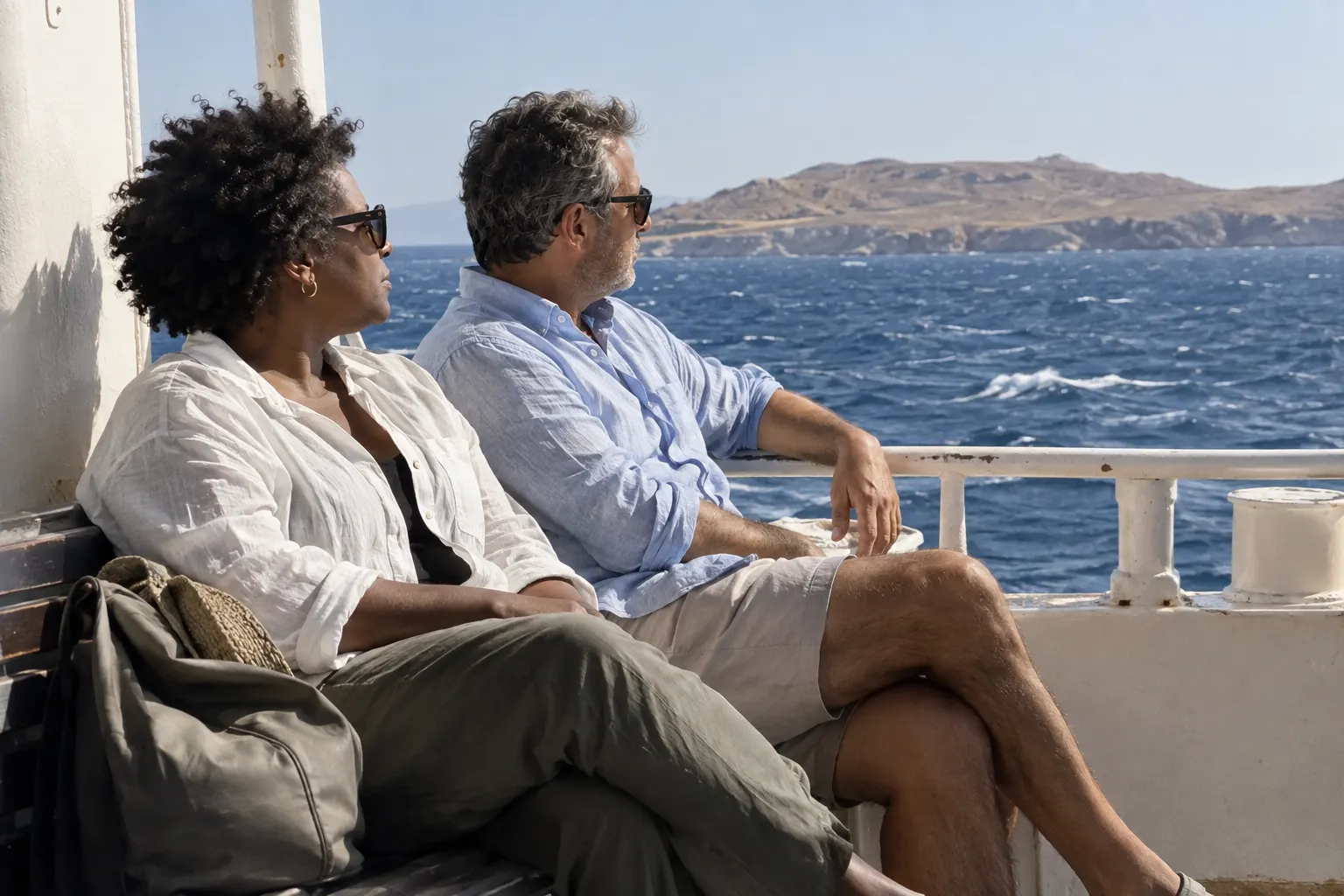
When is the Aegean Sea roughest?
Counter-seasonal to the Atlantic. The Aegean's roughest stretch is high summer, roughly mid-July to mid-August, when the meltemi is strongest and most persistent. Around 70% of meltemi episodes fall between June and September, though it also appears in May and October. Winter brings separate low-pressure storms, but far fewer travellers are on the water. Late April to early June, and late September, are the usual sweet spots.
| Roughest water in Jan | Roughest water in Feb | Roughest water in Mar | Roughest water in Apr | Roughest water in May | Roughest water in Jun | Roughest water in Jul | Roughest water in Aug | Roughest water in Sep | Roughest water in Oct | Roughest water in Nov | Roughest water in Dec |
|---|---|---|---|---|---|---|---|---|---|---|---|
| Mixed | Mixed | Mixed | Calm | Calm | Mixed | Rough | Rough | Mixed | Mixed | Mixed | Mixed |
Typical seasonal pattern, not a forecast. Any month can deliver a calm crossing or a bad one. Check the marine forecast for your sailing date. Select a month to see every sea and ferry crossing ranked for it.
Where to be on board
Front to back
- Bow (front)Avoid
- MidshipBest
- Stern (aft)OK
The crossing: 2.5-8.5 hours
Roughest stretch: Open water between the mainland and the Cyclades
Stay on a low deck, midship. Outside air on a sheltered lee-side deck helps more than an indoor lounge.
Get your read
A few quick questions about you, then your trip. Nothing is saved or sent.
Step 1: about you
How you usually react to travel is the single best signal. These come from the validated MSSQ.
Step 2: your trip
Pick the kind of trip you are planning.
Prepare for a summer crossing
Keep the aisle clear and your bag under the seat. Use your phone and ordinary headphones if you choose to try Dizzout during a seated break.
Free to download. Paid subscription for full access.
30,000+ travelers in 30+ countries · How we count

On your phone? Scan to start there.
Comparing apps first? See how the motion sickness apps compare
Not travelling yet? Remind me the day before my trip

Know someone who gets motion sick?
Send them the app that helps stop it, drug-free, in about 90 seconds, works with any headphones. Free to download.
The crossings that cross it
| Route | Typical duration | What to know |
|---|---|---|
| Piraeus to Mykonos | 2.5 to 5.5 hours | Crosses the open central Aegean. High-speed craft are quickest but feel the wind most. |
| Piraeus to Santorini | 5 to 8.5 hours | High-speed vessels take about 5 hours; conventional ferries 7.5 to 8.5 hours on direct sailings. |
| Piraeus to Heraklion | about 9 to 11 hours | The flagship overnight route to Crete, crossing the full meltemi fetch on big ships. |
| Mykonos to Santorini | about 2 to 3.5 hours | Fast catamarans beam-on to the meltemi; the roughest-feeling mainstream island hop. |
What helps on this crossing
- Book a conventional ferry rather than a high-speed catamaran in July and August; the bigger, heavier hulls ride the meltemi chop far better.
- Check the Beaufort forecast the night before. High-speed craft are often pulled at force 6-7, conventional ferries usually at force 8 and above.
- The meltemi is northerly, so a southbound leg puts it behind you. East-west hops across the wind give the worst rolling.
- Morning sailings are often the least uncomfortable: the meltemi typically builds through the afternoon, and a strong meltemi may not drop away at night.
- Sit outside on the lee side of the vessel, out of the spray, where you can see the horizon and the islands.
For the full toolkit see the seasickness guide, or what to do once it has already started. For what the trials actually say about the oldest trick on that list, see the verdict on looking at the horizon. If the rocking follows you ashore afterwards, that is land sickness, which is normal, and it passes.
Frequently asked questions
Is the Aegean Sea rough in summer?
Yes, more often than in spring or autumn. The meltemi peaks roughly mid-July to mid-August and commonly blows at 5-7 Beaufort during the day. It is the one sea in this region that is reliably rougher in high summer than in the shoulder months, which catches out travellers who assume good weather means a flat sea.
When is the Aegean Sea calmest?
Late April to early June, and the second half of September into October. These are the windows either side of the meltemi season, when the wind is lighter and the sea has less time to build. Winter is quieter for wind-driven summer chop but brings its own winter low-pressure systems and shorter daylight.
Do Greek ferries get cancelled because of the meltemi?
Regularly, in July and August. The decision rests with the port authority. High-speed catamarans are usually the first to be suspended, commonly around force 6-7, while larger conventional ferries typically keep running until force 8 or above. Build a spare day into any itinerary that has to connect with a flight home.
Which Greek island ferry routes are roughest?
The open central Aegean crossings. Passages out to and between the Cyclades, Mykonos, Paros and Naxos in particular, sit in the wind's main corridor with long open stretches and no shelter. Routes that stay inside the Saronic or Argolic gulfs, or hug the mainland, are far more protected.
Is a high-speed ferry or a conventional ferry better in the Aegean?
In meltemi conditions, the conventional ferry. It is slower, but its size and weight damp the short, steep chop that the wind builds, and it is less likely to be held in port. High-speed catamarans are quicker in settled weather and are the sensible choice outside the peak wind months.
Is the Aegean Sea rough in winter?
Not usually. In a typical year, December, January and February are all rated mixed. Its roughest months are usually July and August. This is the typical pattern, not a forecast for any sailing.
Other crossings
Sources & further reading
Sea conditions described here are typical patterns drawn from published marine and operator information as of July 2026, not a forecast: conditions on any given sailing depend on the weather that day, and any month can deliver a calm crossing or a bad one. Route and operator names are trademarks of their respective owners; Dizzout is not affiliated with or endorsed by them. Seasickness sensitivity varies from person to person; this page is informational and not medical advice.