The short answer
Car sickness works the same way in an autistic child as in anyone else: the inner ear feels the road move while the eyes, fixed on a tablet, report that nothing is moving. What differs is everything around it. Reacting more or less than expected to sensory input is part of the diagnostic picture for autism, so the car can already be loud before the motion arrives. Your child may also not tell you they feel sick until they are being sick. And the standard advice assumes a child who follows instructions while distressed. Talk to your child's doctor before you change anything.
You have probably already read the standard list, and found that it assumes a child who will do those things on request.
So this page skips the general tips and stays on what is specific to you: what the studies actually found, what they did not, and which tools fit a child who already copes a certain way.
Talk to your child's doctor before you change anything
That matters more than usual here. A child who cannot easily describe what they feel is harder to assess from the outside. Headaches, or dizziness away from the car, deserve a proper look, not a seat swap.
Why the standard advice does not fit
Open any car sickness guide and you get the same instructions: look at the horizon, sit in the front, put the screen down, get fresh air. Sound advice, written for a child who will redirect their gaze when asked, tolerate a change of seat, and say I feel sick in time for you to pull over.
None of those are safe assumptions here. Taking the tablet away may cost more than the nausea does. A seat swap may break a routine holding the whole trip together. The general list lives on our motion sickness in children page and in the toddler and kid guide.
Vestibular differences, and why over and under responsiveness both show up in a car
The diagnostic criteria for autism include, in the CDC's wording, hyper- or hyporeactivity to sensory input. It runs both ways. One child flinches at the indicator clicking. Another seeks motion out, spins, rocks, loves the swing, and still arrives green.
On the balance system itself the picture is narrower than the internet suggests. A 2024 study in the Journal of Clinical Medicine compared ten autistic children with ten others and found no difference in peripheral vestibular function between the groups. Postural control still differed: once visual cues were removed, the autistic children swayed faster and in different patterns. The authors read that as sensory integration being less developed, rather than a fault in the ear. Ten children per group is a small study, so hold it loosely. The useful question is not whether your child's ears work, but how much the rest of the car is already asking of the same system.
Knowing you feel sick before you are sick
Interoception is the sense of what is happening inside your own body: hunger, thirst, the rising feeling before vomiting.
The research is unsettled, and it is worth saying so. A 2025 systematic review and meta-analysis in Frontiers in Psychiatry looked at the laboratory heartbeat task in children and adolescents: five of the seven studies found no difference between autistic and non-autistic groups, and two found lower accuracy. Questionnaire results ran the other way in places, with some studies finding autistic children reported less awareness of their own body signals. The authors also question how well that heartbeat task measures interoception at all.
The practical conclusion survives either result. Do not build your plan around your child announcing the early warning. Build it around what you can see: the going quiet, the pallor, the swallowing. The toddler guide covers the same problem in a child too young to say it.
Tools that are already accepted: ear defenders, familiar audio, a known route
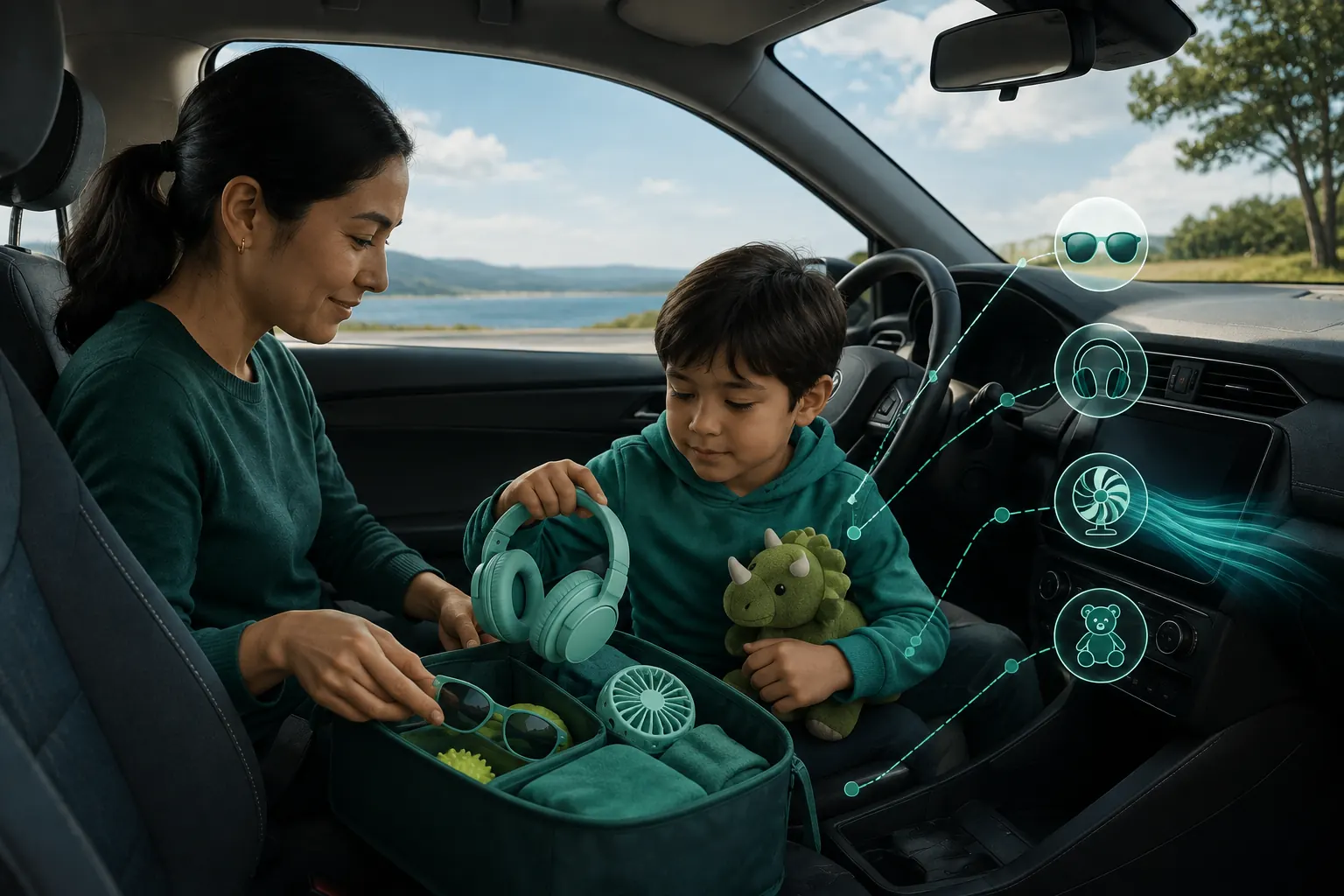
Here is the point most guides miss. Plenty of autistic children already own ear defenders and already accept wearing something over their ears. For many families, getting a child to keep headphones on is the hard part. For yours it may already be solved.
Be honest about what that does. Ear defenders are not a nausea remedy, and there is no good evidence that blocking sound prevents motion sickness. What they do is take one load off, so there is more headroom before the motion tips things over. One disclosure, since it is our field: we make a sound therapy app for motion sickness, and a web page is not the place for us to suggest it for a child. Ask the paediatrician.
- Keep the ear defenders on the whole journey, so nothing has to change mid trip.
- Use the same audio every time. Familiar beats new when the goal is fewer surprises.
- Keep the seat, the side and the order of things the same where you can.
Predictability beats distraction
Most guides tell you to distract a queasy child. Parents of autistic children often report the opposite working better: knowing exactly what is coming. A journey described in advance, with named landmarks and a stated number of stops, asks less of a child than a mystery drive. Nobody has measured that against nausea, and it would be dishonest to present it as a proven effect. It is low cost, and it fits how these children already navigate the world.
The phone and tablet question
This is the genuinely hard one. A near screen in the lap is close to the worst thing for car sickness: the eyes lock onto something perfectly still while the inner ear reports every corner. And for many autistic children the tablet is the reason the journey is survivable at all. Taking it away does not give you a calm child watching the horizon. It gives you a different problem. So weigh the trade for your own child rather than following a blanket rule.
- Try audio only first. A familiar show listened to rather than watched: no fixed near target for the eyes.
- Raise the screen to the window line, so the eyes catch some of the moving world at the edges.
- Front load it. Screen for the first stretch, off before the point where things usually turn.
- Have a stated alternative ready, already agreed and in the bag. The car friendly games that suit a queasy child keep eyes up rather than down.
Planning a longer journey
A long drive is not a short drive with more of the same. The exposure adds up, and hunger and tiredness start blurring into the nausea question.
- Break it into named legs. Three segments with a stop between each is easier to hold than two hours of nothing.
- Stop before you need to. Once a child has been sick, the next journey is harder too.
- Pack for the bad version. Spare clothes, wipes, bags, water.
- If the daily school run is the real problem, it has its own constraints. The school bus guide covers it.
What to raise with your paediatrician or occupational therapist
Go in with specifics rather than the word sickness.
- When it started, and what changed. New car, new route, new medication, new school run.
- The pattern. How many minutes in, which roads, which seat, how long it takes to settle.
- What you have already tried, and what your child refused.
- Whether anything else could be going on. Migraine, ear problems and reflux can look like travel sickness from the back seat.
- Medication, if you are considering it. The CDC's travel guidance says behavioural countermeasures should be tried first, that anti motion sickness medication for children should be used with caution, and that scopolamine should be avoided in children because of adverse effects including hallucinations and confusion. Doses depend on the child, so ask a pharmacist. Our medicine for kids page has the questions worth bringing.
One last thing, before you brace for a lifetime of it. The same CDC guidance describes susceptibility peaking between roughly seven and twelve, then declining through adulthood, and calls habituation the most effective countermeasure there is, more than any medication. That is motion sickness in general, not autistic children specifically. But the worst year is often not permanent.
Frequently asked questions
Do autistic children get car sick more often?
There is no reliable published figure for how common car sickness is in autistic children specifically, so be careful with any percentage you see quoted. What is documented is that hyper- or hyporeactivity to sensory input is part of the diagnostic picture for autism. A small 2024 study of balance also found differences in postural control in autistic children, with no difference in peripheral vestibular function between the groups. Many parents describe harder journeys. The research has not put a number on it.
Why does my autistic child get car sick?
The underlying mechanism is the same for everyone: the inner ear senses the car moving while the eyes, fixed on something inside the car, report stillness, and the brain gets two conflicting accounts. What can make it harder is the rest of the environment. Engine noise, light, smells and an unfamiliar route may already be demanding a lot before the motion is added. Repeated sickness on journeys is worth raising with your child's doctor rather than assuming it is only sensory.
Does sensory processing disorder cause motion sickness?
No, and the reverse is not true either. Motion sickness comes from a mismatch between what the balance system feels and what the eyes see, and it happens to people with and without sensory differences. What sensory differences can change is the threshold: a child already at capacity from noise, light and smell has less room before the motion conflict tips into nausea. That is a difference in how easily it happens, not a cause.
Do ear defenders help with car sickness?
Not directly. There is no good evidence that blocking sound prevents motion sickness, and ear defenders should not be sold to you as a remedy. What they can do is reduce the total sensory load in the car, engine noise, road noise, siblings, which may leave more headroom before the motion becomes a problem. The practical advantage for many autistic children is that they already accept wearing them, so nothing new has to be negotiated in the car.
What can I give an autistic child for car sickness?
That is a question for your paediatrician, GP or pharmacist, because the answer depends on your child's age, weight and other medications. General travel medicine guidance says behavioural measures should be tried first, that anti motion sickness medication for children should be used with caution, and that scopolamine should be avoided in children. Do not scale an adult dose down yourself, and do not rely on a dose you read online.
How do I prepare an autistic child for a long car journey?
Describe the journey in advance and describe it the same way each time: the route, the number of stops, the landmarks, the end. Keep the seat, the audio and the order of things consistent, break the drive into named legs with stops before anyone needs one, and keep the car cool and free of strong smells. Pack for the bad version too, spare clothes, wipes, bags and water, so a difficult stretch does not become a difficult day.
Someone you know gets motion sick?
Send them this guide. It might be the trip it saves.
Your next question, probably
What about medicine, and at what age?
What parents ask a pharmacist
Not your question? What can they do in the car instead of a screen?Is the school run the hard part?
About this article
- CDC: Clinical Testing and Diagnosis for Autism Spectrum Disorder (sensory reactivity criterion)
- Chisari D, Vitkovic J, Clark R, Rance G. Vestibular Function and Postural Control in Children with Autism Spectrum Disorder. Journal of Clinical Medicine, 2024 (ten children per group)
- Klein M, Witthöft M, Jungmann SM. Interoception in individuals with autism spectrum disorder: a systematic literature review and meta-analysis. Frontiers in Psychiatry, 2025
- CDC Yellow Book: Motion Sickness (age curve, habituation, medication in children)
This article is informational and not a substitute for medical advice. Talk to your child's doctor, paediatrician or pharmacist before starting any medication or changing how you manage travel sickness, and see a doctor if the sickness is new, frequent, or comes with headaches, hearing changes or dizziness away from the car.