Motion Sickness in Children: Drug-Free Relief for Kids
Children are the most affected age group, and the curve has a clear shape: motion sickness is uncommon under about age 2, becomes more common than in adults between 2 and 12, peaks between ages 7 and 12, and then fades through the teens as the vestibular system matures. It is not rare at that peak. In a study of school children, 43.4% reported motion sickness in a car and 43.2% on a bus. Screens in the back seat are the modern aggravator, because a child looking down at a tablet has no view of the road at all. This page is information only: any medicine question belongs with your pediatrician.
Before you act on any of this, including anything drug-free, take it to your pediatrician. If it helps to arrive with the evidence, we grade 19 remedies against published trials, with the citations attached and the verdicts that go against us included.
Why this hits Parents of children aged 2-12
Safe dosing for children, non-drug options preferred by most parents The mechanism is the same as any motion sickness: a sensory mismatch between what the inner ear feels and what the eyes see. Your brain treats the disagreement as a poisoning signal and triggers nausea. Some groups and situations, parents of children aged 2-12 included, amplify the mismatch rather than cause a different problem entirely.
Understanding this matters because the fix depends on whether you're preventing the mismatch (smart seat, no screens, fresh air) or looking for something once symptoms have already started. That second list is much shorter. Sound therapy is one of the few drug-free options built to be used after nausea has begun.
Safe options
- A forward-facing seat with the best view out that the car allows
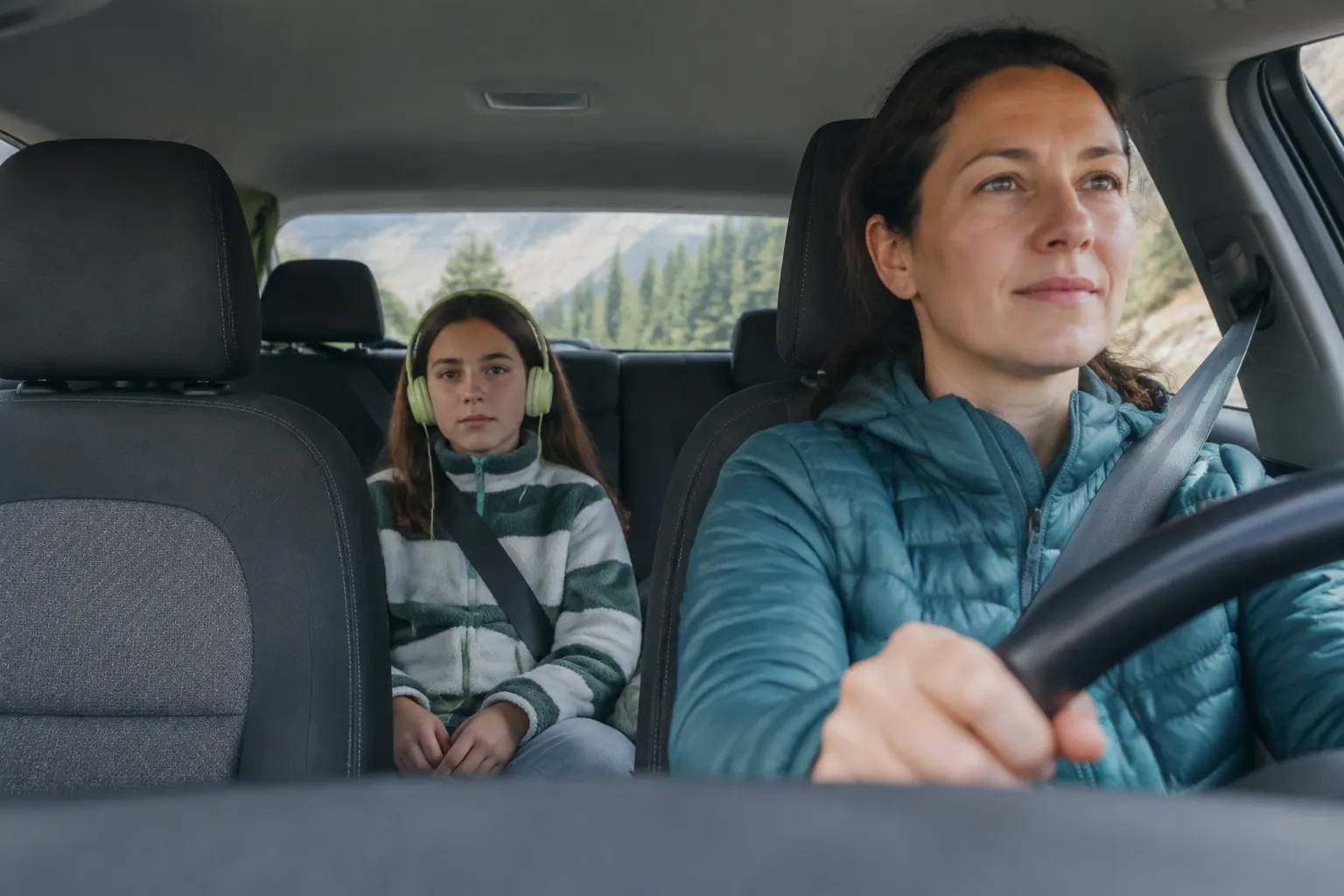
- Sound therapy through headphones, which involves no medication (discuss with your pediatrician)
- Games that keep eyes up and out: spotting road signs, counting bridges, I-spy
- A light snack before setting off rather than an empty stomach
- Cool air and a cracked window
- Breaking a long drive into shorter legs with real stops
- Asking your pediatrician which medicines, if any, suit your child's age and weight
Some of those have been tested properly and some have not. See the verdict on each one, with the trials attached.
What to avoid
- Any medicine dose worked out from an adult label or a web page
- The scopolamine patch, which labels do not support for young children
- Tablets, phones and books in the back seat, the strongest trigger at this age
- A large meal right before a winding drive
- The third row of a van or SUV when a closer seat is free
How sound therapy fits in
Dizzout plays precisely calibrated audio through any headphones, wired or Bluetooth. Dizzout states relief in about 90 seconds. No medication, no drowsiness, no prescription, and you can start another session later in the same trip.
For parents of children aged 2-12 this matters because so many traditional remedies come with trade-offs people would rather not make: drowsiness, dry mouth, or a prescription. Sound therapy has none of those three. Whether it is right for you is still a question for your doctor.
For the full science, see our science page and the vestibular system primer.
⚕️ Important: Talk to your doctor first
We do not have pediatric clinical trial data for Dizzout. The app is drug-free and uses audio through headphones. Because we cannot speak to outcomes specifically in children, we recommend discussing any motion sickness tool, including this one, with your pediatrician first.
Learn more about Dizzout
Dizzout is a drug-free motion sickness app. If you'd like to discuss it with your doctor as a potential option, here's how it works:
Read how Dizzout works →Share this guide
Send it to someone who might find it useful.
When to see a doctor
Ordinary motion sickness, even bad bouts, fades once the motion stops. If symptoms linger days afterward, come with hearing loss, severe headaches, or happen without movement at all, that points to a vestibular condition like BPPV (benign paroxysmal positional vertigo), vestibular migraine, or Ménière's disease. Those need clinical care, not a motion-sickness app. Sound therapy may help you tolerate travel while you work through treatment, but it isn't the treatment itself.
Common questions
What age can children take motion sickness medicine?
Age limits are set on each product's label and they differ between medicines, so the honest answer is to read the box for the specific product and confirm with your pediatrician or pharmacist before giving anything. Do not scale an adult dose down. This matters more with children than adults because the same active ingredient can be labelled for one age in one product and a different age in another.
Do babies and toddlers get motion sickness?
Rarely. Standard clinical references, including the CDC Yellow Book, describe motion sickness as uncommon in children under about 2 years, with susceptibility rising afterwards and peaking between ages 7 and 12. So a very young baby crying in the car is usually about something else: heat, hunger, reflux, a wet nappy or simply being tired. If it happens repeatedly and you are unsure, ask your pediatrician rather than assuming motion is the cause.
Is this kind of motion sickness common in parents of children aged 2-12?
Yes. Safe dosing for children, non-drug options preferred by most parents The pattern is well-documented: a sensory mismatch between the inner ear and what the eyes are seeing triggers the nausea response, and certain situations or demographics amplify it.
What actually causes the nausea?
Motion sickness isn't a stomach problem: it's the brain reacting to a sensory mismatch. Your inner ear detects motion, your eyes may see a stationary view, and the brain interprets the conflict as a poisoning signal. Nausea is the protective response. Sound therapy is a drug-free option once the nausea has started.
Will Dizzout work for this specific situation?
Dizzout is designed for exactly this kind of sensory-mismatch motion sickness. Plug in any headphones, open the app, hit play. Dizzout states relief in about 90 seconds. Drug-free, no special hardware, no drowsiness.
When should I see a doctor instead of using an app?
If symptoms persist days after the motion stops, come with hearing loss, severe headaches, or happen without obvious movement, see a doctor. Those signs point to a vestibular condition (BPPV, vestibular migraine, Ménière's) that requires clinical treatment, not just motion-sickness relief.
Related guides
Further reading
- · Cleveland Clinic: Motion Sickness: clinical overview of causes, symptoms, and treatment options.
- · NHS: Motion sickness: UK National Health Service guidance.
- · CDC Yellow Book: Motion Sickness: official travel-medicine reference.
Other motion sickness guides
Your next question, probably
Feeling it right now?
The 60-second protocol, by situation: car, boat, plane, screens
If that is not your question: