Mirror's Edge (and Catalyst) Motion Sickness: Why It Happens & What Helps
Mirror's Edge is the game people name first when someone asks which game causes motion sickness. First-person parkour is the whole design: sustained sprinting, vaulting, wall runs, and a camera that rolls and dips through every landing. DICE knew the risk before release and built the center reticle as a fixed focal point to fight it.
Before your next session with Mirror's Edge (and Catalyst): Dizzout runs on your phone: pause, move your headphones over and press play, with relief in about 90 seconds.Starts in your browser · works with any headphones
Calm game nausea. Get your personalized Dizzout plan. Paid subscription for full access.

On your phone? Scan to start there.
PC, Xbox 360/One BC, PlayStation 3 (Catalyst: PC, PS4, Xbox One) · first-person · Partial settings · Player-reported motion-sickness risk: one of the most commonly reported triggers in gaming.
- Low
- Moderate
- High
- Very high
Risk levels summarise what passengers and riders commonly report, not measured testing.
Key facts
- Mirror's Edge (and Catalyst) runs on PC, Xbox 360/One BC, PlayStation 3 (Catalyst: PC, PS4, Xbox One).
- The camera is first-person.
- Player reports place it in the high band for motion sickness.
- The game ships some comfort settings, but not a full set.
- It sits at number 1 in our ranking of the 20 games players report most for motion sickness.
Why Mirror's Edge (and Catalyst) can trigger motion sickness
Every core action feeds your eyes continuous self-motion your inner ear never confirms: running, vaulting, wall running, rolling out of a drop. The camera deliberately rolls and dips to sell that momentum, and there is no toggle for any of it. The 2008 original also has no field-of-view slider in its menus, so widening the view means a config file edit that community guides document. Catalyst is the only entry in the series with an official lever, a Character Camera FOV slider running 60 to 90. The one comfort feature the original does ship is the center reticle: DICE interviewed ballerinas about how they spot during turns and added the dot as a fixed point for your eyes, which is why players commonly report that switching it off makes things worse.
- Sustained first-person sprinting, vaulting and wall running with almost no still moments
- Deliberate camera roll and dip on landings and rolls, with no toggle
- No field-of-view slider in the 2008 original's menus
- Springboard launches and long drops that throw the view fast
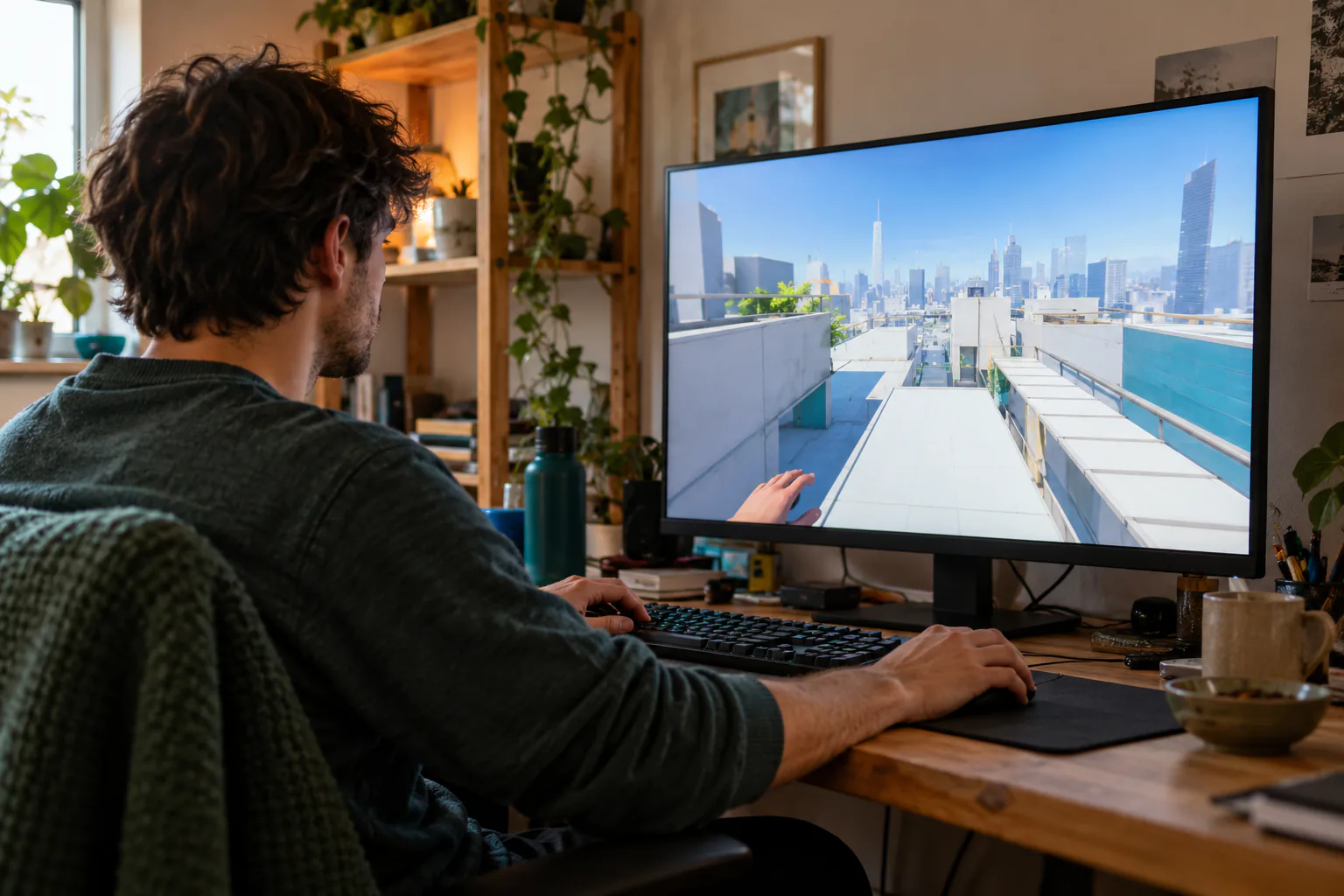
Put handheld play aside
For adult players: put the handheld down and take a screen break. Keep ordinary headphones available if you choose Dizzout afterward.
Free to download. Paid subscription for full access.
30,000+ travelers in 30+ countries · How we count

On your phone? Scan to start there.
Comparing apps first? See how the motion sickness apps compare

Comfort settings in Mirror's Edge (and Catalyst)
Mirror's Edge (and Catalyst) ships some comfort settings, but not a full set.
The 2008 original has no FOV slider and no toggle for the camera roll or the landing dip, on any platform. Catalyst adds a Character Camera FOV slider (60 to 90), the only official comfort lever the series ever shipped. That leaves pacing, the reticle and off-screen help doing most of the work here.
| Setting | Where | Recommendation |
|---|---|---|
| Reticle (the center dot) | In-game options, HUD settings | Keep it on. It was added as an anti-sickness focal point, and players commonly report removing it makes symptoms worse |
| Field of view (original, PC) | No menu slider, config file edit | Raise it if you are comfortable editing config files. A Steam community guide covers the steps |
| Character Camera FOV (Catalyst) | Options > Video | Raise from 60 toward 90, the top of the slider |
| Look sensitivity | In-game options, controls | Lower it so turns and mid-air corrections happen more slowly |
Where is the look sensitivity setting in Mirror's Edge?
In Mirror's Edge, the Look sensitivity setting is under In-game options, controls. Lower it so turns and mid-air corrections happen more slowly.
One guide explains these settings for every game: how field of view, motion blur, head bob and camera shake trigger motion sickness.
Know someone who gets motion sick?
Send them the app that helps stop it, drug-free, in about 90 seconds, works with any headphones. Free to download.
What helps beyond the settings
- Look where you are going, at the route ahead, rather than at the moving edges of the frame
- Take chapters in short stints and break before you need to, not after
- Sit further back so the screen fills less of your visual field
- A drug-free sound-therapy app like Dizzout runs through the headphones you already have on and is designed to help once symptoms start
The fixes people reach for once they step away from the screen are covered separately, with the trials attached: the remedy verdicts.
Frequently asked questions
Why is Mirror's Edge so famous for motion sickness?
The whole game is first-person momentum: sprinting, vaulting, wall running, and a camera that rolls and dips through landings. Your eyes get near-constant self-motion while your inner ear reports you sitting still, which is the mismatch motion sickness runs on. DICE expected it, which is why the center reticle exists as a fixed focal point.
Does Mirror's Edge have an FOV slider?
Not in the 2008 original. PC players raise it with a config file edit that community guides document, and console players have no equivalent. Mirror's Edge Catalyst does have one: a Character Camera FOV slider in the video options, running 60 to 90.
Should I turn the reticle off in Mirror's Edge?
If motion sickness is your problem, no. DICE added the center dot as a fixed point for your eyes to hold while the world moves, after asking ballerinas how they spot during turns. Players who switch it off for a cleaner screen commonly report feeling worse.
Other game motion-sickness guides
Sources & further reading
Your next question, probably
Can you build tolerance?
Graded exposure, honestly assessed, so you can keep playing
Not your question? Is it your screen or your headset?
Based on publicly reported player experiences and each game's documented settings, as of July 2026. Settings menus change with updates, so check your version. Game names are trademarks of their respective owners; Dizzout is not affiliated with or endorsed by them. Motion-sickness sensitivity varies by person, so this is informational, not a game review or a substitute for a doctor's advice.