
How rough is a Panama Canal cruise? Season by season
A Panama Canal cruise contains the flattest cruise day in the world: the transit itself is spent in locks and on Gatun Lake, fresh water about 26 metres above sea level, where there is no swell to feel at all. The motion lives in the approaches. The Caribbean side gets winter trade wind chop and sits inside hurricane season in late summer; on the Pacific side, legs along Central America cross the Gulf of Tehuantepec, where gap winds blow gale force in bursts from November to March.
The canal and lake, plus the Caribbean and eastern Pacific approaches · Full transits cluster in the spring and autumn repositioning windows; partial transits from Florida run through the winter.
- Low
- Moderate
- High
- Very high
The band summarises a typical in-season sailing for this region, not a forecast. The month table below is where the season detail lives.
Key facts
- A typical in-season sailing here sits in the moderate motion band. Full transits cluster in the spring and autumn repositioning windows; partial transits from Florida run through the winter.
- The waters involved: The canal and lake, plus the Caribbean and eastern Pacific approaches.
- Open water is usually at its calmest in April and May.
- Conditions are typically roughest in August, September and October.
Sailing on a Panama Canal cruise? Dizzout is drug-free sound therapy you can start anywhere on the ship, with relief in about 90 seconds.Starts in your browser · works with any headphones
Stop seasickness on your cruise. Get your personalized Dizzout plan. Paid subscription for full access.

On your phone? Scan to start there.
When a Panama Canal cruise is calmest, month by month
| Roughest water in Jan | Roughest water in Feb | Roughest water in Mar | Roughest water in Apr | Roughest water in May | Roughest water in Jun | Roughest water in Jul | Roughest water in Aug | Roughest water in Sep | Roughest water in Oct | Roughest water in Nov | Roughest water in Dec |
|---|---|---|---|---|---|---|---|---|---|---|---|
| Mixed | Mixed | Mixed | Calm | Calm | Mixed | Mixed | Rough | Rough | Rough | Mixed | Mixed |
Typical seasonal pattern, not a forecast. Any month can deliver a calm crossing or a bad one. Check the marine forecast for your sailing date. Select a month to see every sea and ferry crossing ranked for it.
The strip rates the ocean approaches, blended: the winter band is the Caribbean trades plus the Tehuantepec gap wind season, and the late summer band is Atlantic hurricane season on the Caribbean side. The canal day itself is flat in every month.
Why it gets rough here
The canal crosses the isthmus through locks and a lake, so the transit day is inland water. Either side of it, two wind systems set the calendar. Winter cold fronts from North America pile pressure behind the Central American mountains and jet through the gaps, most famously at Tehuantepec, where events reaching gale force or more occur mostly between November and March. On the Atlantic side the same winter pattern reinforces the Caribbean trades, while June to November adds hurricane season, peaking around September 10.
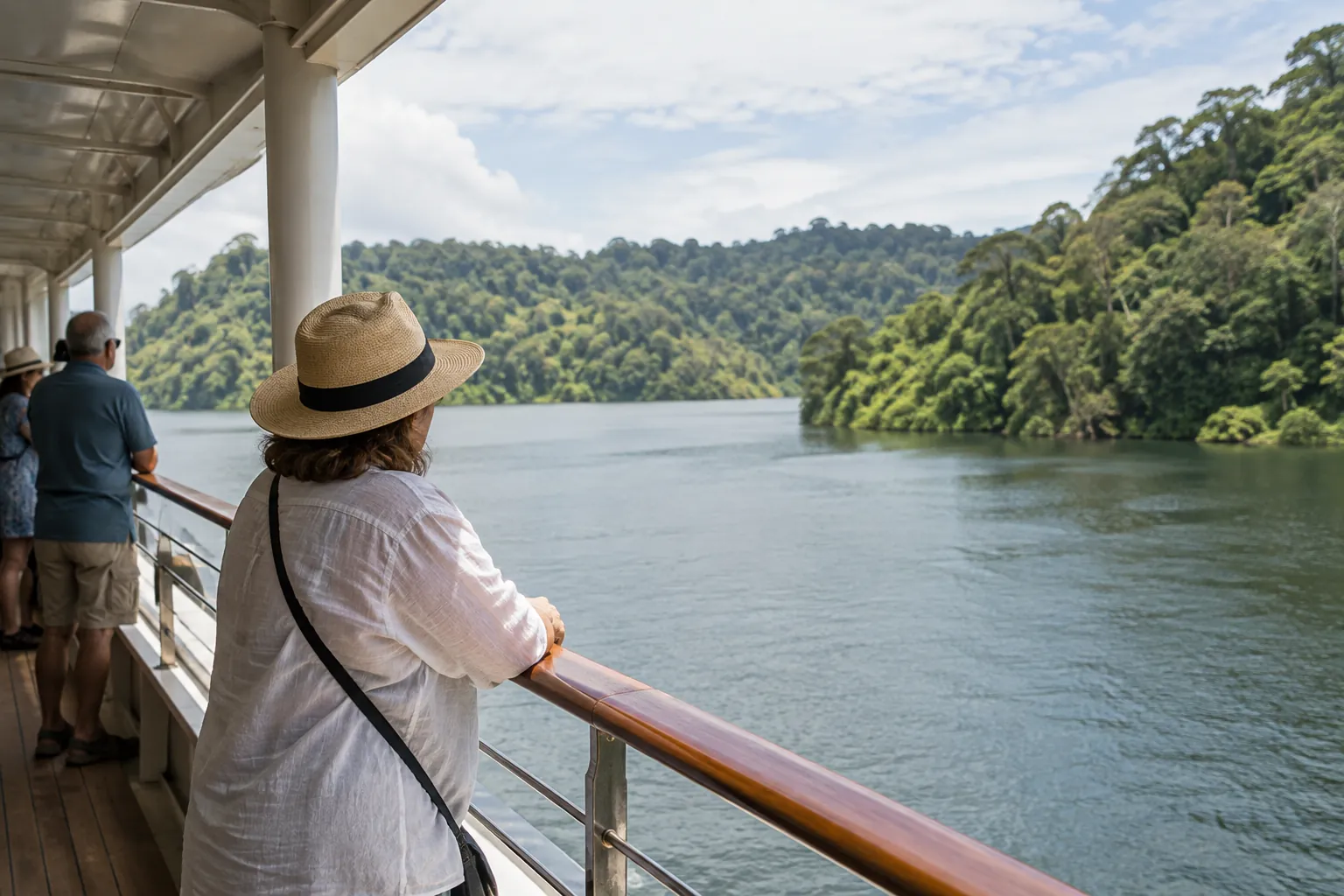
Transit day is the shelter
Partial transits from Florida enter the canal, turn around in Gatun Lake and return, keeping the itinerary inside the Caribbean's usual conditions. Full transits trade that for two ocean systems: the Caribbean approach plus the eastern Pacific run along Central America and Mexico. Booking April or May puts both oceans near their seasonal best. Winter transits are mostly fine too, but carry the Tehuantepec window on the Pacific side and firmer trades in the Caribbean.
When do you sail?
Get a day-by-day prep checklist that unlocks as departure gets closer. Free, stays on your device.
Finish preparation under shelter
Get Dizzout and your headphones ready from a fixed seat. Keep the kit closed while moving between indoor and outdoor parts of the journey.
Free to download. Paid subscription for full access.
30,000+ travelers in 30+ countries · How we count

On your phone? Scan to start there.
Comparing apps first? See how the motion sickness apps compare
Not travelling yet? Remind me the day before my trip

Cabin choice for this region
Choose midship low for the ocean legs on a full transit, and spend transit day on deck: the canal is the sight, and the water under you is a lake. The general rule behind it is the same everywhere, midship and low, and the ship guide explains why that spot moves least.
The ships, and what size buys you here
Canal size classes are real constraints: the original locks capped ships at Panamax dimensions, and the 2016 expansion opened Neopanamax locks that now take large cruise ships. Norwegian Bliss, which repositions between coasts, became the largest cruise ship to transit at the time in May 2018, a record set precisely because the new locks had just made it possible.
Know someone who gets motion sick?
Send them the app that helps stop it, drug-free, in about 90 seconds, works with any headphones. Free to download.
Frequently asked questions
Do you get seasick going through the Panama Canal?
+
On the transit day, essentially nobody does: the ship is in locks and on Gatun Lake, flat fresh water well above sea level. Seasickness on a canal itinerary happens on the ocean days before and after, not in the canal.
When is the best time for a Panama Canal cruise?
+
April and May. They fall after the winter gap wind season fades and before the Atlantic hurricane season gets going, which suits both approaches at once. The classic repositioning windows sit in exactly those weeks for a reason.
What is a Tehuantepecer?
+
A burst of gale force wind that funnels through a mountain gap onto Mexico's Gulf of Tehuantepec when winter cold fronts pile up to the north. Most events happen November to March and last from a day to several. Ships forecast around them; a winter transit or Pacific coast repositioning may detour or take a lively stretch there.
Are Panama Canal cruises calmer than Caribbean cruises?
+
The transit day is calmer than anything the Caribbean offers, and partial transits are otherwise ordinary Caribbean itineraries. Full transits add the eastern Pacific coast, which is usually gentle but has its own winter wind zones, so across a whole itinerary they are comparable rather than calmer.
Other regions
Related guides
Sources & further reading
Conditions described here are typical seasonal patterns drawn from published climatology and operator information as of September 2026, not a forecast: any month can deliver a calm sailing or a rough one, and itineraries change. Route and operator names are trademarks of their respective owners; Dizzout is not affiliated with or endorsed by them. Seasickness sensitivity varies from person to person; this page is informational and not medical advice.