
Is the Busan to Hakata (Fukuoka) crossing rough?
Usually manageable. Busan to Hakata crosses the Korea Strait overnight in about 9 hours on Camellia Line's New Camellia, with the return leg running by day in about 6. The strait is a shallow shelf sea with two windy seasons, and the big conventional ferry rides both far better than the fast craft that used to share the route.
Korea Strait · overnight, about 9 hours dock to dock · Reputation among passengers: mixed: commonly reported as uncomfortable in the wrong conditions.
Service status, September 2026
The high-speed Queen Beetle no longer sails: the service was suspended in August 2024 and JR Kyushu announced its full withdrawal from the Japan to Korea fast ferry business in February 2025. The overnight New Camellia continues, and the slower ship is also the steadier ride. Much of the web has not caught up with this change.
- Low
- Moderate
- High
- Very high
Roughness summarises typical reported conditions on this route, not a forecast for any given sailing.
The overnight strait, after the fast craft era
Key facts
- The Busan to Hakata (Fukuoka) crossing takes overnight, about 9 hours dock to dock, operated by Camellia Line.
- It crosses the Korea Strait, and passenger reports place the route in the moderate roughness band.
- What drives the rough days: The overnight strait, after the fast craft era.
- Conditions are reported roughest in January, February, August, September and December.
- The calmest months are usually April, May and June.
Taking the Busan to Hakata (Fukuoka) crossing? Dizzout is drug-free sound therapy you can start in your seat on the crossing, with relief in about 90 seconds.Starts in your browser · works with any headphones
Stop seasickness. Get your personalized Dizzout plan. Paid subscription for full access.

On your phone? Scan to start there.
Why the Busan to Hakata (Fukuoka) crossing gets rough
The Korea Strait sits between two monsoon systems: the winter north-westerlies chop it up from November to February, and late summer brings typhoon-season swell from the south. Between those windows it is often placid. Shallow shelf water means the rough version is short steep chop rather than ocean swell, which big slow hulls like New Camellia handle with a measured roll.
This route crosses the Korea Strait. For the full picture of that water, every crossing on it and what drives its reputation, see is the Korea Strait rough?
When it's worst, month by month
Winter monsoon (roughly November to February) and the August to September typhoon window are the two seasons to respect; late spring and early summer are the settled core.
| Roughest water in Jan | Roughest water in Feb | Roughest water in Mar | Roughest water in Apr | Roughest water in May | Roughest water in Jun | Roughest water in Jul | Roughest water in Aug | Roughest water in Sep | Roughest water in Oct | Roughest water in Nov | Roughest water in Dec |
|---|---|---|---|---|---|---|---|---|---|---|---|
| Rough | Rough | Mixed | Calm | Calm | Calm | Mixed | Rough | Rough | Mixed | Mixed | Rough |
Typical seasonal pattern, not a forecast. Any month can deliver a calm crossing or a bad one. Check the marine forecast for your sailing date. Select a month to see every sea and ferry crossing ranked for it.
Where to be on board
Front to back
- Bow (front)Avoid
- MidshipBest
- Stern (aft)OK
The crossing: about 9 hours overnight
Roughest stretch: The open strait between Busan and the Japanese coast
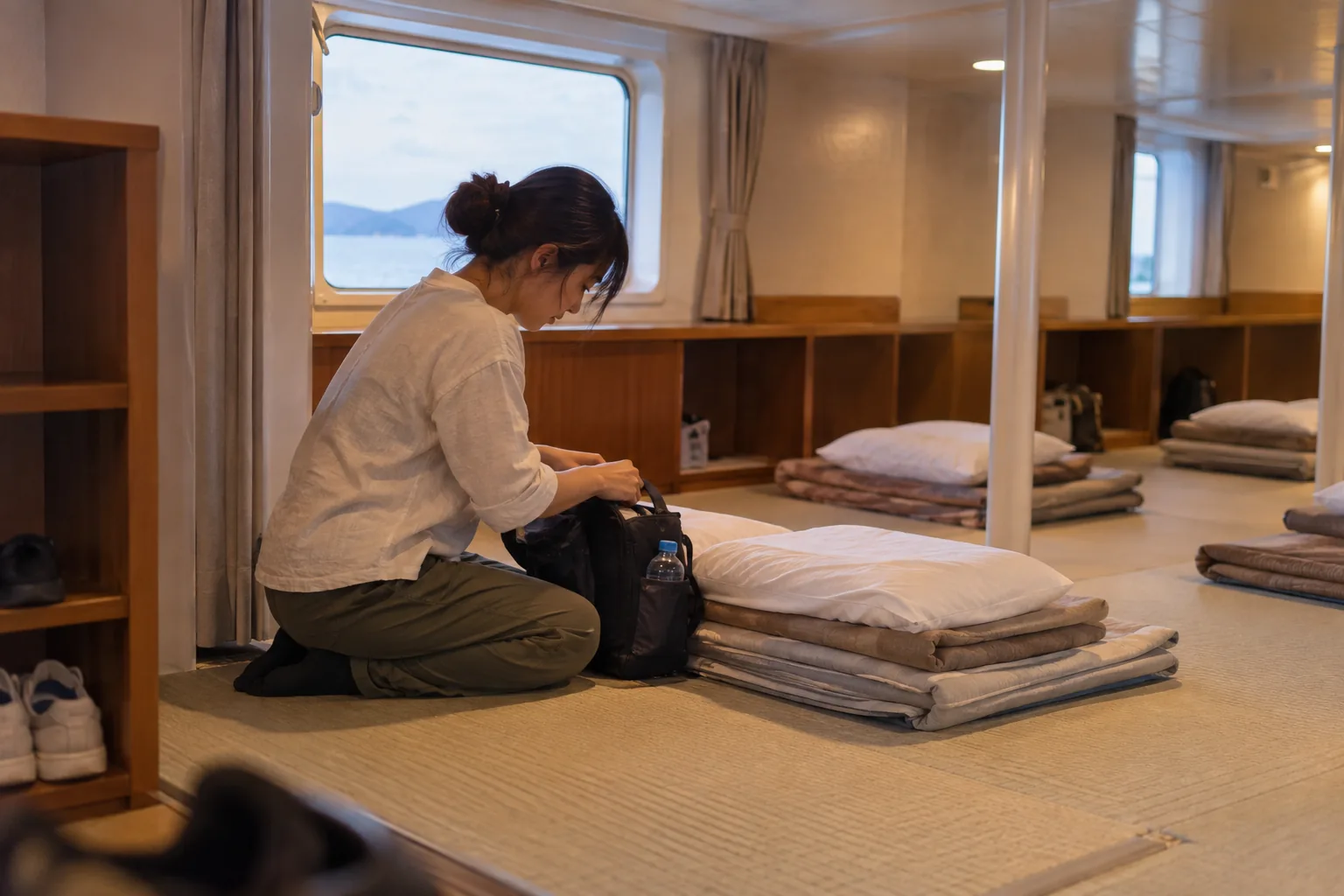
Midship berths low in the ship sleep steadiest; the shared tatami rooms let you claim a central patch of floor, which works surprisingly well.
Keep the audio pocket separate
Pack outer layers separately from your phone and ordinary headphones for Dizzout. Keep the audio pocket dry and easy to reach before boarding.
Free to download. Paid subscription for full access.
30,000+ travelers in 30+ countries · How we count

On your phone? Scan to start there.
Comparing apps first? See how the motion sickness apps compare
Not travelling yet? Remind me the day before my trip

Know someone who gets motion sick?
Send them the app that helps stop it, drug-free, in about 90 seconds, works with any headphones. Free to download.
What helps on this crossing
- Book a midship berth or claim a central spot in the shared rooms early.
- Eat in Busan rather than testing the on-board options in a winter blow.
- The overnight schedule is the motion-sensitive traveller's friend: be horizontal by the time the open strait arrives.
- In typhoon season, watch the tracks a few days out; sailings adjust around storms rather than sailing into them.
For the full toolkit see the seasickness guide, or what to do once it has already started. Choosing between a fast catamaran and a conventional ship elsewhere too? The physics is the same everywhere: see the catamaran guide. If the rocking follows you ashore afterwards, that is land sickness, which is normal, and it passes.
Frequently asked questions
Is the Busan to Fukuoka ferry rough?
Mostly moderate: the strait is a shallow shelf sea whose chop rises in the winter monsoon and the late-summer typhoon window, and stays gentle much of the rest of the year. The overnight New Camellia is a conventional ship that rides those seasons with a slow roll rather than a fast craft's slamming.
Does the Queen Beetle fast ferry still run to Fukuoka?
No. The high-speed Queen Beetle was suspended in August 2024, and in February 2025 JR Kyushu announced it was withdrawing from the Japan to Korea fast ferry business entirely. The sea crossing is now made overnight on the conventional New Camellia, with Kampu Ferry and Panstar covering the other Korea to Japan routes.
How long is the crossing?
About 9 hours dock to dock overnight from Busan to Hakata; the return leg runs by day in about 6 hours. Camellia Line operates the route.
Should I take seasickness medicine for the night ferry?
Ask a pharmacist or doctor, ideally before travel day; most motion sickness medicines are labelled for use before departure. Mention that it is an overnight sailing of about 9 hours, since drowsiness guidance reads differently when sleep is the plan.
Other ferry routes
Sources & further reading
Your next question, probably
Where on the ship should you be?
Which cabins move least, and what to do if you already booked one
Not your question? What actually works at sea?Sick right now, mid-crossing?Still rocking after you land?
Conditions described here are typical patterns drawn from published marine and operator information as of September 2026, not a forecast: any month can deliver a calm crossing or a bad one, and schedules, vessels and operators change. Route, vessel and operator names are trademarks of their respective owners; Dizzout is not affiliated with or endorsed by them. Seasickness sensitivity varies from person to person; this page is informational and not medical advice.