
The short answer
Varifocals can make a journey worse, and they are rarely the whole story. A progressive lens puts your reading power at the bottom and blurs the outer corners, so a view already sliding past the window slides in a way your inner ear does not agree with. The American Academy of Ophthalmology says plainly that looking through the wrong section of the lens can leave you feeling off balance or nauseated. No study has tested progressive lenses in a moving vehicle, so nobody can honestly tell you they cause car sickness. Most people adapt over a week to a couple of months, and journeys usually settle with them. If yours have not, that is a question for your optician, not a reason to stop wearing what you were prescribed.
The timing is what makes people suspicious. The glasses arrive on a Tuesday, and by the weekend a drive that was never a problem ends with the window down.
Opticians talk about stairs and computer screens when they hand over a first pair. Almost nobody mentions the passenger seat, where the lens and the moving view pull hardest against each other.
Prone to motion sickness? Queasy in the passenger seat right now? Drug-free sound therapy, any headphones, about 90 seconds.Starts in your browser · works with any headphones
Get your personalized Dizzout plan. Paid subscription for full access.

On your phone? Scan to start there.
The pattern: new varifocals, and journeys got worse
Two things are true at once. New glasses are the most obvious change, so they get the blame, and balance and eyesight both shift over the same years anyway. But the lens is not innocent either.
Be straight about the evidence, though. Nobody has put progressive lens wearers in a moving vehicle and counted the nausea. Anyone telling you varifocals cause car sickness has gone past what is known. What exists is optical guidance on what these lenses do to vision, and laboratory work on what that distortion does to the sense of motion.
What a progressive lens does to the edges of your view
A progressive lens is one piece of glass doing three jobs. The American Academy of Ophthalmology puts it plainly: the top is for far away objects, the middle for intermediate ones, the bottom for close work. That ramp is paid for at the sides. Blending several powers into one surface leaves blur and skew towards the outer edges, which is why the same guidance says progressives can cause peripheral distortion when you move your eyes from side to side, and warns that you may feel off balance or even nauseated from looking through the wrong section of the lens. Wearers call it the swim effect.
Researchers have measured what that distortion does to the sense of motion. A 2021 study in iScience simulated progressive lens distortion in virtual reality and asked thirteen young adults to judge which way they were travelling. When the simulated distortion landed on the periphery, the angle they read as straight ahead moved by 0.43 degrees: travelling parallel to the ground felt like lifting off it slightly. A small shift, in a simulation rather than in real glasses on a real head. The authors say it could relate to the swim effect and contribute to the discomfort and nausea some wearers report.
Why the passenger seat is the worst place for them
Ordinary car sickness is a disagreement between your senses. Your inner ear feels the car accelerate, brake and lean. Your eyes, fixed on something inside it, report a world holding still. The brain gets two accounts and answers with nausea.
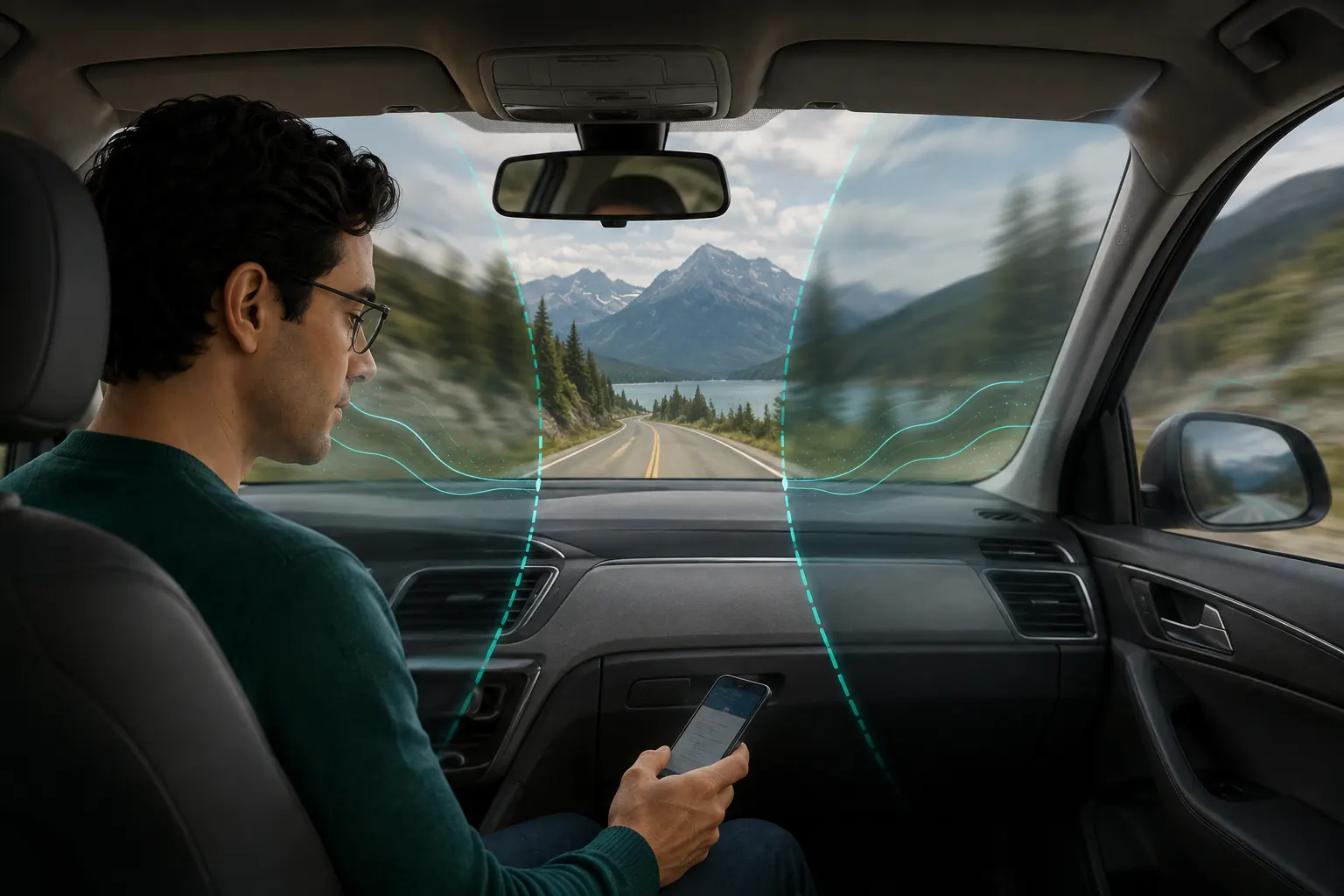
A lens that distorts the edges alters the moving half of that picture. Out of a car window the whole scene sweeps past, and the strongest part of that sweep sits at the edges of your vision, exactly where the lens distorts most. A passenger also does the thing that makes it worse: looking around. A passenger checks a phone, reads the sat nav, turns to talk to the back seat, and each move drags the scene across a different part of the lens.
Reading through the bottom of the lens in a moving vehicle
Reading in a car is a reliable way to feel ill with no glasses involved, and why reading in a car makes you sick covers that. Varifocals add something physical on top. You tip your chin down to read through the near zone at the bottom of the lens, and the widest patches of blur sit either side of it. So while your near vision is on the page, the moving world outside arrives through the least honest part of the glass.
The lens changes how you move, too. The Academy's own instruction is to point your nose at what you want to see and adjust your chin until it looks clear, so a new wearer turns their head where they used to move only their eyes. Everything else about travel advice pushes the other way: keep your head still against the headrest. The same problem covers looking at your phone in the car, and I can't read in the car without getting sick has the fuller answer.
The adaptation window, and when it is not adaptation
Most of this settles. The Academy puts the adjustment period at a week to a couple of months, and the advice is to wear them consistently while you learn where the zones are. Journeys often improve on the same curve. So the first question is how long it has been. Three weeks of odd drives in a new prescription is ordinary. Six months is not.
Keep wearing what you were prescribed while you sort it out. The prescription, the lens design and the fit all need measuring, and your optician makes that call.
A distance only pair as a travel pair
Here is the practical thing worth asking about. Plenty of varifocal wearers keep a second pair of single vision distance glasses for particular situations. Travel is a candidate: on a journey you mostly want to see out of the window, and a distance only lens has one power across the whole surface, so there is no reading zone and no blur creeping in at the edges.
The evidence for a second pair is worth reading carefully, because it answers a different question. The 2010 BMJ trial VISIBLE gave single lens distance glasses to 606 multifocal wearers with a mean age of 80 who were already at raised risk of falling, with advice to wear them for walking and outdoor activity. Across the whole group falls dropped 8%, which was not statistically significant. The subgroups split: falls fell in people who regularly got outdoors, and outside falls rose in people who did not. So a second pair is a real strategy with conditions attached, and the trial paired it with counselling on which glasses to wear when. It says nothing about nausea in a moving car.
So ask, do not improvise. Book the eye test, describe the journeys, and let the optician decide whether a distance only pair suits you and when to wear it. Motion sickness in older adults covers what else changes over the same years. One clarification, because search results mix them up: the fluid-rimmed motion sickness glasses sold as a travel gadget are a different product, and that page grades them a no.
Coaches, boats and trains
- Coaches and buses. Tall windows and a high seat put more moving scenery at the edges of your vision than a car windscreen does. Sit forward, and keep your eyes up. Where to sit on a bus has the rest.
- Boats and ferries. Holding the horizon is distance vision work. The reading zone does nothing for it, and looking down at a deck or a phone is the worst combination on board.
- Trains. Sideways motion past the window lands on the lens periphery. Face forward, and look up the carriage when it starts.
What to tell your optician
Opticians can help, but most people arrive saying the glasses feel funny. Bring specifics:
- When it started, and what the new glasses replaced.
- Which journeys, in which seat, looking at what.
- Whether it happens at a desk or on stairs too.
- Whether it stops when you take them off, or wear an older pair.
- How many hours a day you wear them. Part-time wear stretches adjustment.
Then ask about the fitting heights and frame fit, about lens designs with a wider clear corridor, and about a distance only pair for travel. Those are dispensing decisions, and they belong to the optician.
While the appointment sits in the diary, the journey is still a journey. The remedy finder sorts the options by the evidence behind them, and if one is going badly right now, the 60-second protocol is the page you want. Drug-free sound therapy is one option on it.
When the journey has already turned
Stop the nausea
A lens appointment is a next-week fix. Dizzout is for the seat you are in now: precisely calibrated audio through any headphones, one option designed to help calm the response in about 90 seconds. Drug-free and no drowsiness. Free to download on iOS and Android, subscription for full access.
Get your personalized Dizzout plan. Paid subscription for full access.
30,000+ travelers in 30+ countries · How we count

On your phone? Scan to start there.
Comparing apps first? See how the motion sickness apps compare
Frequently asked questions
Can varifocals cause motion sickness?
No study has tested progressive lenses in a moving vehicle, so nobody can honestly say they cause car sickness. What is documented is that the edges of the lens blur and skew what you see, and that the American Academy of Ophthalmology warns you may feel off balance or even nauseated from looking through the wrong section. In a vehicle, where a moving view is already fighting your inner ear, that is a plausible way to make an existing tendency worse.
Why do my new glasses make me feel sick in the car?
Usually because you are looking through parts of the lens your brain has not learned yet. Progressive lenses blur and skew towards the lower outer corners, which is exactly where the scene sweeping past a car window lands, and reading through the narrow zone at the bottom puts the worst of that distortion between you and the outside world. Most people find it eases as they adapt over the following weeks. If it does not, book an eye test and keep wearing what you were prescribed until you have been seen.
How long do varifocals take to get used to?
The American Academy of Ophthalmology puts the adjustment period at anywhere from a week to a couple of months, and says to wear them as consistently as you can while you learn where the zones are. Part-time wear tends to stretch that out. If nothing has improved after a couple of months of daily wear, that is the point to go back to your optician rather than push on.
Should I wear varifocals as a passenger?
Keep wearing what your optician prescribed, and ask them about it rather than deciding yourself. What you can change without asking anyone is habit: hold a phone or book higher so you are not folding your chin onto your chest, keep your head still against the headrest, and look out at the road before the queasiness builds. If journeys are a recurring problem, ask whether a single vision distance pair for travel makes sense for your prescription.
Do progressive lenses cause dizziness?
Some wearers report a swimming, off-balance feeling in the first weeks, and the optical guidance says as much. There is laboratory work behind it too: a 2021 iScience study simulated progressive lens distortion in virtual reality and found that peripheral gaze tilted people's sense of the direction they were travelling, by a fraction of a degree. It usually fades with adaptation. Dizziness that comes with hearing changes, spinning attacks, or symptoms lasting well beyond the journey is worth seeing a doctor about, since that is no longer a question about glasses.
Someone you know gets motion sick?
Send them this guide. It might be the trip it saves.
Your next question, probably
What actually works for reading in the car?
Remedies compared, side by side
Not your question? Why does reading in a car do this at all?Which remedies have evidence behind them?Is an app worth it for journeys?
About this article
by the Dizzout editorial team.
- American Academy of Ophthalmology: Pros and cons of progressive lenses (zones, peripheral distortion, off balance and nausea, adjustment period)
- Sauer Y, et al. Self-motion illusions from distorted optic flow in multifocal glasses. iScience, 2021 (lens distortion simulated in virtual reality, 13 participants)
- Haran MJ, et al. Effect on falls of providing single lens distance vision glasses to multifocal glasses wearers: VISIBLE randomised controlled trial. BMJ, 2010
This article is informational and not a substitute for medical or optical advice. Keep wearing the glasses you were prescribed, and take any question about your lenses, your prescription or persistent dizziness to your optician or doctor. Brand names are trademarks of their respective owners.