How to Read in the Car Without Getting Sick: Best Remedies
The best remedy for reading in the car without getting sick depends on whether your eyes stay on the screen. Visual-cue tools like Apple Vehicle Motion Cues and KineStop add moving dots to your phone so your eyes and inner ear stop disagreeing - but they only help while you keep looking at the screen, in a car. For when you glance out the window, close your eyes, or already feel queasy, Dizzout is a drug-free sound-therapy app that works on any headphones, eyes-up or eyes-closed, with most users feeling better in about 90 seconds.
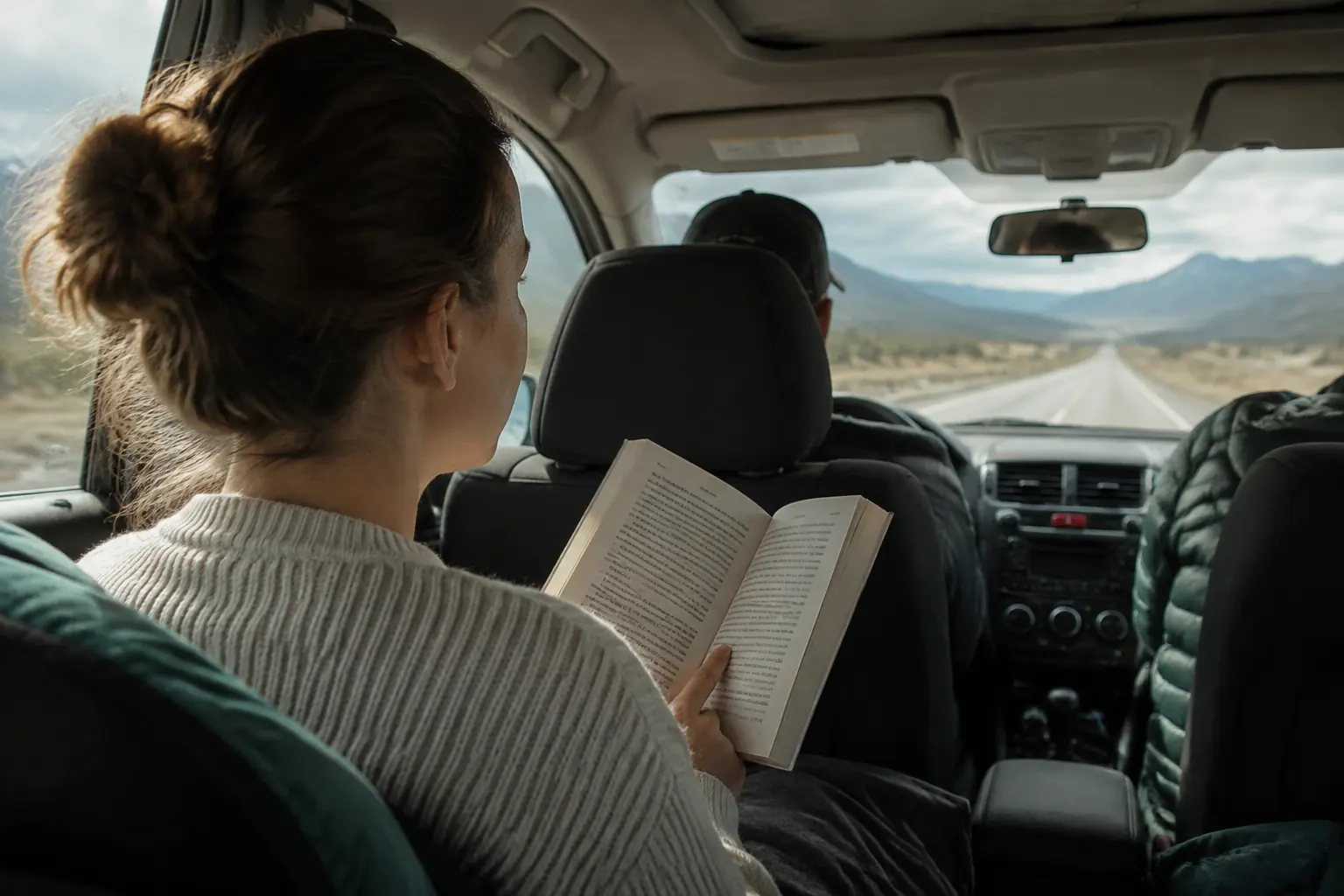
Reading in a moving car makes a lot of people queasy for one reason: your inner ear feels every turn, brake, and bump, while your eyes - fixed on a page or a phone - report that nothing is moving. Your brain reads the mismatch as a problem and answers with nausea. The good news is that the remedy you want depends entirely on what your eyes are doing while you read.
If your eyes stay glued to the screen, a visual cue can close that gap. If you look up to talk, glance out the window, rest your eyes, or you have already started to feel sick, a visual remedy stops helping. This page compares the two visual-cue options most people reach for - Apple Vehicle Motion Cues and KineStop - against Dizzout, a drug-free sound app built for the moments when you are not staring at a screen.
There is a drug-free option in this comparison too. Dizzout works through precisely calibrated sound on any headphones, free to try on iOS and Android.
Free to try, no card needed. Or go straight to the App Store or Google Play.
Reading in the car: visual-cue tools vs. Dizzout's drug-free sound
| Feature | Apple Vehicle Motion Cues | KineStop | Dizzout |
|---|---|---|---|
| How it works | On-screen moving dots | On-screen artificial-horizon dots | Calibrated sound via headphones |
| Works while looking at screen | Yes | Yes | Yes |
| Works when you look away or close eyes | No | No | Yes |
| Works after symptoms start | Not designed for it | Not designed for it | Yes |
| Where it works | Cars only | Cars only | Any vehicle |
| Causes drowsiness | No | No | No (drug-free) |
| Platforms | iPhone (iOS 18) | Android | iOS + Android |
| Price | Free (built in) | Free core (paid themes) | 3 free sessions, then $7.99/mo or $49.99/yr |
How visual-cue tools work (and where they stop)
Apple's Vehicle Motion Cues, built into iOS 18, shows a ring of dots along the edges of your iPhone screen that drift in sync with the car's movement. KineStop, an Android app from indie developer Urbandroid, does something similar: it overlays a moving "artificial horizon" of dots on top of whatever you are reading. Both give your eyes a visual signal that matches the motion your inner ear already feels, shrinking the sensory disagreement that contributes to car sickness.
For a passenger reading or scrolling on a phone, this genuinely helps, and both are free to try. The catch is built into the mechanism: the cue only exists on the screen. The moment you look up at the road, glance out the window, close your eyes, or switch to a paper book, there is no visual cue to anchor you. They are designed as prevention while you watch the screen, not as relief once nausea has set in - and they only address car rides, not boats, planes, or trains.
How Dizzout fits the moments visual cues miss
Dizzout takes a different route. Instead of giving your eyes something to look at, it plays calibrated sound through your headphones, so it does not matter where you point your eyes. You can read, look up to chat, watch the road, or close your eyes entirely and the sound is still working. It runs on any wired or Bluetooth headphones - no special hardware - on iOS and Android.
That makes Dizzout a natural companion to a visual cue rather than a straight replacement. Two situations are where it earns its place: when you look away from the screen, and when you are already queasy. It is drug-free, so there is no drowsiness and nothing to time an hour ahead, and it is designed to work both before you travel and after symptoms have already started. Most users feel better in about 90 seconds.
Honest pricing and what "free" really means
Both visual tools are easy to start with: Apple Vehicle Motion Cues is free and already built into iOS 18, and KineStop's core feature is free on Google Play (a small one-time payment unlocks extra themes). Dizzout is freemium, not free forever: you get 3 full sessions free to try, then it is $7.99/month or $49.99/year if you decide to keep it. We would rather say that plainly than surprise you.
A sensible, low-cost way to read in the car: turn on the visual cue you already own for free, and keep Dizzout's free sessions ready for the times you look away from the screen or start to feel sick. Try the visual option first since it costs nothing, and reach for Dizzout when the visual cue stops doing the job.
When to use which
If you mostly read on your phone with your eyes on the screen, start with the free visual cue you already have: Vehicle Motion Cues on an iPhone, or KineStop on Android. If you tend to look up, glance out the window, read a paper book, rest your eyes, or you often feel sick before you can prevent it, a sound-based option like Dizzout covers those moments because it does not depend on where you look. Many people use both: the visual cue while staring at the screen, Dizzout for everything else. None of these is a medical treatment, and if car sickness is frequent, severe, or affecting daily life, talk to a doctor or pharmacist about the right approach for you.
Try drug-free motion sickness relief
Try Dizzout Free
Free to try on iOS and Android · ~90 seconds · works on any headphones.
Frequently asked questions
Can I read a paper book in the car, or do these only help on a phone?
The visual-cue tools only help on a phone, because the moving dots live on the screen you are looking at - a paper book gives your eyes nothing to anchor to. Dizzout works through sound regardless of what you are reading, so it covers a paper book, an e-reader, or your eyes resting between pages.
I already feel carsick from reading - what helps now?
Visual-cue tools are built to prevent the mismatch while you stare at the screen, not to settle nausea that has already begun. At that point it usually helps to put the reading down and look at the road ahead, get cool air, and steady your balance. Dizzout is designed to be used after symptoms have already started, and most users feel better in about 90 seconds - but it is not a medical treatment, and severe or frequent nausea is worth raising with a doctor.
Do I need to buy anything to read in the car without getting sick?
Not necessarily. Apple Vehicle Motion Cues is free and built into iOS 18, and KineStop's core feature is free on Android, so the cheapest start is the visual cue you already own. Dizzout is free to try with 3 full sessions before it becomes a $7.99/month or $49.99/year subscription, which makes it a low-cost way to test sound therapy for the times you look away from the screen.
There is no single best remedy for reading in the car - there is the right tool for what your eyes are doing. Keep the free visual cue on for screen reading, and have a drug-free sound option ready for the moment you look up, close your eyes, or start to feel queasy. Dizzout is free to try on any headphones, so you can see how it feels for yourself before you commit. Try Dizzout Free.
Related comparisons
- Why reading triggers car sickness - and how to prevent it
- Dizzout vs KineStop: a drug-free alternative
- The best motion sickness app, compared
- All motion sickness comparisons
This page is informational and not a substitute for professional medical advice - talk to a doctor or pharmacist about your situation. Product and brand names are trademarks of their respective owners; Dizzout (Kinda Smart Inc.) is not affiliated with or endorsed by them.