The short answer
The best seat on a bus for motion sickness is in the front third, roughly over or just behind the front axle, by a window, facing forward. Motion is gentlest there, and you can see the road ahead, so your eyes confirm what your inner ear feels. The back row is the worst seat on the vehicle: it hangs behind the rear axle and magnifies every bump, and on most coaches the engine sits right underneath it. On a double decker, stay on the lower deck. If you cannot choose your seat, face forward, look out at the road, and keep your phone in your pocket.
You know the pattern. The first ten minutes are fine, then the bus swings through a roundabout, brakes hard behind a cyclist, and pulls away again, and your stomach files a complaint. Where you sit decides how big that complaint gets, and the difference between the best seat and the worst one on the same vehicle is bigger than most people expect.
This guide covers the exact rows to aim for on a city bus, a long-distance coach, a school bus and a double decker, and what to do on the days the good seats are gone before you board.
Sick on the bus? Drug-free relief in about 90 seconds, on the headphones you already wear on the bus.Starts in your browser · works with any headphones
Stop travel sickness on your commute. Get your personalized Dizzout plan. Paid subscription for full access.

On your phone? Scan to start there.
The short answer: front third, over the front axle
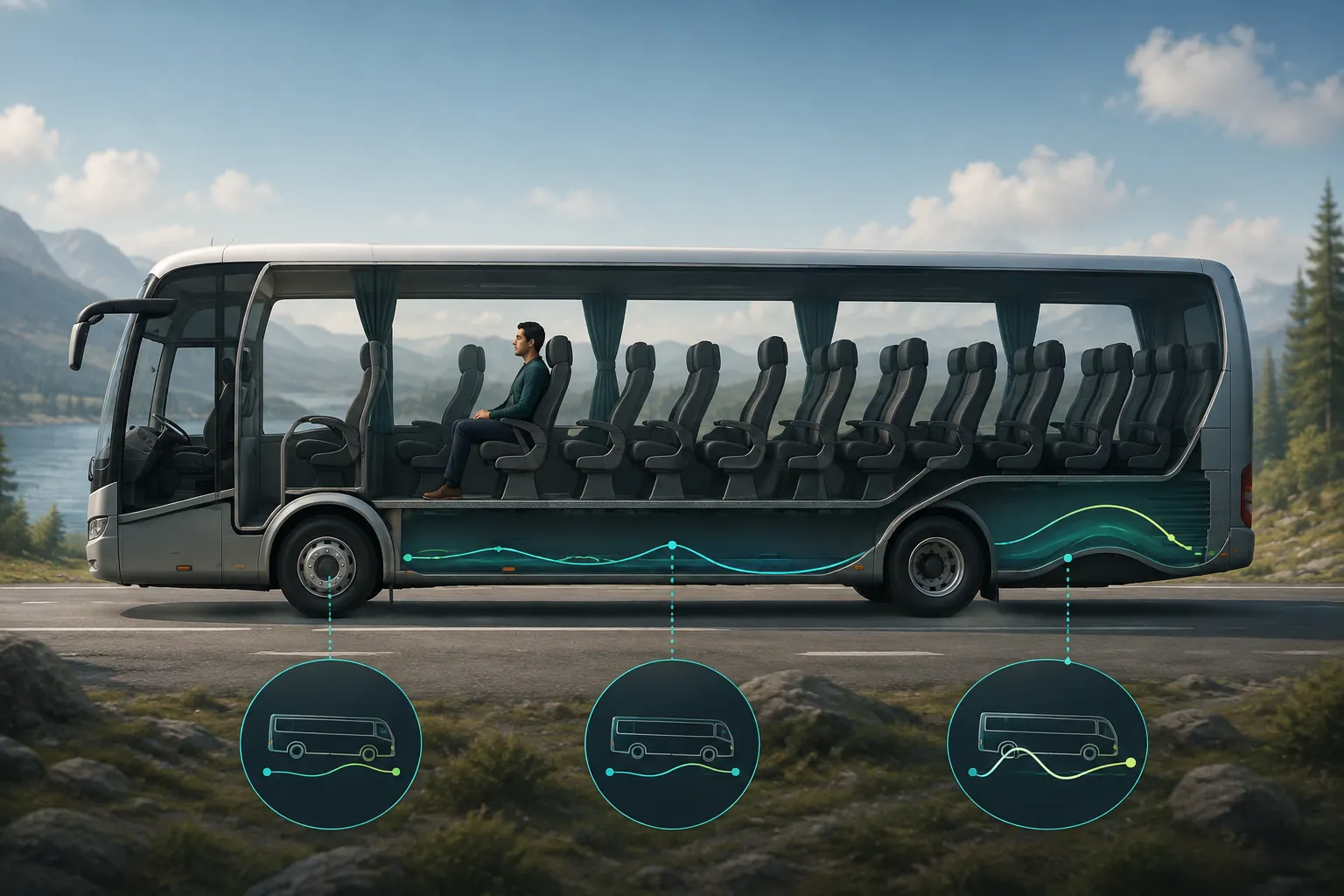
A bus pivots around its axles. Sit between them and near the front, and the vehicle's pitching and bouncing pass through you at their smallest. Sit far behind the rear axle and you ride the end of a lever: the same speed bump that nudges the driver launches the back row.
The front third wins on the second factor too: the view. Motion sickness starts as a mismatch between your senses, your inner ear feels the bus move while your eyes, fixed on a seatback or a phone, report a still world. From the front you can watch the road through the windshield, so your eyes and inner ear tell the brain the same story. In a survey of 3,256 coach passengers, feeling ill was almost three times as common among riders with no view of the road ahead as among those who could see it clearly. The front seats fix exactly that.
- Prefer
- Front third, over or just behind the front axle. The calmest ride, plus a clear view of the road ahead.
- Alternative
- Middle, between the axles. Motion is still moderate, but the forward view is mostly seatbacks.
- Watch for
- Back row, behind the rear axle. Bumps are magnified, and on most coaches the engine sits underneath.
Why the back of the bus is the worst place to be
Kids fight for the back row because it is the bounciest seat on the bus. That is precisely the problem. The rear seats overhang the rear axle, so every bump and dip gets amplified before it reaches you, the same way the end of a diving board moves more than the middle.
The back row stacks other problems on top. On most modern coaches the engine sits at the rear, adding heat and vibration right under your seat. The rear toilet on a long-distance coach adds smells, another thing your stomach does not need. And from the back you can see almost nothing of the road ahead, so every turn and stop arrives as a surprise your eyes never predicted.
Window or aisle, and which side of the bus
Window, clearly. Not for comfort but for information: a window seat lets you look out and give your eyes the motion your inner ear is already feeling. Look far down the road or at the horizon, not at the guardrail flicking past beside you. Nearby objects streak by too fast to help.
Which side matters much less than which row. Two small tiebreakers: pick the shaded side on a hot day, since cool air on your face helps, and if watching oncoming traffic rush at you feels bad, sit on the side away from it. Neither beats moving up ten rows.
Coaches and long-distance buses: picking a seat when you book
Most coach operators let you pick a numbered seat at booking, which means you can win this battle days before the trip:
- Book rows 1 to 5. The seats right behind the driver combine the calmest motion with the windshield view.
- Take the window. You want the outside view for the whole ride, not just when your neighbour leans back.
- Avoid the last three rows. Rear axle, engine, toilet: the three worst features of the vehicle, stacked.
- Never book a rear-facing seat. Some coaches have table groups where two seats face backwards. In the same coach survey, riding backwards raised illness ratings measurably, so give those seats away.
Double deckers: upper or lower deck
Lower deck, front half. Height amplifies sway: the higher you sit above the road, the further you swing on every corner and lane change. The famous front-top seat has the best view in public transport and one of the wobbliest rides, which is a fair trade on a special occasion and a bad one on a daily commute.
If you do ride upstairs, the front seats are still your best option there, because the panoramic view lets your eyes track every movement. Just know that the same journey one deck down is calmer.
School buses and city buses when you cannot choose
School buses are open seating, and school-age kids are the group most prone to motion sickness in the first place: the CDC notes susceptibility peaks between ages 7 and 12. The playbook for a child is the same as for an adult. Get on early enough to sit in the front third, take the window, look outside, and keep books and screens in the bag until the bus stops.
On a crowded city bus, work with what is left. A forward-facing seat in the middle beats the rear bench. Skip the side-facing bench seats if you can, since they put the bus's motion at a right angle to everything your eyes see. Standing, hold a rail, face forward, keep your knees soft, and look out at the road above the passengers' heads. If it builds anyway, getting off one stop early and walking the rest is a legitimate fix.
What to do once you are seated
The seat sets your baseline. What you do in it decides the rest:
- Look up and out. Eyes on the road ahead or the horizon, especially through turns and stops.
- Do not read or scroll. A phone or book locks your eyes on a still object while the bus moves, which is the exact conflict that starts the nausea. Podcasts and music are the bus-friendly formats.
- Get air moving. Open the vent, crack the window if you can, take the shaded side. Fresh air on your face helps.
- Keep your head still. Rest it against the seat or window frame so it stops adding its own motion.
- Ride on a light stomach. A small plain snack before boarding beats both a heavy meal and an empty tank.
If the bus is part of your daily routine and the queasiness is too, the commuter's guide covers the patterns that make weekday rides worse and what regular riders change first. And for how buses compare with every other vehicle, the best seat guide maps the calm zones on planes, trains, cars and boats.
When the seat is not enough
Some days the front seats are taken before you board, and some riders feel sick from row two anyway. Seat choice lowers the odds; it does not switch the mechanism off. So it is worth having something that works from any seat on the vehicle.
One option is sound therapy through the headphones you are probably already wearing on the bus. Dizzout plays precisely calibrated audio designed to help calm the response in about 90 seconds, from any seat, with your eyes open or closed. It is drug-free and does not cause drowsiness, which matters when the bus is taking you to work or an exam rather than a beach. The app is free to download, with a paid subscription for full access.
Relief that rides in any seat
Stop the nausea
When the good rows are gone, the seat map cannot help you. Dizzout plays precisely calibrated audio through any headphones, from the back row as well as the front. Drug-free, no drowsiness, about 90 seconds. Free to download on iOS and Android.
Get your personalized Dizzout plan. Paid subscription for full access.
30,000+ travelers in 30+ countries · How we count

On your phone? Scan to start there.
Comparing apps first? See how the motion sickness apps compare
Frequently asked questions
Is the front or back of the bus better for motion sickness?
The front, clearly. The front third of the bus sits near the front axle, where pitching and bouncing are smallest, and it gives you a view of the road ahead so your eyes and inner ear agree. The back row hangs behind the rear axle, which amplifies every bump, and it usually adds engine heat and vibration underneath.
Is a window seat better on a bus?
Yes. The point of the window seat is the view: looking far down the road or at the horizon gives your eyes the motion your inner ear is feeling, which reduces the sensory mismatch behind the nausea. An aisle seat leaves you staring at seatbacks and other passengers, which does not help.
Where should you sit on a double decker bus?
Lower deck, front half. Height amplifies sway, so the upper deck swings further on every corner than the lower deck does on the same road. The front-top seat has a wonderful view but one of the wobbliest rides on the bus, so save it for days when you feel robust.
Why does the back of the bus feel so much bouncier?
The rear seats overhang the rear axle, so the back of the bus acts like the end of a lever. When the wheels hit a bump, the overhang swings further than the space between the axles, the same way the tip of a diving board moves more than its middle. Add the engine under the floor on most coaches and you get the roughest, warmest, most vibration-heavy seats on the vehicle.
What helps if every good seat is taken?
Take the most forward-facing seat left, look out at the road instead of at a screen, keep cool air on your face, and hold your head still against the seat. If nausea builds anyway, drug-free options that work from any seat include controlled breathing and sound therapy through headphones; the Dizzout app is one option designed to help calm the response in about 90 seconds. Getting off a stop early to walk is also a real fix, not a defeat.
Someone you know gets motion sick?
Send them this guide. It might be the trip it saves.
Your next question, probably
Which seat is best on every other vehicle?
Cars, planes, trains and boats compared
Not your question? Why does the bus set you off at all?Is the daily commute making it worse?Feeling it right now?
About this article
- Turner M, Griffin MJ. Motion sickness in public road transport: passenger behaviour and susceptibility. Ergonomics, 1999.
- Turner M, Griffin MJ. Motion sickness in public road transport: the effect of driver, route and vehicle. Ergonomics, 1999.
- CDC Yellow Book. Motion sickness.
This article is informational and not a substitute for medical advice. If motion sickness is severe, frequent, or comes with hearing changes or lasting vertigo, talk to your doctor. Brand names are trademarks of their respective owners; Dizzout is not affiliated with or endorsed by them.