
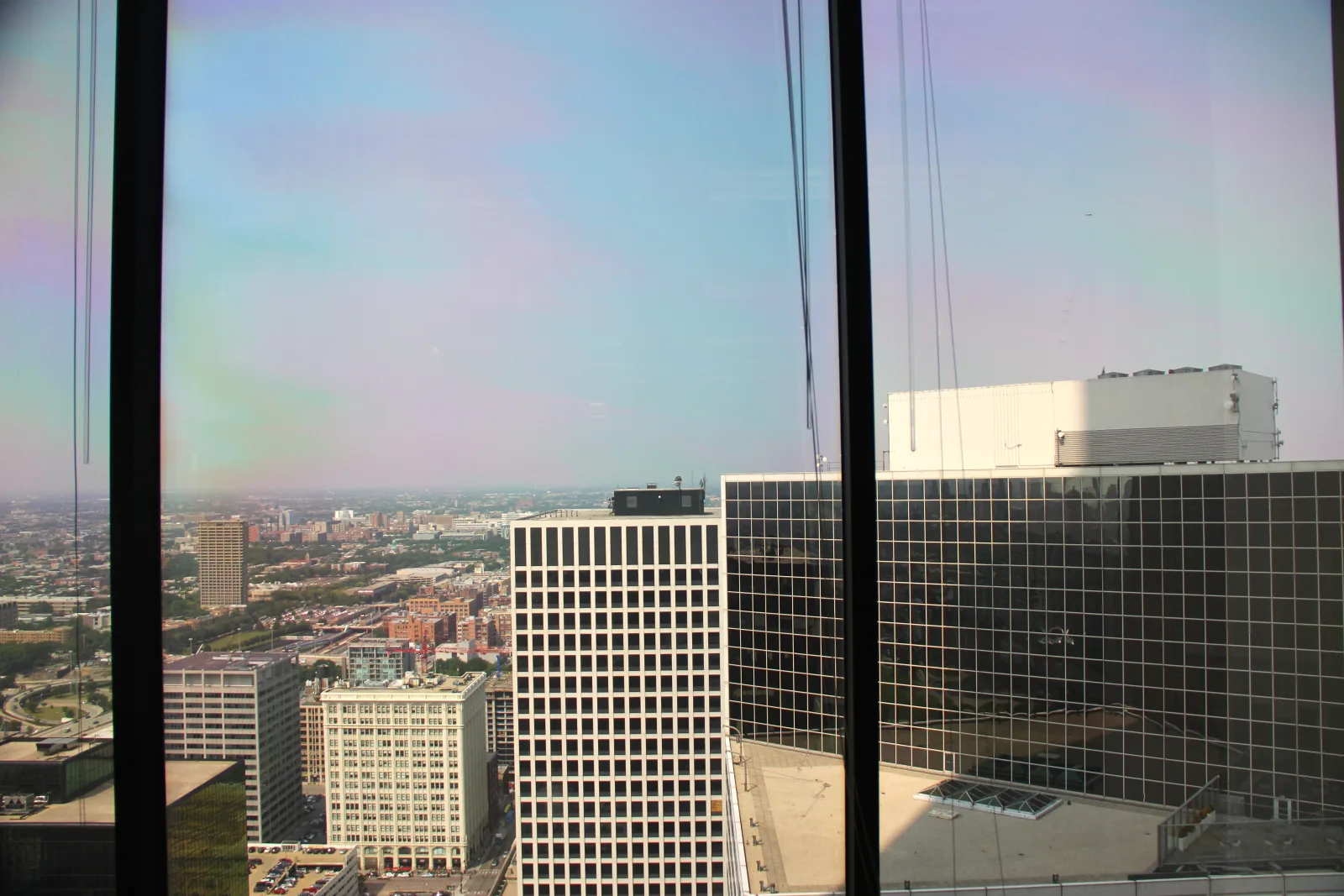
The short answer
Yes, a tall building moves in the wind, and on a high floor you can feel it. Towers are built to flex rather than stand rigid, so wind leans the upper floors a small distance and lets them drift back, taking seconds to complete each pass. Your balance system registers that slow motion and your eyes cannot confirm it, because the desk, the walls and the window frame all move with you. Plenty of people on the same floor notice nothing at all. Others feel queasy, get a headache, or turn strangely tired on windy afternoons, and that response has been measured in office workers.
You are at your desk on floor thirty-something. Nothing is happening, and yet something is. A blind cord swings with nobody near it. Your coffee has a ripple in it. There is a queasy edge that arrived with the weather.
Search for it and you land in wind engineering papers written for the people who design towers. Here is the occupant's version: why the building moves, why the top notices, and what you can do without leaving work.
Prone to motion sickness? Drug-free and no drowsiness, which matters when the rest of the day is work. About 90 seconds on any headphones.Starts in your browser · works with any headphones
Get your personalized Dizzout plan. Paid subscription for full access.

On your phone? Scan to start there.
Buildings are supposed to move
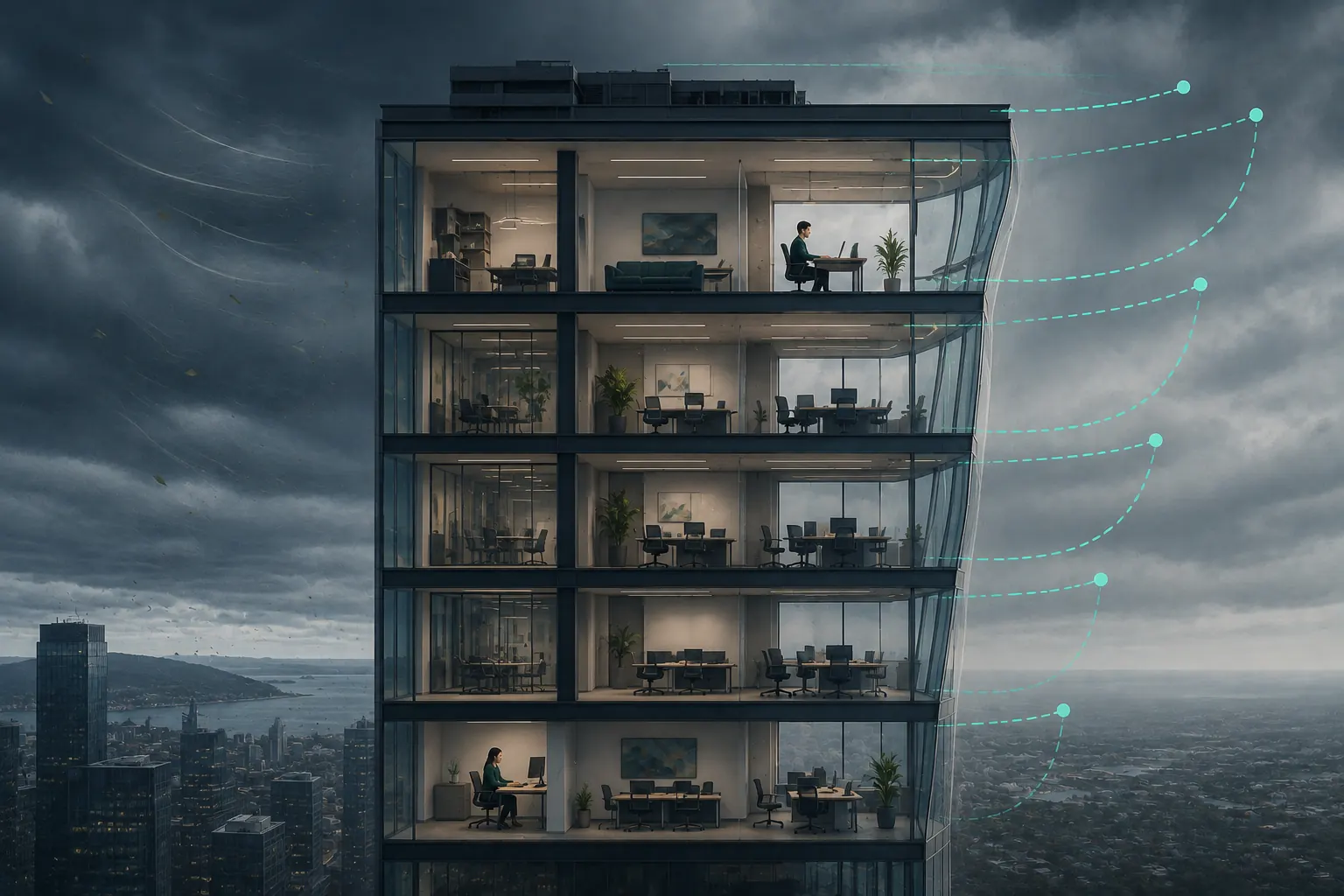
A tall building is not a rigid pole. It is designed to flex. Wind pushes on a very large surface, the structure gives a little, and the top travels away from the push and back. The distance is small next to the height of the building, and still enough to feel.
This is studied, not folklore: slow building movement is known to bring on motion sickness symptoms in some occupants, and wind engineers design against it. Some towers carry a damper near the top, a heavy mass that swings against the building's motion. Whether yours has one is a question for your building manager.
Why you feel it and the person on floor three does not
A swaying tower does not slide sideways as one block. It bends, anchored at the base, so movement grows with height. Three floors up it is almost nothing. Forty floors up it is a journey, repeated all day. So this is a high floor problem, and the same building at street level can feel like a different address.
The second reason is you. Sensitivity varies a lot between people, so one person can feel wretched while a colleague at the next desk notices nothing. If cars and boats have always got to you, you are the likelier candidate. The two-minute motion sickness test gives you your own band, and what motion sickness actually is covers why the ranking exists.
Slow sway is the pattern the stomach objects to
Motion sickness starts when your senses disagree, and building sway sets that up almost perfectly. Your inner ear feels the floor moving. Your eyes find no confirmation, because desk, monitor and window frame hold the same relationship to your body through the whole slow arc.
Pace matters as much as motion. In one laboratory study, twelve volunteers picked for high susceptibility were slid slowly back and forth at three different paces. They got sick fastest at one cycle every five seconds, and at that pace all twelve reached moderate nausea, against eight and seven of them at the paces either side. The standard used to judge occupant response to building motion covers sway from roughly one to sixteen seconds per cycle, and a tower in wind sits inside that band. Small, slow and hours long is the hard combination.
Wind, storms and the days people notice
The trigger is weather, so the symptom is episodic. It shows up on gusty days and through storms, in bursts rather than steadily, and stops when the weather does.
That pattern is useful. Write down the date, the time and what you felt: two or three entries turn a vague complaint into something a building manager can act on. Queasiness on still days and at ground level points elsewhere, which is what sudden motion sickness covers, and queasiness that arrives in the lift is elevator motion sickness.
The other clues: blind cords, water in a glass, a door that drifts
Because the whole room moves together, your eyes catch only what hangs free or lies loose:
- Blind cords and pull chains swinging with nobody near them.
- Water in a glass with a slow ripple that keeps returning.
- A door on a slack latch drifting closed, then back.
- Pendant lights and hanging plants moving slightly out of time with each other.
- Small creaks and ticks from partitions and ceiling tiles.
Headache, tiredness and trouble concentrating
People who react to building sway rarely get near vomiting. The usual version is quiet: heavy eyelids, a headache behind the eyes, work that takes twice as long. That drained end of the response has a name in the research, sopite syndrome, and it is easy to blame on a bad night instead.
It has been measured. In an eighteen month field study, 55 office workers across eight Wellington buildings reported how they felt while an accelerometer in each building recorded what it was doing. When the buildings moved more, people reported more motion sickness and more sleepiness, and the effort they put into tasks dropped sharply. Cognitive performance was only mildly affected, which fits how it feels: you can still think, you just do not want to.
If your version arrives as dizziness or a headache, those pages cover how long each tends to last.
What helps at your desk
You cannot ask the wind to stop and you probably cannot go home. You can shrink the mismatch:
- Look far out of the window. A distant fixed point lets your eyes see the movement your ears report. Same reason the horizon helps at sea, and the one advantage a high floor has.
- Take your break at ground level. Ten minutes downstairs is a real reset, and it tests the theory.
- Park the fine detail work. Small type and fast scrolling lock your eyes onto something moving with you. Screens can do this on their own: motion sickness indoors.
- Cool air, and something plain to eat. Heat, stuffiness and an empty stomach lower the point at which queasiness tips over.
- Be careful with the medicine cabinet. The over the counter dimenhydrinate label warns that marked drowsiness may occur and to take care driving or using machinery, which is a poor trade in the middle of a work day. Ask your doctor or pharmacist first.
- Have drug-free relief on your phone. Once it has started, sound therapy through headphones is one option to try, about 90 seconds and no drowsiness. If it is happening right now, go to the 60-second protocol.
Do
- Look far out of a window and let your eyes see the sway
- Take the break at ground level, not the kitchen on 38
- Move detail work to a calmer day
- Write down the date, time and weather
Don't
- Push through a bad spell to prove it is nothing
- Reach for a drowsy remedy in the middle of a work day
- Take a structural worry to a search engine instead of the building manager
Practical strategies, not measured effects. Which ones help is personal.
Hotel rooms on high floors
The same thing happens in hotels, and it feels worse because of when you meet it. You are lying still in a dark room, which removes the last visual reference you had. In a hotel it usually turns up as a sleep problem: a bed that seems to breathe, or a slow drift that keeps you awake.
Two things help. Ask at the desk for a lower floor when the forecast is rough, before you unpack. And leave a curtain open so your eyes have a skyline to hold. If the rocking is still there after a calm night, that is a different pattern, and rocking that outlasts the motion is a question for a doctor.
When to raise it with the building manager
Nobody online, this page included, can tell you what the movement in your building means. Occupant comfort under wind is a designed quantity with standards behind it, and only the building manager and the engineering team can say what your tower was built for. Feeling movement is not proof that something is wrong, and it is not proof that everything is fine. It is a question, and it has an owner.
Bring them the log rather than the feeling. Dates, times and floors can be checked against the weather and, in an instrumented building, against what the building itself recorded. A survey of city centre office workers found that almost nobody who felt their building move ever told the landlord or the property manager, so silence is the normal state and your manager may simply not know it is happening on your floor.
Keep the health question separate. Dizziness that turns up on still days, that happens away from the building, that comes with hearing changes, or that involves the room genuinely spinning belongs with a doctor, because that pattern no longer looks like ordinary motion sickness.
Relief that fits a working day
Stop the nausea
You cannot leave the building, and you should not spend the afternoon drowsy. Dizzout plays precisely calibrated audio through any headphones, one option designed to help calm the response in about 90 seconds, drug-free and with no drowsiness. It runs at your desk with your eyes closed.
Get your personalized Dizzout plan. Paid subscription for full access.
30,000+ travelers in 30+ countries · How we count

On your phone? Scan to start there.
Comparing apps first? See how the motion sickness apps compare
Frequently asked questions
Can a tall building make you feel sick?
Yes, for some people. Wind makes tall buildings sway slowly, and slow motion that your inner ear feels while your eyes see a room moving with you is the same sensory mismatch behind car sickness and seasickness. Wind engineering research has documented motion sickness symptoms in occupants of buildings that move in wind. Plenty of people in the same building feel nothing at all, which is normal: susceptibility varies a lot from person to person.
Do skyscrapers sway enough to feel?
On the upper floors of a tall tower in strong wind, often yes. The building bends from the base, so movement grows with height: what is imperceptible on floor three can be obvious on floor forty. The distance travelled is small next to the height of the building, but it repeats for hours, and slow repeated motion is what bodies notice. The clearest evidence is usually indirect, like a blind cord swinging or a ripple in a glass of water.
Why do I feel dizzy on a high floor when it is windy?
Because your senses disagree. Your inner ear registers the floor drifting and coming back, while your eyes see a desk, walls and window frame that hold still relative to you, so nothing confirms the motion. Slow sway also falls in the pace range that provokes motion sickness most readily. Looking far out of a window, so your eyes can finally see the movement, is the fastest thing to try.
Is building sway dangerous?
That is not a question anyone online can answer about your building, and this page will not try. Movement in wind is designed into tall buildings, and international standards cover how much motion is acceptable for the people inside, but only your building manager or facilities team can say what your tower was built for and what it has actually been measured doing. If you are worried about the structure, ask them, and bring dates, times and floors rather than a general impression.
What can I do about nausea from building sway at work?
Look far out of a window so your eyes can see the motion, take your break at ground level, and move fine detail work to a calmer day. Keep the air cool and eat something plain, since heat and an empty stomach both lower your threshold. The over the counter dimenhydrinate label warns that marked drowsiness may occur, a poor trade at work, so ask your doctor or pharmacist first. Sound therapy through headphones is one drug-free option built for the moment after symptoms start, about 90 seconds and no drowsiness.
Can you feel a building move on a high floor in a hotel?
Some people do, and it can feel stronger than at the office because you are lying still in a dark room with no visual reference. A bed that seems to breathe or a floor that seems to tilt during a storm is the same slow sway, met at the worst moment for noticing it. Asking reception for a lower floor when rough weather is forecast is a reasonable request, and leaving a curtain open gives your eyes something distant to hold on to.
Someone you know gets motion sick?
Send them this guide. It might be the trip it saves.
Your next question, probably
Is the dizziness itself worth reading up on?
What it feels like, and why
Not your question? Want the mechanism from the start?Queasy at your desk right now?Looking for something that works at work?
About this article
- Walton D, Lamb S, Kwok KCS. A review of two theories of motion sickness and their implications for tall building motion sway. Wind and Structures, 2011;14(6):499-515
- Lamb S, Kwok KCS. The effects of motion sickness and sopite syndrome on office workers in an 18-month field study of tall buildings. Journal of Wind Engineering and Industrial Aerodynamics, 2019;186:105-122
- Lamb S, Kwok KCS, Walton D. Occupant comfort in wind-excited tall buildings: motion sickness, compensatory behaviours and complaint. Journal of Wind Engineering and Industrial Aerodynamics, 2013;119:1-12
- Golding JF, Mueller AG, Gresty MA. Aviation, Space, and Environmental Medicine, 2001;72(3):188-192. PubMed 11277284
- DailyMed: dimenhydrinate 50 mg tablet, over the counter Drug Facts label
- NIH National Institute on Deafness and Other Communication Disorders: Balance Disorders
This article is informational and not a substitute for medical advice. Questions about how your building is designed, maintained or performing belong with your building manager or facilities team, not with a website. Talk to your doctor or pharmacist before taking anything for motion sickness, and see a doctor if dizziness happens away from the building, keeps coming back, or arrives with hearing changes.



.jpg)