
Is the Bernina Express rough?
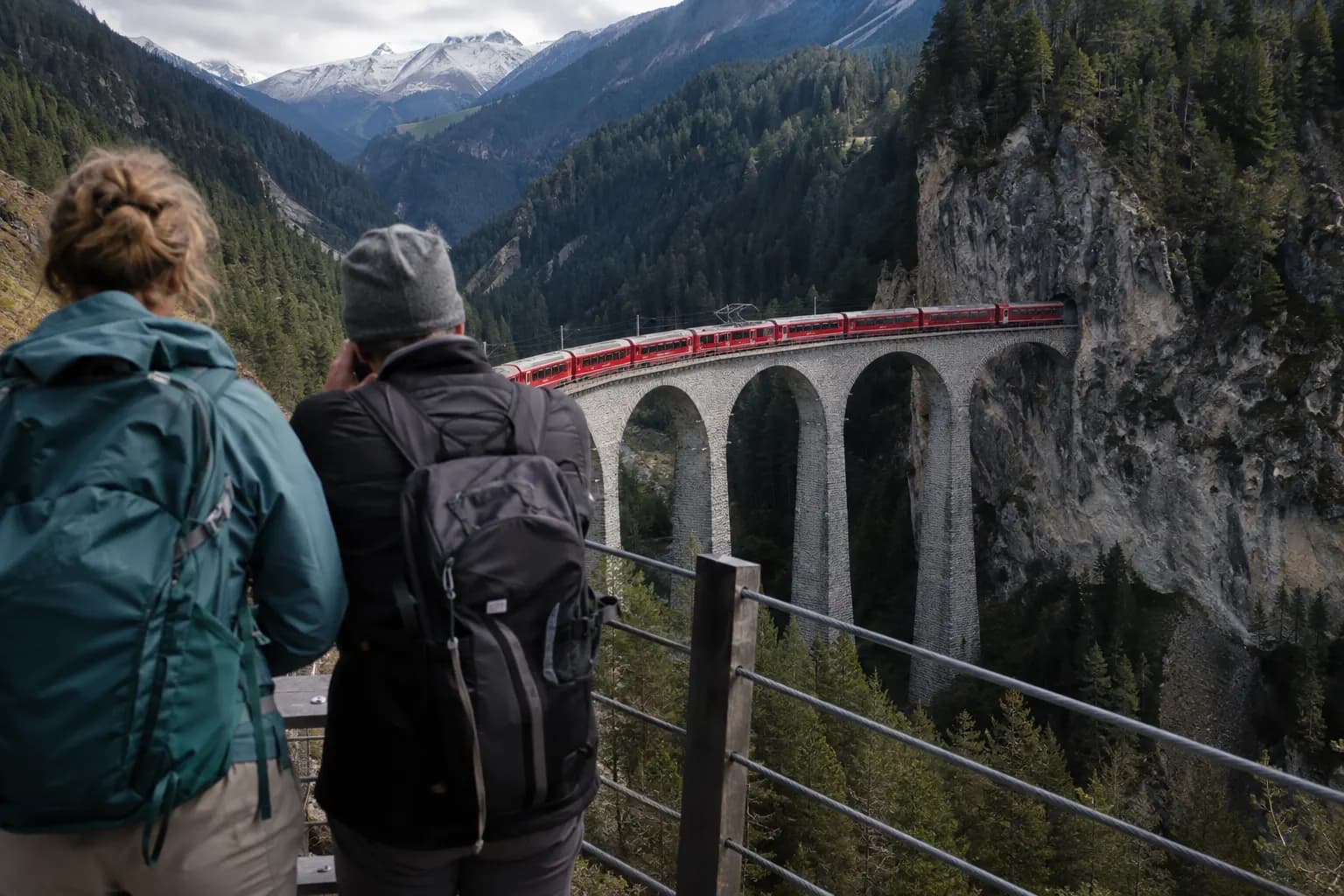
The Bernina Express packs more engineering drama into 4 hours than most railways manage in a day: 196 bridges, 55 tunnels, 7 percent gradients climbed without a rack, the open-air Brusio spiral viaduct and a summit at 2,253 m. For motion sickness the story is the spirals and the constant curvature. The train is slow, but it is almost never pointing the same direction for long.
Chur to Tirano, Switzerland and Italy · about 4 hours 13 minutes · Spirals, 7 percent grades, 2,253 m
Key facts
- The Bernina line crosses 196 bridges and 55 tunnels, with gradients of 7 percent climbed without a cogwheel; the Bernina Express run takes about 4 hours 13 minutes. The Albula/Bernina route was UNESCO listed in 2008.
- Ospizio Bernina, at 2,253 m, is the highest point of the route.
- The Brusio spiral viaduct, opened in 1908 with nine arches, exists to keep the line's gradient within the 7 percent maximum.
Queasy on the train? Dizzout is drug-free sound therapy you can start from your seat, with relief in about 90 seconds.Starts in your browser · works with any headphones
Get your personalized Dizzout plan. Paid subscription for full access.

On your phone? Scan to start there.
Why the Bernina Express moves you the way it does
To hold the gradient at 7 percent without cogwheels, the line's builders coiled it: the track gains height by turning in circles, most visibly on the nine-arch Brusio spiral viaduct where the train loops over itself in the open. Spirals are hard on the inner ear because the turn is continuous and prolonged rather than a curve you enter and exit. Add the steady descent toward Tirano, where the same 7 percent runs downhill through repeated horseshoe curves, and sensitive riders get their densest motion in the final hour. The UNESCO-listed section is spectacular, and the spectacle and the queasiness have the same cause.
The journey
- Operator
- Rhaetian Railway
- Duration
- about 4 hours 13 minutes
- Windows
- Panoramic cars
- Season
- Runs year round, with deep-snow scenery in winter
Put reading away before the mountain leg
Before boarding, pack the guidebook and prepare Dizzout with your headphones if you choose an audio option. Keep the phone and case easy to reach.
Free to download. Paid subscription for full access.
30,000+ travelers in 30+ countries · How we count

On your phone? Scan to start there.
Comparing apps first? See how the motion sickness apps compare

Know someone who gets motion sick?
Send them the app that helps stop it, drug-free, in about 90 seconds, works with any headphones. Free to download.
What helps on board
- Watch the spirals happen: on the Brusio viaduct and the circling climbs, seeing the world rotate explains the turn your body feels, and the confusion drops.
- The long 7 percent descent toward Tirano is the stretch to ride eyes-up; save the phone for the valley floor.
- A light lunch beats a heavy one; four winding alpine hours reward it.
- Board with relief ready. If nausea starts mid-journey, sound therapy through any headphones is a drug-free option with relief in about 90 seconds.
Where to sit is its own question, answered properly in where to sit on a train for motion sickness. And for why trains set people off at all, from sway to reading to tilting stock, see the train motion sickness guide.
Frequently asked questions
Is the Bernina Express rough?
Not rough, but constantly turning. The speeds are low; what sensitive riders notice is the density of curves, the spiral sections where the train turns continuously, and the long 7 percent descent to Tirano. The panoramic cars keep the horizon in view, which helps most people stay comfortable.
What is the Brusio spiral like on board?
The train circles a full loop in the open on a nine-arch viaduct, so the view rotates around you for the better part of a minute. It is the single most concentrated turning motion on the route, and also its most famous photograph.
Should I worry about altitude sickness on the Bernina Express?
The summit at Ospizio Bernina is 2,253 m, high enough that some people notice lightheadedness if they hop out, but the train crosses it in under an hour and descends promptly. Queasiness on this route is more often the curves than the altitude.
Other trains and lines
Sources & further reading
- https://www.rhb.ch/en/panoramic-journeys/bernina-express/
- https://www.newlyswissed.com/ultimate-guide-bernina-express-train-line/
- https://www.thomascrauwels.ch/en/blog/blog-bernina-express-voyage-train-alpes/
- https://en.wikipedia.org/wiki/Brusio_spiral_viaduct
- https://www.rhb.ch/en/panoramic-journeys/bernina-express
Your next question, probably
Feeling it right now, on board?
The 60-second protocol
Not your question? Why do trains set some people off?What actually has evidence?How prone are you, really?
Details on this page reflect published operator, heritage and engineering information as of September 2026; services, fleets and tilt settings change, so check with the operator before you travel. Train, route and operator names are trademarks of their respective owners; Dizzout is not affiliated with or endorsed by them. Motion sickness sensitivity varies from person to person; this page is informational and not medical advice.