The short answer
Air sickness feels like a slow slide, not a sudden hit. It usually opens with a vague awareness of your stomach and a warm, clammy feeling, then cold sweat, extra saliva, yawning, and a mild headache, before real nausea arrives. It is ordinary motion sickness on a plane: your inner ear feels the aircraft climb, bank, and bump while your eyes see a still cabin, and your brain reacts to the mismatch. Turbulence and descent are the most common triggers, and for most people the symptoms settle within a few hours of landing.
Nobody warns you how quiet it starts. One minute you are reading, the next you notice your stomach exists. Then the cabin feels too warm, your mouth waters, and you catch yourself yawning even though you slept fine. By the time you admit you feel sick, you have been sliding toward it for twenty minutes.
That slide has a fixed shape, and knowing it is genuinely useful: catch air sickness at the first sign and it is much easier to stop than at the peak. Here is what each stage feels like, why a plane sets it off, and what you can do while belted into seat 23B.
Airsick when the bumps start? Drug-free relief through any headphones, about 90 seconds, no seat change needed.Starts in your browser · works with any headphones
Ease plane sickness. Get your personalized Dizzout plan. Paid subscription for full access.

On your phone? Scan to start there.
What air sickness is and what it is called
The name is exactly what you would guess: air sickness, or airsickness. There is no separate medical condition behind it. It is motion sickness that happens to occur on an aircraft, the same response you can get in a car, on a boat, or in a VR headset. Doctors file all of them under motion sickness.
That matters, because it means everything known about motion sickness applies in the air. The same people are prone to it, the same early signs announce it, and the same kinds of relief work, with one catch: on a plane you cannot pull over, open a window, or step outside. The fixes have to work from your seat. That constraint shapes everything on the air sickness page, and it shapes the rest of this article.
The symptom sequence: from warm and quiet to queasy
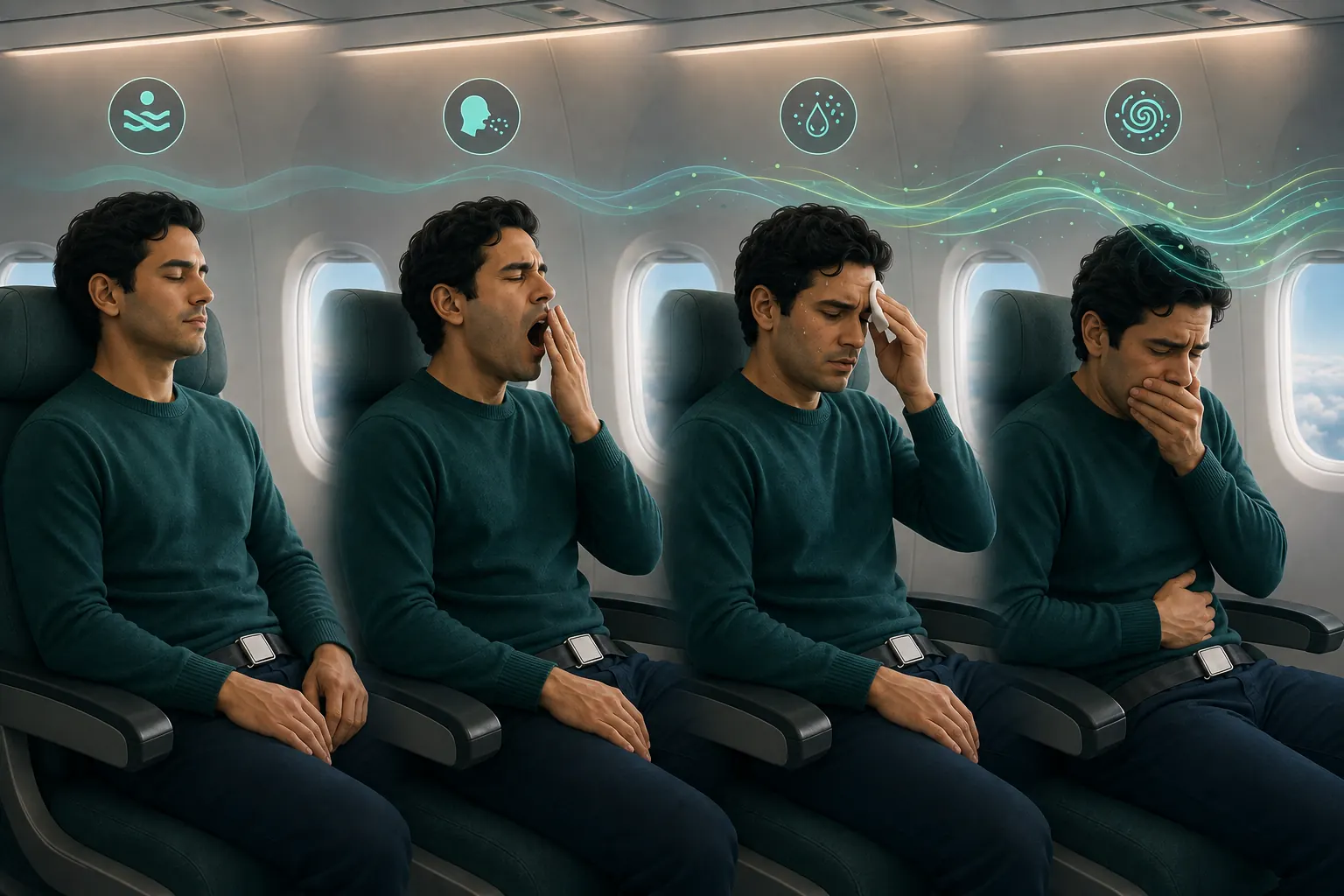
Air sickness escalates in a recognizable order. Not everyone gets every stage, and the pace varies from minutes to an hour, but the order itself is remarkably consistent:
First sign
Stomach awareness. Not nausea yet, just a sudden sense that you have a stomach.
Building
Warmth and cold sweat, a pale face, extra saliva, yawning, sometimes a mild headache.
Queasy
Real nausea, dizziness, and a strong urge to sit very still and breathe.
Peak
Vomiting for some. For most, waves of nausea that ease once the motion does.
Symptom order as described by MedlinePlus. Timing varies by person and by flight.
The early stage is the one worth memorizing. Stomach awareness, sudden warmth, watering mouth, and unexplained yawning are your warning window. Act there, and you can often stop the slide before nausea takes hold. Wait until the queasy stage, and everything works slower. The full list of signs, including the odd ones like drowsiness and loss of appetite, is on the motion sickness symptoms page.
Why flying triggers it when you cannot see the motion
Motion sickness comes from a conflict between your senses. Your inner ear is a motion detector, and on a plane it registers everything: the push of takeoff, every banking turn, every dip and shudder of turbulence. Your eyes, meanwhile, see a cabin that looks perfectly still. Seatback, tray table, the pages of your book: nothing in view is moving. Your brain gets two stories that cannot both be true, and its response to that mismatch is nausea.
This is why a plane can feel worse than a car even though the ride is often smoother. In a car you can watch the road and let your eyes confirm what your inner ear feels. In a window seat over a cloud deck, or any aisle seat, there is often nothing outside to anchor to. The motion is real, but invisible, which is the exact recipe for the conflict. Add a warm cabin, recycled air, and a phone held close to your face, and the threshold drops further.
Takeoff, turbulence, descent: when it hits hardest
The cruise portion of a flight is usually the kindest. The motion is steady, and steady motion is easy for your brain to tune out. The trouble comes at the edges:
- Takeoff and climb. Strong acceleration plus a steep pitch your eyes cannot see. Brief, but enough to start the slide for sensitive flyers.
- Turbulence. The classic trigger. The motion is irregular and unpredictable, so your brain cannot adapt to it, and every jolt renews the mismatch. There is a dedicated turbulence plan for exactly this moment.
- Descent and approach. Often the roughest stretch. The aircraft flies a series of banking turns, the air below the clouds is frequently bumpier, and by then you have been sitting in a warm cabin for hours with your reserves already spent.
If you always seem to feel worst in the last thirty minutes of a flight, that is the pattern, not bad luck. Descent stacks the most triggers at the moment your tolerance is lowest.
Who gets air sick and who mostly does not
Susceptibility is real and personal. Children are more prone than adults, and it tends to ease with age. People who get migraines are more likely to feel it. Anxiety about flying makes it worse, partly because an anxious flyer sits rigid and scans the cabin instead of relaxing back into the seat. And being tired, hungry, hungover, or overheated lowers anyone's threshold.
If you are not sure where you sit on that spectrum, the motion sickness test gives you a personal risk profile in a few minutes. Knowing you are high-risk changes how you book seats and what you bring on board.
In-seat tactics that work while belted
Everything below works without leaving your seat, which matters, because air sickness peaks exactly when the seatbelt sign is on:
- Press your head back against the headrest. A firmly supported head moves less, and less head movement means less inner-ear input. It costs nothing and works in any seat.
- Eyes to the horizon or eyes shut. If you have a window, look at the horizon line, the one stable reference outside. No window, or nothing but cloud? Close your eyes. That takes the still-cabin picture out of the argument entirely.
- Put the phone away. A screen held close is a still world glued to your eyes. It is the worst possible input during turbulence.
- Open the air vent. Cool moving air on your face will not fix the mismatch, but heat and stuffiness lower your threshold, and the vent is the one piece of climate control you own.
- Slow your breathing. Long, unhurried exhales. It gives your body a calm signal to work against the nausea.
- Have relief that needs no lead time. Motion sickness tablets generally have to be taken before boarding to help, so mid-flight is usually too late for them; check with your pharmacist or doctor about timing. Sound therapy through headphones is one option you can use after symptoms start: plug in, press play, eyes closed, about 90 seconds.
After landing: how long the wooziness lasts
For most people, air sickness fades quickly once the motion stops. The nausea usually settles within a couple of hours of landing, though a washed-out, low-appetite feeling can linger for the rest of the day. Some travelers also notice a faint rocking sensation for a few hours afterward, as if the ground were gently moving. That, too, normally resolves on its own.
Two situations deserve a doctor rather than a blog post: a rocking or spinning sensation that persists for days after you land, or dizziness that arrives with hearing changes, severe headache, or trouble walking. Those point away from simple motion sickness.
When to plan ahead for your next flight
If this article described your last flight, spend five minutes before your next one. Book a window seat over the wing, where the aircraft's motion is smallest and the horizon is available. Eat a light meal before boarding rather than flying hungry or stuffed. Board rested and hydrated. If you use medication, sort out the timing with your pharmacist or doctor before travel day, since most options need to be taken in advance.
And decide what your mid-flight plan is before you need it. Whether that is the head-back-eyes-shut routine, a wristband you trust, or sound therapy on the headphones you were bringing anyway, having a plan beats discovering at the start of descent that you do not have one. The full prevention checklist lives on the air sickness page.
Relief that fits an airplane seat
Stop the nausea
You cannot pull over at cruising altitude, and pills need lead time you no longer have. Dizzout plays precisely calibrated audio through the headphones already plugged into your phone. Drug-free, no drowsiness, about 90 seconds, and you can keep your eyes closed the whole time. Free to download, with a paid subscription for full access.
Get your personalized Dizzout plan. Paid subscription for full access.
30,000+ travelers in 30+ countries · How we count

On your phone? Scan to start there.
Comparing apps first? See how the motion sickness apps compare
Not travelling yet? Remind me the day before my trip
Frequently asked questions
What is airplane sickness called?
Air sickness, or airsickness. It is not a separate condition: medically it is motion sickness that happens on an aircraft, the same response people get in cars, on boats, and in VR. Everything that helps motion sickness in general applies to it.
What are the first signs of air sickness?
The earliest signs are subtle: a sudden awareness of your stomach, feeling unusually warm, a watering mouth, repeated yawning, and cold sweat. Nausea comes after these, not before. Acting at the first signs, head back, eyes to the horizon or shut, air vent on, works much better than waiting until you feel properly sick.
Why do I get motion sick on a plane but not in a car?
In a car you can usually see the motion: the road, the turns, the world sliding past. On a plane the motion is real but mostly invisible, since the cabin around you looks still while your inner ear feels every climb, bank, and bump. That larger gap between what you see and what you feel is exactly what triggers motion sickness. A warm cabin and a phone held close make the gap worse.
Is turbulence or descent worse for air sickness?
Both are bad in different ways. Turbulence is irregular and unpredictable, so your brain cannot adapt to it. Descent stacks banking turns and often bumpier low-altitude air at the end of the flight, when hours in a warm cabin have already drained your tolerance. Many flyers feel worst in the final thirty minutes for exactly that reason.
Does air sickness go away after landing?
Almost always, yes. Symptoms usually settle within a couple of hours once the motion stops, though a tired, low-appetite feeling can hang around for the day, and some people notice a faint rocking sensation for a few hours. If rocking or dizziness persists for days after landing, or comes with hearing changes or severe headache, see a doctor.
Can you get air sick on a smooth flight?
Yes. Even a smooth flight is full of motion you cannot see: the climb, banking turns, small continuous corrections. If you are reading or on your phone, your eyes report a still world while your inner ear feels all of it, and that mismatch is enough for sensitive flyers. Heat, anxiety, and fatigue lower the threshold further.
Someone you know gets motion sick?
Send them this guide. It might be the trip it saves.
Your next question, probably
Need the full turbulence plan?
Step by step, belted in
Not your question? Feeling it right now?Is your symptom on the list?Want the full air sickness fix?
About this article
- CDC Yellow Book: Motion Sickness
- MedlinePlus: Motion Sickness
- StatPearls: Motion Sickness (NCBI Bookshelf)
This article is informational and not a substitute for medical advice. If your symptoms are severe, persistent, or come with hearing changes or trouble walking, talk to a doctor. Product and company names are trademarks of their respective owners.