The short answer
Use timing first. Motion sickness builds within minutes of the vehicle moving and eases once it stops. Altitude sickness usually starts hours after you arrive high, often during or after the first night, and it stays with you whether the bus is moving or parked. Motion sickness leads with a cold sweat and nausea; altitude sickness leads with a headache. If you are sleeping above about 2,450 m and a headache came first, assume altitude, do not climb higher, and go down if it gets worse.
The bus climbs for four hours. Somewhere on the switchbacks your stomach turns over and your head starts to ache, and the person beside you says it is the road while the driver says it is the elevation. Both answers fit what you feel.
Only one of them changes what you should do next. The symptom lists overlap almost completely, so what separates them is not what you feel, it is when it started and what happens when the wheels stop.
Prone to motion sickness? For the road half of the answer: Dizzout is drug-free sound therapy, any headphones, about 90 seconds.Starts in your browser · works with any headphones
Get your personalized Dizzout plan. Paid subscription for full access.

On your phone? Scan to start there.
Why the two get confused on the same bus
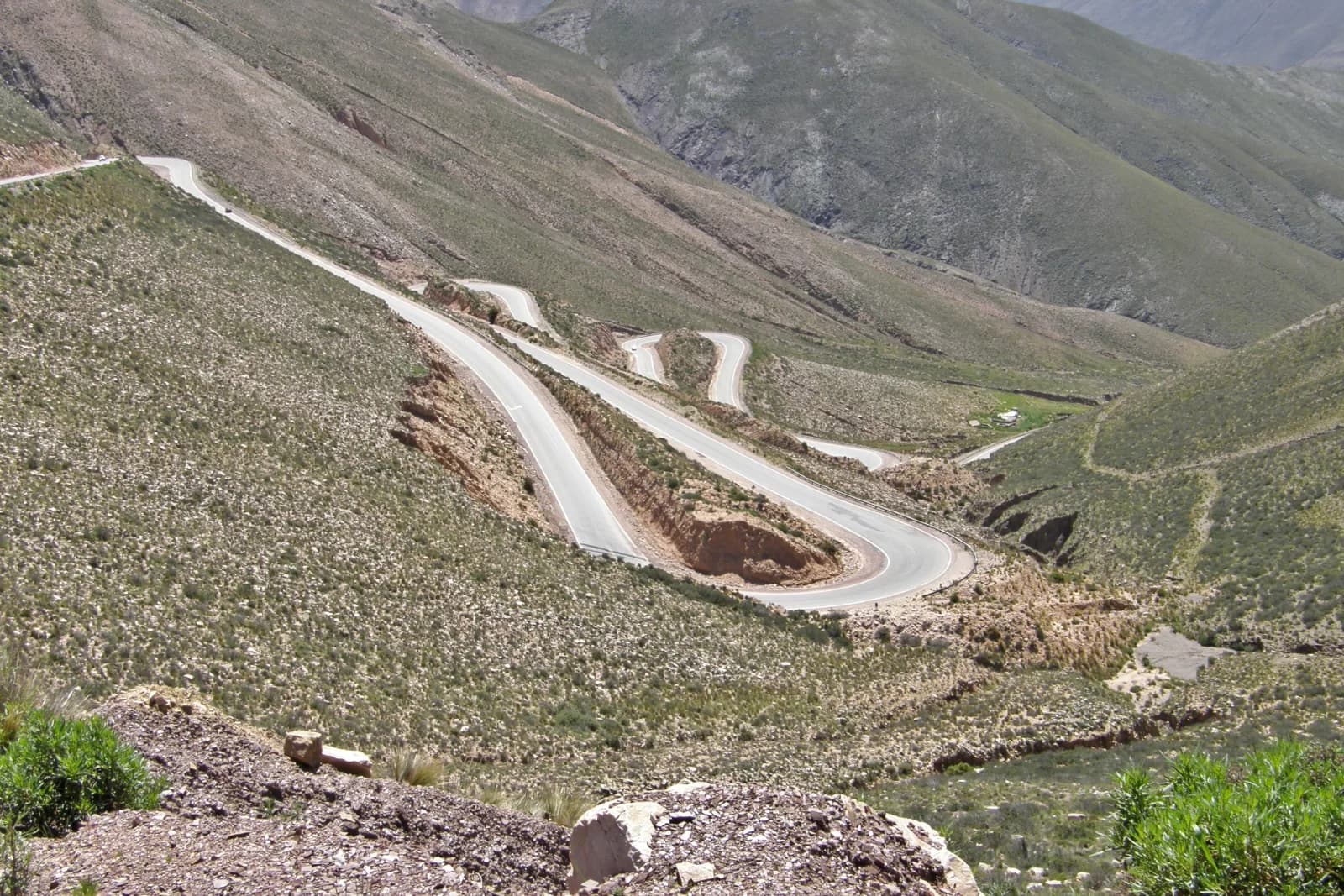
The confusion is built into the geography. Roads that reach altitude are the same roads with the hairpins, so both triggers arrive in the same hour, in the same seat. A bus climbing from the coast to Cusco at 3,399 m gives you hours of corners and thousands of meters of ascent in one ride.
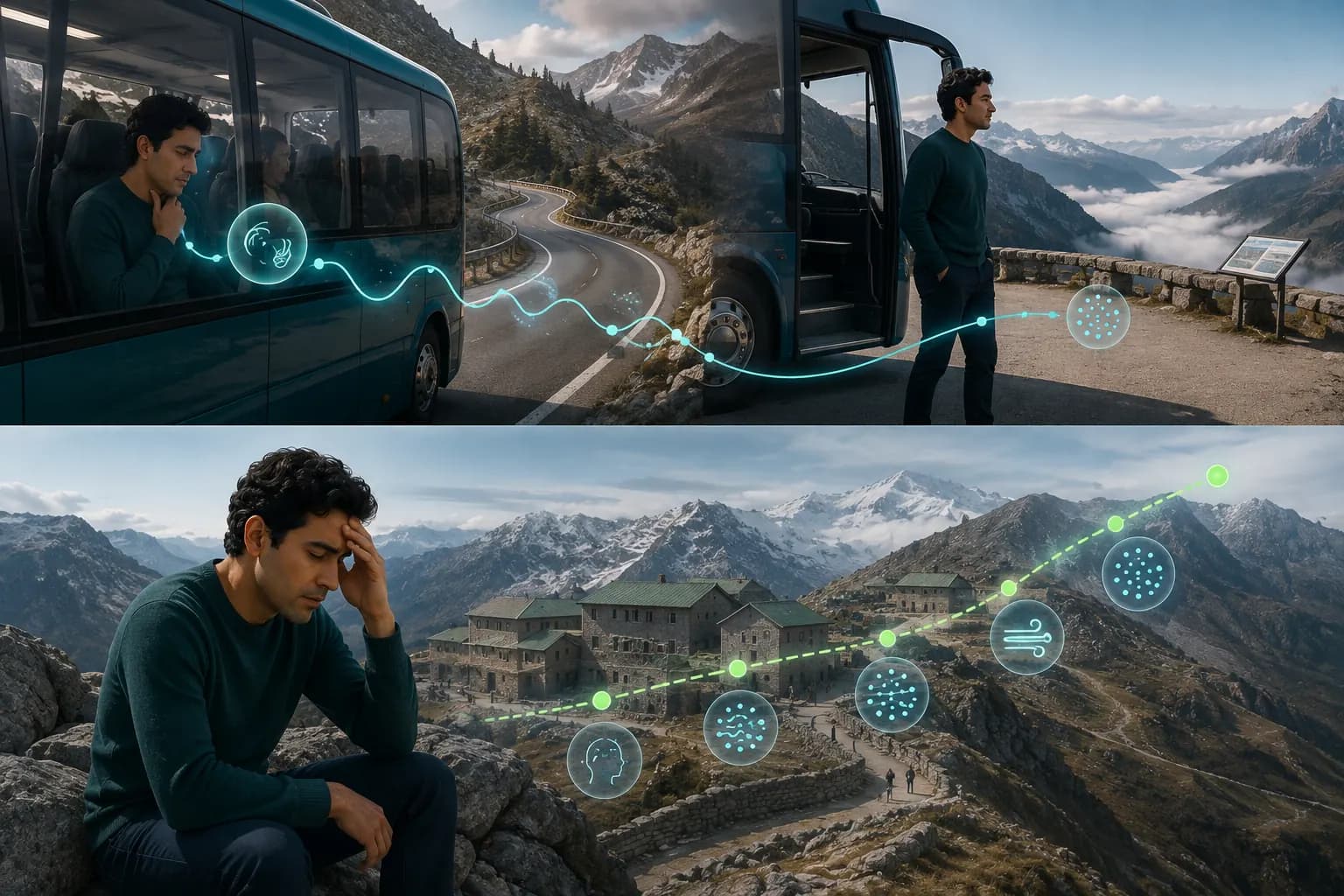
Then the symptom lists overlap. Nausea, dizziness, fatigue and a lost appetite sit on both, so a symptom check alone will not settle it. Look at where the lists stop touching instead.
Road only (Left of the diagram)
- Cold sweat and pale skin
- Salivation, then the urge to vomit
- Eases once the vehicle stops
- Settles with the horizon in view
Both (Middle of the diagram)
- Nausea
- Dizziness
- Fatigue
- No appetite
Altitude only (Right of the diagram)
- Headache that leads rather than follows
- Broken sleep at the new elevation
- The whole picture feels like a hangover
- Stays put while the bus is parked
Symptom lists from the NHS and the CDC Yellow Book. The overlap is why timing, not symptoms, is the test.
The timing test: minutes against hours
Motion sickness runs on the clock of the ride. It builds once the movement starts, faster when the road is rougher, so a queasy stomach twenty minutes into the first bends is the road talking.
Altitude runs on a slower clock. The CDC Yellow Book puts symptom onset at 2 to 12 hours after arriving high, often during or after the first night; the NHS gives a narrower 6 to 10 hours. Either way, that window is measured in hours, not corners.
One complication: on a long climb both clocks run at once. A bus that left at 1,500 m this morning and sits at 4,000 m by mid-afternoon has given you both. When they overlap, use the next test.
The stopping test: does it ease when the vehicle stops
This is the cleanest separator you have on the road. Motion sickness symptoms gradually subside once the motion stops or you leave the vehicle, per the MSD Manual. Altitude symptoms do not care that the bus is parked. The air at the viewpoint is the same air.
So run it deliberately at the next stop. Get out, stand in open air, look at something far away and stationary, and give it fifteen minutes. Clearly better means the road. Unchanged or worse means elevation.
What leads, the nausea or the headache
Order of arrival is the third test, and it earns its place because both conditions can end up producing both symptoms. The CDC describes motion sickness as progressing from stomach awareness, warmth, yawning, sweating and dizziness through to nausea and then vomiting. That progression starts in the stomach. A headache is on the symptom list, but it is not what opens the sequence.
Altitude sickness runs the other way. Headache is the cardinal symptom in the CDC's description, usually joined by at least one of lost appetite, dizziness, fatigue, nausea or occasionally vomiting. The CDC likens the picture to a hangover, a useful test of its own: a road makes you feel carsick, thin air makes you feel hungover.
How high is actually high
The CDC's threshold is any unacclimatized traveler going to a sleeping altitude of 2,450 m (8,000 ft) or above, and sometimes lower. The NHS puts it at usually more than 2,500 m. The word doing the work is sleeping: where you spend the night matters more than the highest point the road touched.
That makes most famous sick-making roads easy to call. The Amalfi coast road never leaves the coastline, and the Ha Giang loop runs far below the threshold, so nausea on either is the corners, full stop. Cusco is 3,399 m, and La Paz and Leh are higher again. Machu Picchu itself is 2,430 m, lower than the city most people sleep in the night before, which is why the bus up from the valley is more often a motion problem than an altitude one.
| Test | Points to the road | Points to altitude |
|---|---|---|
| When it started | Minutes into the ride | 2 to 12 hours after arriving high |
| What a 15-minute stop does | It eases | No clear change |
| Which symptom led | Stomach unease, then nausea | Headache, then no appetite |
| Where you sleep | Any elevation, sea level included | About 2,450 m and up |
What to do for each, and what not to do
- If it is the road. Face forward, hold your eyes on the horizon, get air moving over you, and if the corners are relentless, close your eyes and breathe slowly instead. The bus and coach guide has the rest, and the remedy finder narrows what fits a bus seat.
- If it is the altitude. Stop ascending. Rest where you are, drink water, skip alcohol, and let it settle. The CDC notes acute mountain sickness generally clears in 12 to 48 hours as long as you do not go higher; the NHS gives 1 to 3 days.
- Do not climb higher to get past it. The CDC's golden rules are explicit: never ascend to sleep at a higher altitude while you have symptoms, and descend if they get worse despite rest.
- Do not blind-dose a sedating antihistamine on a mountain road. Dimenhydrinate and meclizine make many people drowsy, and extreme drowsiness is one of the emergency signs the NHS lists for altitude illness. Masking the signal you need to read is a bad trade at 3,500 m. Ask your doctor or pharmacist before the trip.
- Ask about altitude medication in advance. The CDC notes travelers to high elevations might need acetazolamide, dexamethasone or another prescription option. That is a conversation with your doctor weeks ahead.
When altitude symptoms mean stop climbing and descend
Ordinary acute mountain sickness is a rest-and-wait problem. Memorize the point where it stops being one, because by then you may not be the best judge of your own state.
Booking around it: night buses, acclimatization days, seat choice
- Buy the acclimatization nights. The CDC notes that 2 to 3 nights at around 2,450 to 2,750 m before going higher is markedly protective, and that above 3,000 m you should gain no more than 500 m of sleeping altitude a night, plus an extra night per 1,000 m.
- Think twice about the night bus on a mountain route. Overnight travel takes away the horizon that keeps motion sickness in check, and delivers you high having slept badly.
- Pick the seat before the queue forms. Front half, low, facing forward. One line, one link: the seat guide has the vehicle-by-vehicle version.
- Run the route through the predictor. Will this trip make me sick turns your route, vehicle and history into a risk read before you commit to a schedule.
If you are reading this on the bus rather than at a desk, skip the theory: run the stopping test at the next halt, and the 60-second protocol is the page you want.
For the road half, and only the road half
Stop the nausea
Dizzout plays precisely calibrated audio through any headphones, one option designed to help calm the response in about 90 seconds. Drug-free and no drowsiness, which matters on a mountain road where extreme drowsiness is itself a warning sign. It does nothing for altitude sickness. If the tests above pointed at altitude, stop climbing and go down. Free to download on iOS and Android, subscription for full access.
Get your personalized Dizzout plan. Paid subscription for full access.
30,000+ travelers in 30+ countries · How we count

On your phone? Scan to start there.
Comparing apps first? See how the motion sickness apps compare
Frequently asked questions
Is it altitude sickness or motion sickness?
Timing separates them better than symptoms do. Motion sickness starts within minutes of the vehicle moving and eases once it stops; altitude sickness typically starts 2 to 12 hours after you arrive at a high elevation and does not care whether you are moving. Motion sickness leads with a cold sweat and nausea, altitude sickness leads with a headache. If you are sleeping above about 2,450 m and cannot tell, act as though it is altitude: do not go higher, and descend if it worsens.
Can you get altitude sickness on a bus?
Yes, if the bus takes you high enough. Altitude illness is caused by the low oxygen in the air, not by exertion, so being driven up a mountain counts. The CDC puts the risk threshold at a sleeping altitude of about 2,450 m and above for anyone unacclimatized, and the NHS at usually more than 2,500 m. What the bus adds on top is a separate problem: the corners.
Why do winding mountain roads make me feel sick?
Switchbacks produce constant changes of direction that your inner ear registers while your eyes, fixed on the seat back or a phone, report a still world. That mismatch is what motion sickness is. Mountain roads make it worse than most because the corners never stop, the view out of the window is often blocked by rock, and a slow climb makes looking down at your phone the easy thing to do.
Does altitude make motion sickness worse?
We could not find a reliable figure for that, so read any percentage you see quoted as a guess. What is fair to say is that the two stack. An altitude headache and a lost appetite leave you with less tolerance for a rough road, and neither one cancels the other. The practical answer is to handle them separately, because the fixes are different: the road half responds to the horizon, the seat and moving air, and the altitude half responds to rest and to not going higher.
At what altitude does altitude sickness start?
The CDC Yellow Book puts any unacclimatized traveler at risk from a sleeping altitude of 2,450 m (8,000 ft) upward, and sometimes lower; the NHS says usually more than 2,500 m. Sleeping altitude matters more than the highest point you passed through, so a day trip up to a viewpoint carries less risk than spending the night up there. Below roughly 2,000 m, nausea on a mountain road is almost always the road.
How do I avoid getting sick on the bus to Machu Picchu?
Machu Picchu sits at 2,430 m, lower than Cusco, so the bus up from the valley is far more often a motion sickness problem than an altitude one. Sit forward and low, face the direction of travel, keep your eyes on something distant rather than your phone, and get air moving. If you slept in Cusco at 3,399 m and a headache is leading, that part is more likely altitude, and heading down the valley is the direction that helps.
Someone you know gets motion sick?
Send them this guide. It might be the trip it saves.
Your next question, probably
Will your route make you sick?
Answer a few questions, get a risk read
Not your question? Driving the mountain leg yourself?Which remedy fits your trip?Is an app worth packing?
About this article
- CDC Yellow Book: High-Altitude Travel and Altitude Illness
- NHS: Altitude sickness (symptoms, onset, when to descend)
- MSD Manual Consumer Version: Motion Sickness
- CDC Yellow Book: Motion Sickness
This article is informational and not a substitute for medical advice, and the comparison above is orientation rather than a diagnosis. Altitude illness can become serious: if you are unsure, stop ascending and speak to a doctor. Check with your doctor or pharmacist before taking any medication for motion sickness or for altitude, and seek urgent medical help if severe symptoms appear.

.JPG)