
Does the Shinkansen N700S make you motion sick?
The Shinkansen is close to the anti-Pendolino. The N700S does technically tilt, but only about 1 degree, using air springs, and most riders never notice it happening. Motion sickness on the Tokaido Shinkansen is uncommon and usually has other causes: long tunnel sequences with no horizon, pressure changes you feel in your ears, and reading or working for two hours while the world outside moves at 285 km/h.
Tokaido and Sanyo Shinkansen, Japan · Air-spring tilt of about 1 degree
Key facts
- N700 family trains tilt about 1 degree using air springs, allowing 270 km/h through the Tokaido line's 2,500 m radius curves.
- The N700S entered revenue service on the Tokaido Shinkansen on 1 July 2020.
Queasy on the train? Dizzout is drug-free sound therapy you can start from your seat, with relief in about 90 seconds.Starts in your browser · works with any headphones
Get your personalized Dizzout plan. Paid subscription for full access.

On your phone? Scan to start there.
Why the Shinkansen N700S feels the way it does
Tilt: Active air-spring, very small
Air springs lift one side of the car to tilt the body about 1 degree, enough to hold 270 km/h through the Tokaido line's 2,500 m radius curves.
High-speed lines are engineered so trains do not need dramatic tilt: the Tokaido Shinkansen's curves are built to a 2,500 m radius, and roughly 1 degree of air-spring tilt is enough to keep 270 km/h through them comfortable. That leaves very little of the roll-versus-view mismatch that makes big-tilt trains hard for some riders. What sensitive passengers notice instead is visual: at close range the scenery streams past too fast to rest your eyes on, tunnels remove the horizon entirely for minutes at a time, and pressure waves in tunnels add an ear sensation that some people find disorienting.
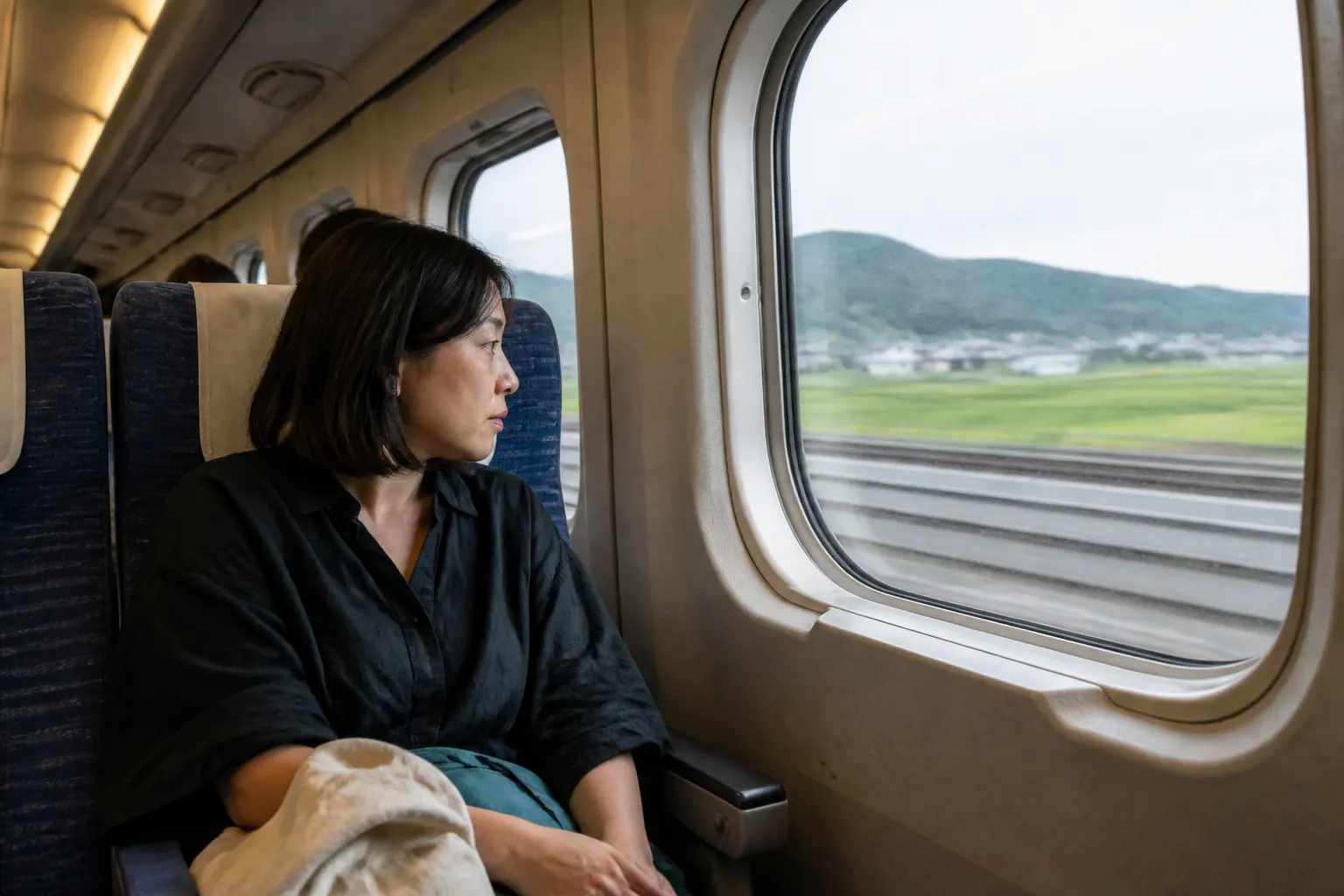
Where it runs
- JR Central and JR WestTokyo to Shin-Osaka and through services beyond; N700S in service since 1 July 2020
Clear the table after screen work
Put the laptop away when you take a break. Keep ordinary headphones for Dizzout on a clear, stable surface.
Free to download. Paid subscription for full access.
30,000+ travelers in 30+ countries · How we count

On your phone? Scan to start there.
Comparing apps first? See how the motion sickness apps compare
Know someone who gets motion sick?
Send them the app that helps stop it, drug-free, in about 90 seconds, works with any headphones. Free to download.
What helps on board
- Rest your eyes on the far side of the landscape, not the blur beside the track; distant objects move slowly enough to read.
- In the long tunnel sequences, look at something fixed inside the carriage and let your ears equalise; chewing or swallowing helps with the pressure changes.
- Save close screen work for the station stops if you know you are sensitive.
- Have relief ready before you board. If nausea starts, sound therapy through any headphones is one drug-free option, with relief in about 90 seconds.
Where to sit is its own question, answered properly in where to sit on a train for motion sickness. And for why trains set people off at all, from sway to reading to tilting stock, see the train motion sickness guide.
Frequently asked questions
Do people get motion sick on the Shinkansen?
It is uncommon. The lines are built with very large curve radii and the N700S tilts only about 1 degree, so there is little of the roll that troubles riders on hard-tilting trains. The riders who do feel off usually point at tunnels, ear pressure or prolonged reading rather than the motion itself.
Does the N700S tilt like a Pendolino?
No. The Pendolino family tilts up to 8 degrees with hydraulics; the N700S lifts one side of the car about 1 degree on its air springs. It is a comfort and speed aid, not a full tilting system, and most passengers cannot feel it working.
Why do my ears feel strange in Shinkansen tunnels?
Tunnel passages at speed create pressure changes inside the sealed car, similar to a plane's descent but quicker. Swallowing, yawning or chewing equalises the pressure. The sensation is an ear thing rather than motion sickness, though for some riders it adds to overall queasiness.
Other trains and lines
Sources & further reading
Your next question, probably
Feeling it right now, on board?
The 60-second protocol
Not your question? Why do trains set some people off?What actually has evidence?How prone are you, really?
Details on this page reflect published operator, heritage and engineering information as of September 2026; services, fleets and tilt settings change, so check with the operator before you travel. Train, route and operator names are trademarks of their respective owners; Dizzout is not affiliated with or endorsed by them. Motion sickness sensitivity varies from person to person; this page is informational and not medical advice.