Does closing your eyes help motion sickness?
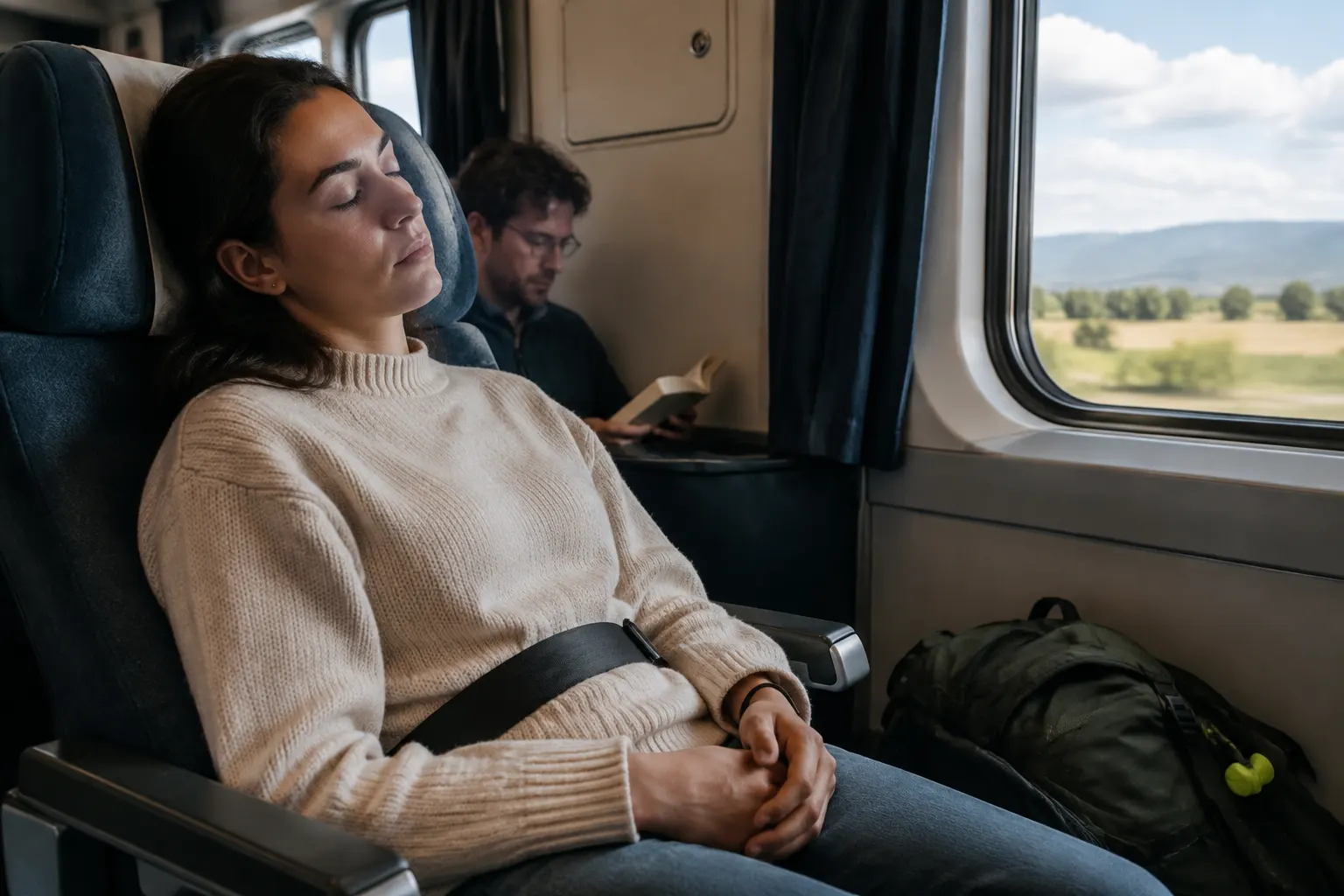
Closing your eyes: untested. It depends entirely on what your eyes would otherwise be doing. Shutting them removes the visual half of the sensory conflict, which is why it helps in a back seat with no view, and why it is the wrong move if you could be looking at the horizon instead.
By Dizzout Editorial·Evidence last checked 31 July 2026·How we review
Verdict: Untested
Key facts
- The claim being tested: The instinctive response to feeling sick in a vehicle, and the one piece of advice that appears to contradict the other piece of advice everyone gives.
- One study is summarised on this page, with its participant count and finding.
- On the remedies hub it sits under things you look at, hear or smell.
- Something with better evidence for the same job: Looking at the horizon.
What it's claimed to do
The instinctive response to feeling sick in a vehicle, and the one piece of advice that appears to contradict the other piece of advice everyone gives.
- YesTested for motion sickness and it held up.
- ProbablyReal trial support, but modest or from a single study.
- MixedTrials disagree: some found an effect, better-designed ones did not.
- Untestedthis remedyNo one has tested this for motion sickness. It may still be sensible.
- NoTested for motion sickness and it did not beat a placebo.
Levels describe the state of the published research on motion sickness specifically, not on nausea in general, and not how well something worked for any individual. “Untested” means no trial has looked; it is not the same as a remedy having been tested and failed.
What the research actually says
No trial has isolated eye closure as a treatment for motion sickness, so this verdict is reasoning from mechanism rather than from a result, and we would rather say that plainly than dress it up. The reasoning is well-founded. Motion sickness on the sensory-conflict account arises when the vestibular system reports motion the eyes do not confirm. There are two ways to resolve that: give the eyes a matching signal, or take the visual signal away. Turner and Griffin's coach data shows the first route works, and works well. Closing your eyes is the second route, and it is the only one available when there is no view to be had: below deck, in a windowless cabin, in the middle of a back seat behind a tall headrest. What makes it awkward as advice is that the two routes are mutually exclusive, and the right choice depends on your seat. Closing your eyes when you could have been watching the road is trading a strong, evidenced fix for an unevidenced one. Closing them when the alternative is staring at a cabin wall or a book is straightforwardly sensible.
The studies, in full
Ergonomics 42(3):444-61 · PMID 10048305
Participants: 3,256 coach passengers
Establishes that visual input strongly influences sickness: passengers without a forward view fared far worse. It supports the mechanism eye-closure relies on without testing eye closure itself. (Turner & Griffin, 1999)
Read the source →Safety & what to watch for
- If you have a window and a forward view, use it. Closing your eyes is the fallback, not the first choice.
- It does nothing about the vestibular signal itself, so on genuinely rough water it may not be enough on its own.
- Sleeping is the strongest version of this and works well on overnight crossings and long flights, but is obviously not available to a driver.
- Nobody has run the trial. Treat this as sound reasoning about a mechanism rather than a demonstrated result.
If you want to try it
- Combine it with keeping your head still and supported on a headrest, a wall, or a neck pillow, so your inner ear gets less to report.
- Reclining slightly and closing your eyes is more effective than sitting upright with them shut.
- This is the natural pairing for music and slow breathing, both of which work fine with your eyes closed.
- If you are reading or on your phone and starting to feel ill, closing your eyes is a large improvement on continuing.
Something with better evidence: Does looking at the horizon help motion sickness. Verdict: yes, and it costs nothing to try.
Frequently asked questions
Should I look at the horizon or close my eyes?
Look at the horizon if you have one. The forward-view evidence is strong and the eye-closure evidence does not exist. Close your eyes when there is no usable view: below deck, in a windowless seat, at night.
Why does closing my eyes help when reading makes me worse?
Reading is the worst case: your eyes report a stable page while your inner ear reports movement, which is the conflict at maximum. Closing your eyes removes the conflicting report entirely. Looking at the horizon resolves it instead, which is better still.
Does sleeping stop motion sickness?
It reliably helps, and it is the reason overnight crossings are often easier than daytime ones. You cannot be nauseated by a visual conflict you are not awake to experience, though you may still wake feeling unsettled.
Looking for something drug-free?
Try Dizzout Free
We make a free, drug-free app that plays calibrated sound through headphones you already own. We hold it to the same standard as everything on this page: it is not a medication, it will not suit everyone, and if a forward view and slow breathing are enough for you, use those first.
Free to try, no card needed. Or go straight to the App Store or Google Play.
 Scan to open on your phone
On a computer? Dizzout installs on your phone. Scan the code, or open dizzout.com/get on your phone and it'll take you straight to the right store.
Know someone who gets motion sick?
Send them the app that helps stop it, drug-free, in about 90 seconds, works with any headphones. Free to try.
Check another remedy
Sources
Your next question, probably
So what has the strongest evidence?
All of them ranked, from the ones that work to the ones that do not
If that is not your question:
When it isn't motion sickness. Severe or lasting dizziness, a spinning sensation at rest, hearing loss, ringing in one ear, double vision, a bad headache, chest pain, fainting, or vomiting you cannot stop are not motion sickness. Seek medical care rather than a travel remedy.
Dizzout is not a medical provider and nothing here is medical advice. These pages summarize published research so you can weigh it: they cannot account for your health, your medicines or your pregnancy. Talk to a doctor or pharmacist before starting any supplement or medication, especially if you take other drugs, are pregnant or breastfeeding, or are buying for a child. Evidence summaries reflect the published literature as of July 2026 and describe findings in groups of people, which cannot predict your individual response. Product and brand names are trademarks of their respective owners; Dizzout is not affiliated with or endorsed by them.