Does controlled breathing help motion sickness?
Controlled breathing: probably. Yes, modestly. Slow, deliberate breathing significantly delayed the onset of nausea in a controlled crossover trial, an effect the authors put at roughly half that of a standard dose of scopolamine, with none of the side effects.
By Dizzout Editorial·Evidence last checked 31 July 2026·How we review
Verdict: Probably
Key facts
- The claim being tested: Slow diaphragmatic breathing is standard advice for nausea of every kind.
- One study is summarised on this page, with its participant count and finding.
- Of the studies listed, 1 supports it.
- On the remedies hub it sits under things you do.
What it's claimed to do
Slow diaphragmatic breathing is standard advice for nausea of every kind. Unlike most standard advice, this one was actually measured against a control condition.
- YesTested for motion sickness and it held up.
- Probablythis remedyReal trial support, but modest or from a single study.
- MixedTrials disagree: some found an effect, better-designed ones did not.
- UntestedNo one has tested this for motion sickness. It may still be sensible.
- NoTested for motion sickness and it did not beat a placebo.
Levels describe the state of the published research on motion sickness specifically, not on nausea in general, and not how well something worked for any individual. “Untested” means no trial has looked; it is not the same as a remedy having been tested and failed.
What the research actually says
Yen Pik Sang and colleagues at Imperial College tested 24 people three times each, a week apart, under three conditions: controlled breathing, a music audiotape, and no intervention. They measured how long each person could tolerate nauseogenic motion before reaching moderate nausea. Controlled breathing bought 10.7 minutes against 9.2 for the control condition, a statistically significant difference. That is a real effect and a small one: about a minute and a half of extra tolerance. The authors were unusually candid about the size of it, writing that these behavioral methods were only about half as effective as standard doses of anti-motion-sickness drugs such as oral scopolamine, while noting they are easy to implement and free of side effects. That trade is the whole case for breathing: it will not rescue a bad crossing on its own, but it is free, instant, available in a middle seat, and there is nothing to carry, swallow or wear.
The studies, in full
Journal of Travel Medicine 10(2):108-11 · PMID 12650654
Participants: 24 healthy adults, within-subject crossover
Motion tolerance before moderate nausea: controlled breathing 10.7 ± 5.6 min versus control 9.2 ± 5.9 min (p < 0.01). Authors described the effect as about half as effective as standard doses of oral scopolamine, but free of side effects. (Yen Pik Sang, Billar, Golding & Gresty, 2003)
Read the source →Safety & what to watch for
- It is a single, small trial of 24 people, and the effect it found is modest. Treat it as one useful tool among several rather than a solution.
- Deliberate breathing takes attention. Once nausea is well advanced most people find it hard to sustain, which is an argument for starting early rather than waiting.
- Do not hyperventilate. Fast, deep over-breathing causes light-headedness and tingling and will make you feel worse, not better. The technique is slow and unhurried.
If you want to try it
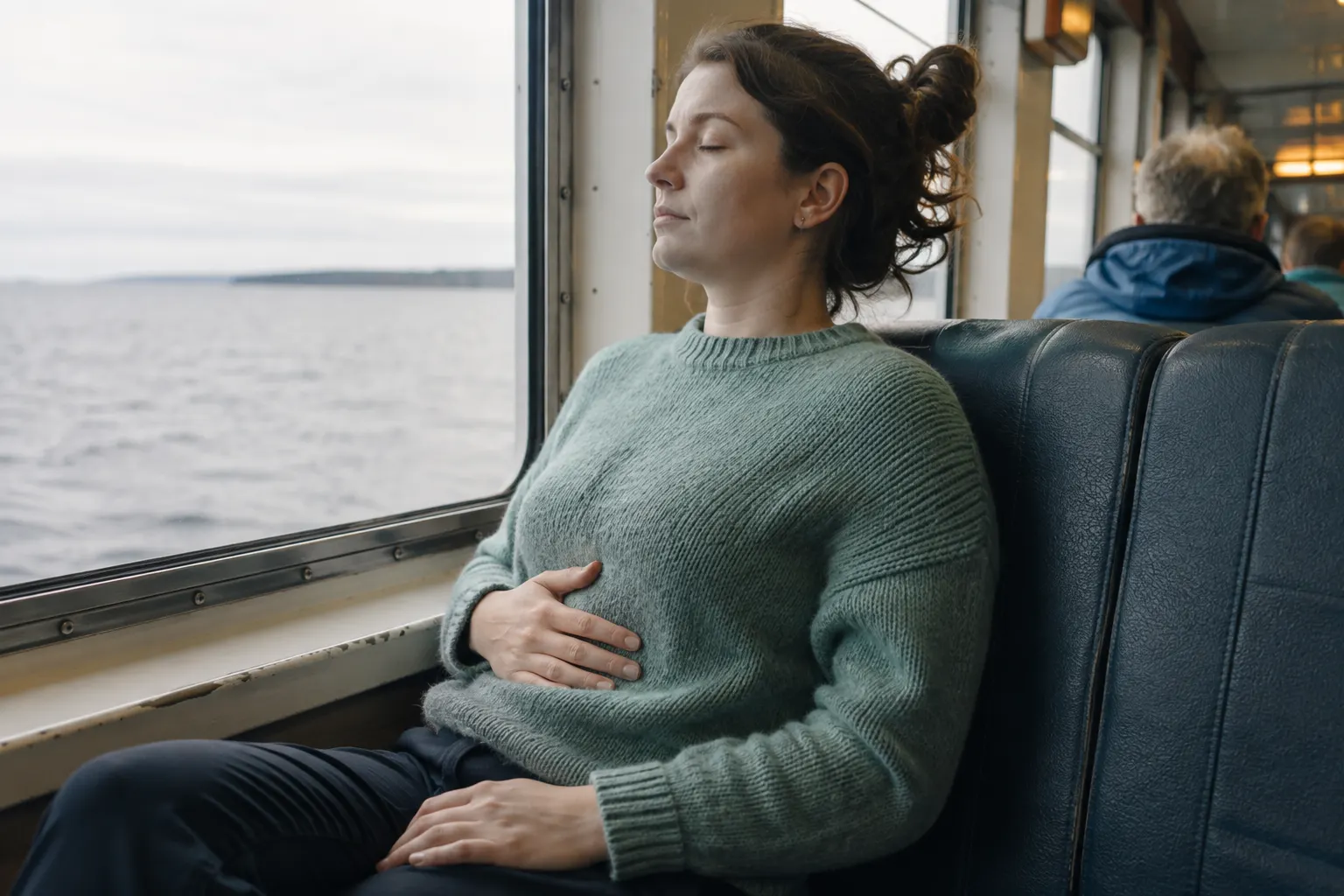
- Breathe with your diaphragm, not your chest: one hand on your stomach should rise more than the hand on your ribs.
- Slow the rate down to roughly six breaths a minute, with the out-breath longer than the in-breath.
- Start before the rough section, not after. Every behavioral method on this page works better as prevention than as rescue.
- Cool air on your face makes it easier to keep going, which is one reason the two are so often recommended together.
Paced breathing
Six breaths a minute: in for 4 seconds, out for 6. Follow the circle, or just the words if you'd rather close your eyes.
Ready
Start before the rough part, not after: it works better as prevention.
Slow, even breathing at this pace is a widely used comfort technique for nausea. Stop if you feel light-headed: that means you're breathing too deeply, not too slowly. This is a comfort technique, not medical treatment.
Frequently asked questions
How long do I need to breathe like this for it to work?
In the trial it was applied throughout the motion exposure, so treat it as something you do continuously through the rough part rather than a fixed exercise you complete. Starting a few minutes before helps.
Is controlled breathing better than an acupressure band?
The evidence is better, yes. Breathing beat its control condition in a properly designed crossover trial; the wristband trials disagree with each other, and the larger motion sickness one found nothing. Both are free of side effects, so there is no harm in trying both.
Looking for something drug-free?
Try Dizzout Free
We make a free, drug-free app that plays calibrated sound through headphones you already own. We hold it to the same standard as everything on this page: it is not a medication, it will not suit everyone, and if a forward view and slow breathing are enough for you, use those first.
Free to try, no card needed. Or go straight to the App Store or Google Play.
 Scan to open on your phone
On a computer? Dizzout installs on your phone. Scan the code, or open dizzout.com/get on your phone and it'll take you straight to the right store.
Know someone who gets motion sick?
Send them the app that helps stop it, drug-free, in about 90 seconds, works with any headphones. Free to try.
Check another remedy
Sources
Your next question, probably
So what has the strongest evidence?
All of them ranked, from the ones that work to the ones that do not
If that is not your question:
When it isn't motion sickness. Severe or lasting dizziness, a spinning sensation at rest, hearing loss, ringing in one ear, double vision, a bad headache, chest pain, fainting, or vomiting you cannot stop are not motion sickness. Seek medical care rather than a travel remedy.
Dizzout is not a medical provider and nothing here is medical advice. These pages summarize published research so you can weigh it: they cannot account for your health, your medicines or your pregnancy. Talk to a doctor or pharmacist before starting any supplement or medication, especially if you take other drugs, are pregnant or breastfeeding, or are buying for a child. Evidence summaries reflect the published literature as of July 2026 and describe findings in groups of people, which cannot predict your individual response. Product and brand names are trademarks of their respective owners; Dizzout is not affiliated with or endorsed by them.