Why do drivers rarely get car sick?
Driving instead of riding: yes. Because they are in control. When 22 pairs of people were exposed to identical nauseating motion, one steering it and one just along for the ride, the person holding the controls reported significantly fewer symptoms.
By Dizzout Editorial·Evidence last checked 31 July 2026·How we review
Verdict: Yes
Key facts
- The claim being tested: Everyone notices it eventually: the driver is fine and the passengers are green.
- 2 studies are summarised on this page, each with its participant count and finding.
- Of the studies listed, 2 support it.
- On the remedies hub it sits under things you do.
- Something with better evidence for the same job: Looking at the horizon.
What it's claimed to do
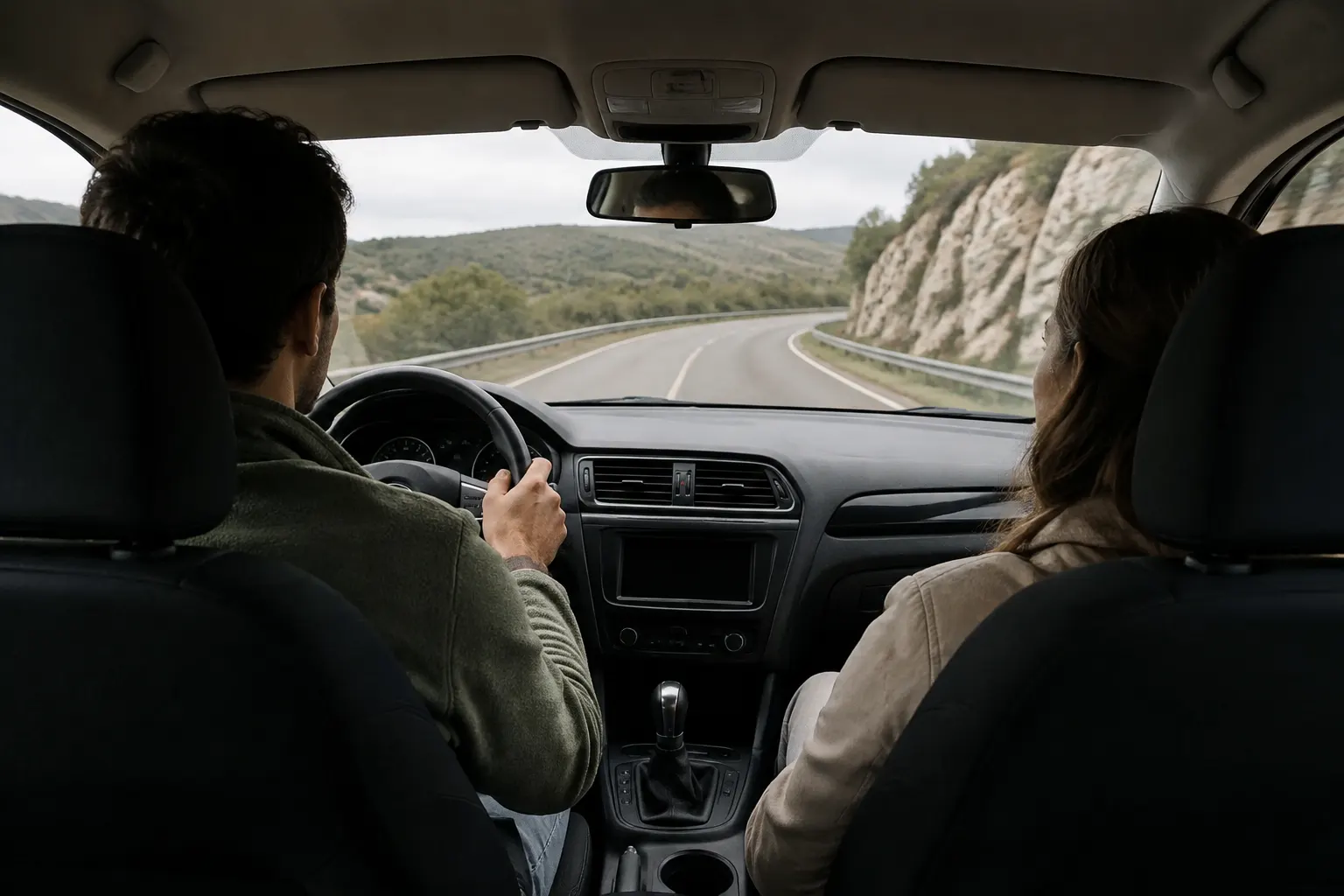
Everyone notices it eventually: the driver is fine and the passengers are green. The question is whether that is really about control, or just about the driver having the best seat and the best view.
- Yesthis remedyTested for motion sickness and it held up.
- ProbablyReal trial support, but modest or from a single study.
- MixedTrials disagree: some found an effect, better-designed ones did not.
- UntestedNo one has tested this for motion sickness. It may still be sensible.
- NoTested for motion sickness and it did not beat a placebo.
Levels describe the state of the published research on motion sickness specifically, not on nausea in general, and not how well something worked for any individual. “Untested” means no trial has looked; it is not the same as a remedy having been tested and failed.
What the research actually says
Rolnick and Lubow designed their experiment specifically to answer that objection. They used yoked pairs: two people exposed to exactly the same rotation, one controlling it and one not. They equated the groups for head movement, vision, activity and predictability, which are the four things usually offered as alternative explanations for the driver's immunity. Control still mattered. The person with it got significantly fewer symptoms and less decline in well-being. The mechanism is anticipation. When you initiate a movement, your brain generates a prediction of the sensory consequences before they arrive, so the vestibular signal that follows is expected rather than surprising. A passenger has no such prediction and gets the raw mismatch. This is why the finding has become central to modern work on self-driving cars, where every occupant is a passenger.
The studies, in full
Ergonomics 34(7):867-79
Participants: 22 yoked pairs (44 people)
Subjects with control over nauseogenic rotation reported significantly fewer motion sickness symptoms and less decrement in well-being than their yoked partners receiving the identical motion stimulus, with groups equated for head movement, vision, activity and predictability. (Rolnick & Lubow, 1991)
Read the source →Ergonomics 42(3):444-61 · PMID 10048305
Participants: 3,256 coach passengers
Found forward visibility strongly predicted sickness in real passengers, the part of the driver's advantage that a passenger can most easily copy. (Turner & Griffin, 1999)
Read the source →Safety & what to watch for
- This is not advice to drive when you should not. Nobody should take the wheel who is unlicensed, tired, unwell, or has been drinking. And if you already feel sick, driving is not the moment to start.
- It does not transfer to sea or air, where nobody in the cabin is in control of anything.
- Drivers are not immune. Motion sickness at the wheel does happen, particularly in stop-start traffic, on winding mountain roads, and in cars with strong regenerative braking.
If you want to try it
- On a long trip with someone who gets sick, put them in the driver's seat for the worst leg, like the winding section or the mountain pass, rather than saving the swap for when they already feel ill.
- If they cannot drive, the front passenger seat is the closest substitute: same view, same anticipation of curves.
- Passengers can recover some anticipation by watching the road rather than a screen: you start to see the corners coming and brace for them.
- In the back seat, call out the turns. Knowing a curve is coming is a weak version of the same effect and costs nothing to try.
Something with better evidence: Does looking at the horizon help motion sickness. Verdict: yes, and it costs nothing to try.
Frequently asked questions
Can a passenger get the same benefit as the driver?
Not fully, but partly. The controllable parts are visual: sitting where you can see the road ahead and watching it rather than a screen, plus anticipating the motion. What a passenger cannot replicate is the motor prediction that comes from actually initiating the movement.
Will self-driving cars make motion sickness worse?
It is a real concern in the research literature, because a fully automated car turns every occupant into a passenger and invites them to look at screens instead of the road. That is why so much recent work focuses on giving passengers anticipatory cues about upcoming motion.
Do drivers ever get car sick?
Yes, it is less common, not impossible. It shows up most in heavy stop-start traffic and on tight winding roads, and some drivers report it in EVs with aggressive one-pedal regenerative braking.
Looking for something drug-free?
Try Dizzout Free
We make a free, drug-free app that plays calibrated sound through headphones you already own. We hold it to the same standard as everything on this page: it is not a medication, it will not suit everyone, and if a forward view and slow breathing are enough for you, use those first.
Free to try, no card needed. Or go straight to the App Store or Google Play.
 Scan to open on your phone
On a computer? Dizzout installs on your phone. Scan the code, or open dizzout.com/get on your phone and it'll take you straight to the right store.
Know someone who gets motion sick?
Send them the app that helps stop it, drug-free, in about 90 seconds, works with any headphones. Free to try.
Check another remedy
Sources
Your next question, probably
So what has the strongest evidence?
All of them ranked, from the ones that work to the ones that do not
If that is not your question:
When it isn't motion sickness. Severe or lasting dizziness, a spinning sensation at rest, hearing loss, ringing in one ear, double vision, a bad headache, chest pain, fainting, or vomiting you cannot stop are not motion sickness. Seek medical care rather than a travel remedy.
Dizzout is not a medical provider and nothing here is medical advice. These pages summarize published research so you can weigh it: they cannot account for your health, your medicines or your pregnancy. Talk to a doctor or pharmacist before starting any supplement or medication, especially if you take other drugs, are pregnant or breastfeeding, or are buying for a child. Evidence summaries reflect the published literature as of July 2026 and describe findings in groups of people, which cannot predict your individual response. Product and brand names are trademarks of their respective owners; Dizzout is not affiliated with or endorsed by them.