Motion Sickness in the Toyota Prius: Why It Happens & How to Prevent It
The Prius is the unusual Toyota where the ride is not the thing passengers react to: the view out is. The current fifth-generation car (2023 onward) was redesigned around aerodynamics, and Toyota says the roofline sits two inches lower than the previous generation. Reviewers have consistently linked that shape to a small rear window, a low windshield and a rear seat that sits low with tight headroom. Since a clear view of the road ahead is the single biggest thing that settles a motion-sensitive passenger, that trade-off matters more here than the hybrid system does.
Hatchback · Hybrid · Reader-reported motion-sickness risk: mixed, very person-dependent.
- Low
- Moderate
- High
- Very high
Risk levels summarise what passengers and riders commonly report, not measured testing.
Key facts
- The Toyota Prius is a hatchback. It is a hybrid.
- Reader reports place it in the moderate band for motion sickness.
- 6 design factors are documented on this page as motion triggers in the Toyota Prius.
- Best seat: For an adult who reliably gets carsick, prioritize the front seat: it is the one place in a Prius with a genuinely clear forward view, and that forward sightline matters more here than it would in a tall, upright SUV.
- Settings that matter: Leave the shifter in D for everyday driving and save B for long descents, which is what Toyota describes it for; on the current car B can only be selected from D, and in normal traffic it mainly adds engine-braking drag every time the driver lifts off, which a queasy passenger feels as an unexpected pull.
Try Dizzout free. Put it on your phone before you go, so it is there when you need it. Drug-free, any headphones.Free · works with any headphones · no account to try
Stop car sickness. Free to try, no card needed. Or go straight to the App Store or Google Play.
Why the Toyota Prius can trigger motion sickness
Two things come up around the Prius, and they pull in opposite directions. The first is visibility. Toyota lowered the fifth-generation car's roofline two inches for aerodynamics and dropped the hip point about an inch to go with it, and reviewers who have driven it describe the consequences plainly: a super-low windshield, a sloped rear end with a small rear window, and thick windshield pillars. Consumer Reports found the rear seat tighter than before, sitting low to the floor with little underleg support and headroom that is tight for average-sized adults and up. For a carsick-prone rear passenger that is the part that counts, because looking out at the road and horizon is the most reliable way to keep the eyes and the inner ear telling the same story, and a low seat behind a high beltline and sloped glass leaves less to look at. Every Prius since the second generation in 2003 has been a liftback, so sloped rear glass is a long-running trait of the car rather than something new; the current one simply takes it further. The second thing is the hybrid drivetrain, and here the Prius reads more as a good example than a problem one. Like other Toyota hybrids it uses a power-split eCVT, so the engine can settle at a steady note while road speed keeps climbing, and the rising pitch a passenger expects during acceleration never arrives. Its braking blends regenerative and friction braking, but Cars.com praised the current car's regenerative braking as well integrated and free of the lurchiness some other hybrids show. The chassis is a genuine plus too: the second-generation TNGA-C platform gives a low center of gravity, and the ride is firm and composed rather than floaty, which avoids the slow body float that draws the most passenger complaints in taller, softer Toyota family models.
- Toyota lowered the fifth-generation (2023 onward) roofline for aerodynamics and dropped the hip point with it; reviewers link that shape to a small rear window, a low windshield and thick windshield pillars, and a restricted outward view is one of the factors most consistently linked to car sickness
- Consumer Reports found the rear seat tighter than before, sitting low to the floor with little underleg support and tight headroom for average-sized adults and up, so rear passengers sit low relative to the window line
- The power-split eCVT lets the engine hold a steady note while the car keeps gathering speed, so the rising engine pitch a passenger expects during acceleration never arrives
- With the engine often off at low speed and on lift-off, the engine-braking cue that normally signals slowing down is reduced
- Shifting the console lever into B increases engine-braking drag on lift-off. It is intended for long downhill grades, and that extra deceleration can feel abrupt to a sensitive passenger in ordinary driving
- On the positive side, the second-generation TNGA-C platform gives a low center of gravity and a firm, composed ride with little body float, and Cars.com described the regenerative braking as well integrated and free of the lurchiness some other hybrids show
Best seat & setup in the Toyota Prius
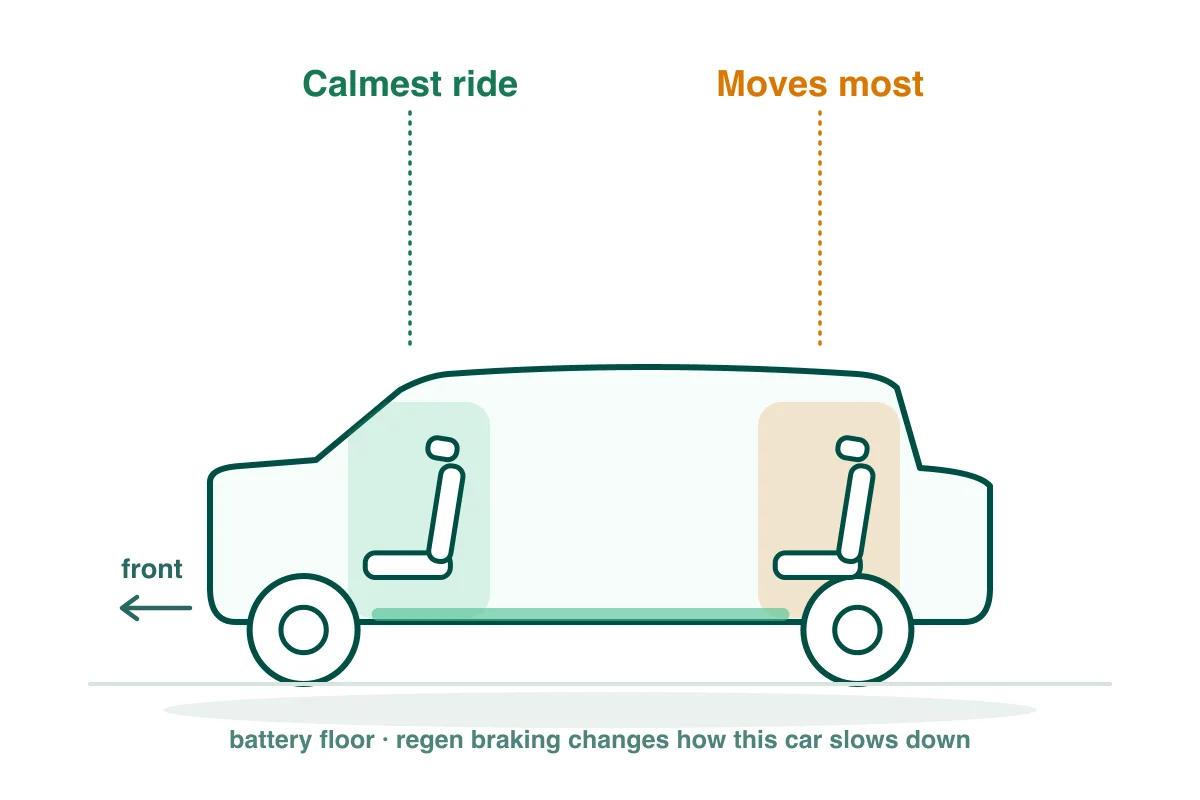
For an adult who reliably gets carsick, prioritize the front seat: it is the one place in a Prius with a genuinely clear forward view, and that forward sightline matters more here than it would in a tall, upright SUV. In the back, an outboard seat beats the middle, but expect to sit fairly low behind the beltline, so a rear passenger sees less of the road than they would in most crossovers. Children should stay in the back in the restraint appropriate for their age and size, correctly fitted, and if they are at the booster stage, a properly fitted booster that lets them see out of the window helps. If a child gets carsick in the car regularly, ask your pediatrician.
Leave the shifter in D for everyday driving and save B for long descents, which is what Toyota describes it for; on the current car B can only be selected from D, and in normal traffic it mainly adds engine-braking drag every time the driver lifts off, which a queasy passenger feels as an unexpected pull. The Prius has no driver-adjustable regen level the way a full EV does, so the remaining levers are Eco mode, which softens throttle response so speed builds more gently, and the standard adaptive cruise control, which holds a steadier highway speed than most drivers manage on the pedal. Beyond that it is technique: brake earlier and more gradually, and carry a steadier pace through corners.
Going on a drive in the Toyota Prius? Set it up first
Set it up before you pull out, not at the first lay-by. Dizzout is a drug-free app that plays precisely calibrated audio through any headphones you already own, wired or Bluetooth, with relief in about 90 seconds. Free to try.
Before you need it: find out how prone you are
Take the free 2-minute testTwo minutes, no sign-up, and it ends with a drug-free plan to prepare.
Put it on your phone before you go
Free to try, no card needed. Or go straight to the App Store or Google Play.
 Scan to open on your phone
On a computer? Dizzout installs on your phone. Scan the code, or open dizzout.com/get on your phone and it'll take you straight to the right store.
Know someone who gets motion sick?
Send them the app that helps stop it, drug-free, in about 90 seconds, works with any headphones. Free to try.
What helps in the Toyota Prius
- Seat carsick riders up front where the forward view is clearest, and keep their eyes on the road ahead and the horizon rather than on the cabin or a screen
- In the back, choose an outboard seat; for a child at the booster stage, make sure a correctly fitted booster lets them actually see out over the beltline
- Keep the car in D rather than B, and use Eco mode so acceleration and deceleration both arrive more gradually
- Crack a window or aim a vent at your face for cool, fresh airflow, which many riders find settles the stomach
- Avoid reading, phones and screens while moving; looking down widens the eye-versus-inner-ear mismatch that drives nausea
- Dizzout is a drug-free, screen-free sound therapy you can start the moment symptoms begin; most users feel better in about 90 seconds. Over-the-counter options also exist (follow the label or ask a pharmacist), and check with a pediatrician for children
The screens-away item on that list has a page of its own, with the trials attached: see the verdict on putting your phone away.
Frequently asked questions
Why do some passengers feel carsick in a Toyota Prius?
For most people it is the view out rather than the hybrid system. Toyota lowered the fifth-generation Prius roofline for aerodynamics, and reviewers have tied that shape to a small rear window, a low windshield and thick pillars, while Consumer Reports found the rear seat tighter than before and low to the floor. Seeing the road ahead is what keeps the eyes and the inner ear in agreement, so a low rear seat behind sloped glass gives a sensitive passenger less to work with. The eCVT also lets the engine hold a steady note while the car speeds up, which removes another cue passengers rely on.
Should I use B mode in the Prius if I get carsick?
Generally no. Toyota's guidance is to shift to B when engine braking is wanted, such as on a long downhill grade, and on the current car B can only be selected from D. In ordinary driving it simply adds engine-braking drag whenever the driver lifts off, which a motion-sensitive passenger tends to feel as an unexpected pull. Leaving the car in D and braking earlier and more gradually usually feels smoother.
Is the Prius a good car for someone who gets carsick easily?
It is mixed, and it depends a lot on where you sit. Up front it is a reasonable place to be: the second-generation TNGA-C platform gives it a low center of gravity and a firm, composed ride without the slow body float that draws complaints in taller, softer family cars, and reviewers rate its regenerative braking as well integrated. The rear seat is the harder spot, because it sits low with tight headroom and a sloped, small rear window limits how much road a passenger can see. If a carsick-prone rider will usually be in the back, a car with a more upright greenhouse is worth considering.
Other car motion-sickness guides
Sources & further reading
- https://pressroom.toyota.com/hybrid-reborn-2023-toyota-prius-revealed/
- https://pressroom.toyota.com/five-things-to-know-about-the-2023-toyota-prius-and-2023-toyota-prius-prime/
- https://en.wikipedia.org/wiki/Toyota_Prius
- https://www.cars.com/articles/2025-toyota-prius-review-big-on-miles-small-on-space-513894/
- https://www.consumerreports.org/cars/toyota/prius/2025/road-test-report/
- https://assets.sia.toyota.com/publications/en/om-s/OM24W1QRG/pdf/OM24W1QRG.pdf
- https://wwwnc.cdc.gov/travel/page/motion-sickness
Your next question, probably
Car sick on every single drive?
The graded plan that builds tolerance ride by ride
If that is not your question:
Based on publicly reported owner experiences and the vehicle's documented design characteristics, as of 2026. Vehicle and brand names are trademarks of their respective owners; Dizzout is not affiliated with or endorsed by them. Motion-sickness sensitivity varies by person, so this is informational, not a vehicle review or a substitute for a doctor's advice.