
Motion Sickness in the Toyota Sienna: Why It Happens & How to Prevent It
The fourth-generation Toyota Sienna (2021 and newer) is a hybrid-only minivan, and that powertrain change is at the center of a recurring motion-sickness conversation among owners. If your family rode comfortably in an older Sienna but a newer one feels different in the back, you're not imagining the shift.
Minivan · Hybrid · Reader-reported motion-sickness risk: mixed, very person-dependent.
- Low
- Moderate
- High
- Very high
Risk levels summarise what passengers and riders commonly report, not measured testing.
Key facts
- The Toyota Sienna is a minivan. It is a hybrid.
- Reader reports place it in the moderate band for motion sickness.
- 6 design factors are documented on this page as motion triggers in the Toyota Sienna.
- Best seat: Seat the most motion-sensitive rider in the second row rather than the third row, and use the center position if your trim has a second-row bench.
- Settings that matter: The Sienna's regenerative braking isn't a one-pedal system you can switch off, but the deceleration feel is largely in the driver's hands: lift off the accelerator gradually rather than abruptly, brake early and smoothly, and avoid alternating hard between throttle and lift-off.
Try Dizzout free. Put it on your phone before you go, so it is there when you need it. Drug-free, any headphones.Free · works with any headphones · no account to try
Stop car sickness. Free to try, no card needed. Or go straight to the App Store or Google Play.
Why the Toyota Sienna can trigger motion sickness
On the SiennaChat owner forum, riders of the 2021-and-newer hybrid Sienna commonly report a deceleration and throttle feel that some find queasy-making; in one widely-read thread a test-driver described feeling nauseated after roughly ten minutes, and a pre-2021 owner called the older, non-hybrid van "rock solid and very smooth." Owners often point to two things: the hybrid's regenerative braking (the car begins slowing the moment you lift off, blending regen and friction braking in a way that can feel slightly surge-like) and an electronically managed throttle whose power delivery feels different from a conventional gas engine. None of this is a verdict that the van is defective. The Sienna is otherwise praised for its quiet, spacious cabin, easy outward visibility, and strong fuel economy, and the deceleration character is a design trade-off of an efficient hybrid drivetrain that most riders adapt to.
- The 2021+ hybrid powertrain delivers an 'increasing gradient of thrust' throttle feel that owners describe as different from the older gas Sienna they were used to
- Regenerative braking begins decelerating the van as soon as the driver lifts off the accelerator, so passengers feel slowing they didn't anticipate
- Owners on SiennaChat report a brief brake surge/release sensation as the system blends regenerative and hydraulic braking (a 2024 service bulletin, T-SB-0047-24, addressed a related brake-feel software update)
- As a three-row minivan, the rearmost bench sits behind the rear axle, where pitch and bounce are felt most
- Captain's chairs on many trims remove the second-row center position, often the steadiest seat for a sensitive child
- Pre-2021 (non-hybrid) Siennas are frequently described by owners as 'rock solid and very smooth,' a clean before/after generational contrast
Best seat & setup in the Toyota Sienna
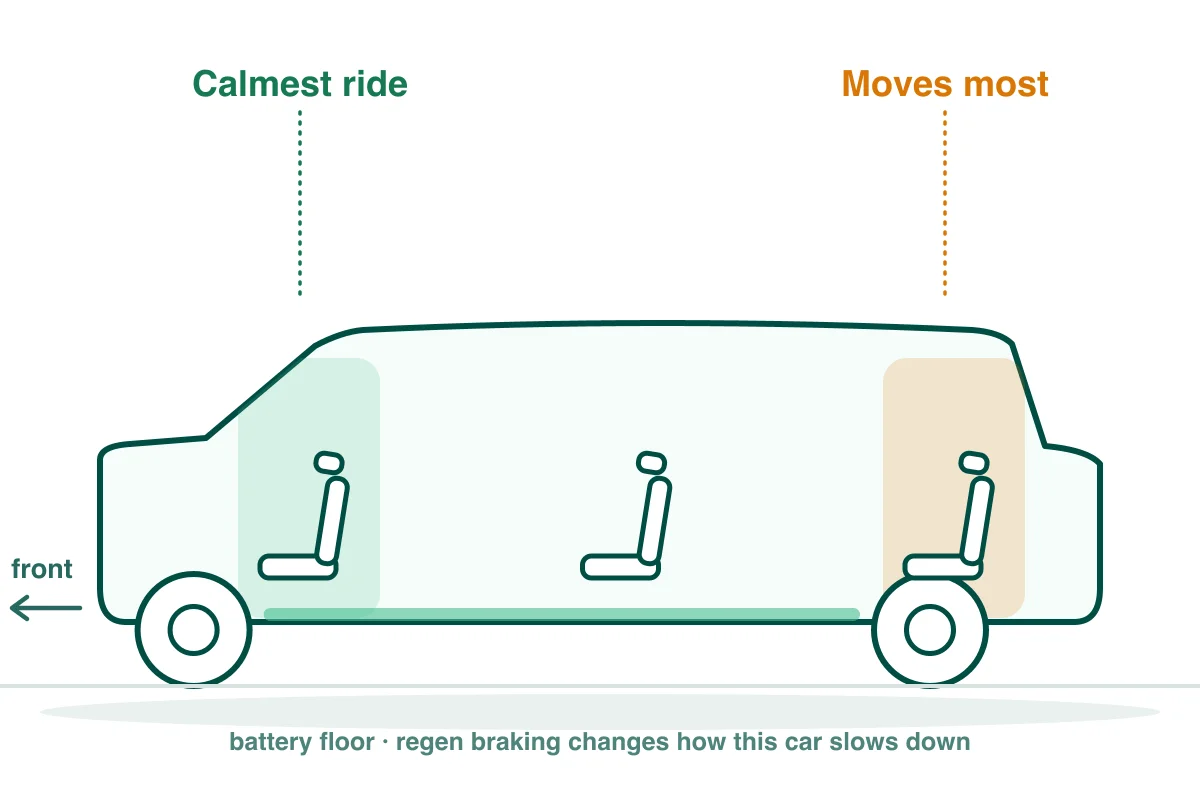
Seat the most motion-sensitive rider in the second row rather than the third row, and use the center position if your trim has a second-row bench. Front passengers should keep their eyes on the road ahead and the horizon. The third-row bench, behind the rear axle, is the seat where bounce and pitch are felt most.
The Sienna's regenerative braking isn't a one-pedal system you can switch off, but the deceleration feel is largely in the driver's hands: lift off the accelerator gradually rather than abruptly, brake early and smoothly, and avoid alternating hard between throttle and lift-off. Using the gas pedal with steady, gentle inputs lets the hybrid system blend regen and friction braking more seamlessly, which owners report softens the surge-like sensation for back-seat riders.
Going on a drive in the Toyota Sienna? Set it up first
Set it up before you pull out, not at the first lay-by. Dizzout is a drug-free app that plays precisely calibrated audio through any headphones you already own, wired or Bluetooth, with relief in about 90 seconds. Free to try.
Before you need it: find out how prone you are
Take the free 2-minute testTwo minutes, no sign-up, and it ends with a drug-free plan to prepare.
Put it on your phone before you go
Free to try, no card needed. Or go straight to the App Store or Google Play.
 Scan to open on your phone
On a computer? Dizzout installs on your phone. Scan the code, or open dizzout.com/get on your phone and it'll take you straight to the right store.
Know someone who gets motion sick?
Send them the app that helps stop it, drug-free, in about 90 seconds, works with any headphones. Free to try.
What helps in the Toyota Sienna
- Seat sensitive riders in the second row (center if a bench is available) instead of the third row, and keep their eyes on the horizon ahead
- Drive with gradual lift-off and early, smooth braking so the hybrid's regenerative deceleration feels less surge-like to passengers
- Open a window or aim the vents for cool, fresh airflow, which many riders find settles their stomach
- Avoid reading, phones, and the rear entertainment screen while moving, since looking down widens the sensory mismatch that drives nausea
- Take breaks on longer trips and let a queasy child step out and look at the horizon for a few minutes
- Dizzout is a drug-free, screen-free sound-therapy option you can start the moment symptoms begin; most users feel better in about 90 seconds. Over-the-counter options also exist, especially for kids, follow the label or ask a pharmacist or pediatrician
The screens-away item on that list has a page of its own, with the trials attached: see the verdict on putting your phone away.
Frequently asked questions
Why does the newer hybrid Sienna feel different from our old one?
The 2021 redesign made the Sienna hybrid-only. Owners commonly attribute the changed feel to regenerative braking, which slows the van as soon as the driver lifts off, and to the electronically managed throttle, whose power delivery differs from the older gas engine. Many pre-2021 owners described that earlier van as exceptionally smooth, which is why the contrast stands out.
Where should a carsick child sit in a Toyota Sienna?
The second row is generally steadier than the third, which sits behind the rear axle where bounce and pitch are strongest. If your trim has a second-row bench, the center seat offers the most direct forward view of the road, which helps the inner ear and eyes agree. Trims with captain's chairs remove that center option.
Can I turn off regenerative braking on the Sienna?
No, the Sienna doesn't offer a one-pedal mode or a toggle to disable regenerative braking. The deceleration feel is mostly controlled by driving style: lifting off gently and braking early and smoothly lets the system blend regen and friction braking more gradually, which owners report reduces the surge-like sensation for passengers.
Other car motion-sickness guides
Sources & further reading
Your next question, probably
Car sick on every single drive?
The graded plan that builds tolerance ride by ride
If that is not your question:
Based on publicly reported owner experiences and the vehicle's documented design characteristics, as of 2026. Vehicle and brand names are trademarks of their respective owners; Dizzout is not affiliated with or endorsed by them. Motion-sickness sensitivity varies by person, so this is informational, not a vehicle review or a substitute for a doctor's advice.