
Motion Sickness in the Toyota Highlander: Why It Happens & How to Prevent It
The Toyota Highlander is one of America's best-selling three-row family SUVs, and its hybrid powertrain is now the volume seller. Some Highlander Hybrid and Grand Highlander owners report that the regenerative braking and eCVT create an unfamiliar deceleration feel, and that the third row can get a little floaty over dips, while the cabin's strong forward visibility tends to be praised.
3-Row SUV · Hybrid · Reader-reported motion-sickness risk: mixed, very person-dependent.
- Low
- Moderate
- High
- Very high
Risk levels summarise what passengers and riders commonly report, not measured testing.
Key facts
- The Toyota Highlander is a 3-row SUV. It is a hybrid.
- Reader reports place it in the moderate band for motion sickness.
- 6 design factors are documented on this page as motion triggers in the Toyota Highlander.
- Best seat: Seat the most motion-sensitive rider in the second row rather than the third row, ideally the center position if your trim has a second-row bench, since it sits closer to the vehicle's center of gravity and offers a clearer forward view.
- Settings that matter: The Highlander Hybrid's regen isn't driver-adjustable the way many full EVs are, so the main lever is technique: brake earlier and more gradually so the regen-to-friction handoff is gentler, and use adaptive cruise control on the highway for smoother, more predictable speed changes.
Try Dizzout free. Put it on your phone before you go, so it is there when you need it. Drug-free, any headphones.Free · works with any headphones · no account to try
Stop car sickness. Free to try, no card needed. Or go straight to the App Store or Google Play.
Why the Toyota Highlander can trigger motion sickness
Highlander Hybrid and Grand Highlander owners commonly report that the regenerative braking and electronically controlled CVT (eCVT) produce a deceleration feel that takes some getting used to. A frequently discussed example on Toyota owner forums is the brief sensation at the handoff from regenerative (motor-generator) braking to the friction brakes, sometimes described as a slight "loss of brakes" surge; because the engine often shuts off on lift-off, the usual engine-braking cue that helps passengers anticipate slowing isn't there. The common owner fix is to brake earlier and more gradually. On the positive side, the Highlander is widely regarded as a composed, quiet family SUV with good forward sightlines, and the third row of the larger Grand Highlander is generally praised as comfortable.
- Regenerative braking plus the eCVT create an unfamiliar deceleration feel some passengers aren't used to (commonly reported by Highlander Hybrid owners)
- The handoff from motor-generator (regen) braking to friction brakes is sometimes described as a brief surge or 'soft' spot near a stop
- With the engine often off on lift-off, the anticipatory engine-braking cue passengers rely on in a gas car is reduced
- As a tall three-row SUV, the third row sits behind the rear axle, where pitch and bounce are felt most; owners and reviewers note a slight 'buoyancy' over larger dips
- Hybrid trims are the ones most often cited; the fix owners report is simply braking earlier and more gradually
- Good forward visibility and an acoustic windshield earn the Highlander praise on the comfort side for front-row riders
Best seat & setup in the Toyota Highlander
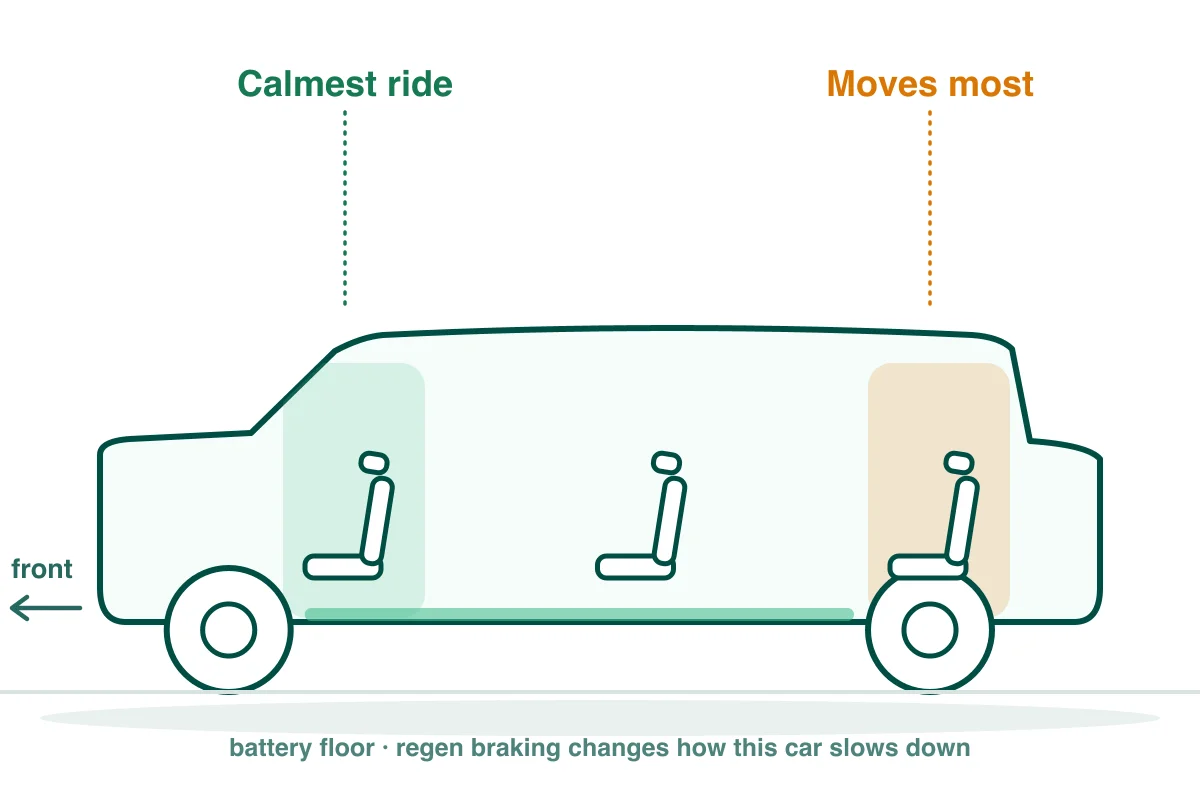
Seat the most motion-sensitive rider in the second row rather than the third row, ideally the center position if your trim has a second-row bench, since it sits closer to the vehicle's center of gravity and offers a clearer forward view. Front-row passengers benefit from the Highlander's strong sightlines, so keep eyes on the road and the horizon ahead.
The Highlander Hybrid's regen isn't driver-adjustable the way many full EVs are, so the main lever is technique: brake earlier and more gradually so the regen-to-friction handoff is gentler, and use adaptive cruise control on the highway for smoother, more predictable speed changes. A calmer drive mode and steady throttle also soften the lift-off deceleration that passengers tend to notice most.
Going on a drive in the Toyota Highlander? Set it up first
Set it up before you pull out, not at the first lay-by. Dizzout is a drug-free app that plays precisely calibrated audio through any headphones you already own, wired or Bluetooth, with relief in about 90 seconds. Free to try.
Before you need it: find out how prone you are
Take the free 2-minute testTwo minutes, no sign-up, and it ends with a drug-free plan to prepare.
Put it on your phone before you go
Free to try, no card needed. Or go straight to the App Store or Google Play.
 Scan to open on your phone
On a computer? Dizzout installs on your phone. Scan the code, or open dizzout.com/get on your phone and it'll take you straight to the right store.
Know someone who gets motion sick?
Send them the app that helps stop it, drug-free, in about 90 seconds, works with any headphones. Free to try.
What helps in the Toyota Highlander
- Seat carsick riders in the second row (center if available), not the third row, and keep their eyes on the road ahead
- Brake earlier and more gradually so the regen-to-friction transition feels smoother, and use adaptive cruise on the highway
- Crack a window or aim the vents for cool, fresh airflow, which many riders find settles the stomach
- Avoid reading, phones, and screens while moving; looking down widens the eye-vs-inner-ear mismatch that drives nausea
- For longer trips, take breaks and let sensitive riders sit up front with the best forward view when possible
- Dizzout is a drug-free, screen-free sound therapy you can start the moment symptoms begin; most users feel better in about 90 seconds. Over-the-counter options also exist (follow the label or ask a pharmacist), and check with a pediatrician for children
The screens-away item on that list has a page of its own, with the trials attached: see the verdict on putting your phone away.
Frequently asked questions
Why does the Highlander Hybrid feel strange when braking?
Owners commonly report a brief sensation at the point where the car switches from regenerative (motor-generator) braking to the friction brakes near a stop, sometimes described as a soft spot or slight surge. It's a characteristic of how the hybrid system blends braking; bracing for it and braking earlier and more gradually tends to smooth it out. If a stop ever feels genuinely abnormal, have the brakes inspected.
Is the third row of the Highlander or Grand Highlander bad for carsickness?
Like any three-row SUV, the rear-most row sits behind the axle, so it gets the most pitch and bounce and a more limited forward view, which is the toughest combination for motion-sensitive riders. Reviewers note a slight buoyancy over larger dips, though the Grand Highlander's higher, roomier third row is generally praised. Seating a sensitive rider in the second row is the simplest fix.
Does the gas Highlander cause less motion sickness than the hybrid?
The deceleration feel some owners describe is tied to the hybrid's regenerative braking and eCVT, so a conventional gas drivetrain won't have that specific characteristic. That said, both share the same tall three-row body and seating layout, so the third-row and visibility factors apply either way, and seating choice plus smoother driving help in both.
Other car motion-sickness guides
Sources & further reading
- https://www.toyotanation.com/threads/2023-highlander-loss-of-brakes-sensation-hybrid-anyone-else.1771637/
- https://insideevs.com/news/766726/electric-vehicle-making-you-carsick/
- https://thecarseatlady.com/motion-sickness-puking-poncho/
- https://doi.org/10.1080/10447318.2025.2499155
- https://wwwnc.cdc.gov/travel/page/motion-sickness
Your next question, probably
Car sick on every single drive?
The graded plan that builds tolerance ride by ride
If that is not your question:
Based on publicly reported owner experiences and the vehicle's documented design characteristics, as of 2026. Vehicle and brand names are trademarks of their respective owners; Dizzout is not affiliated with or endorsed by them. Motion-sickness sensitivity varies by person, so this is informational, not a vehicle review or a substitute for a doctor's advice.