
Ford Explorer Motion Sickness: Ride, Gears, Seats
The Ford Explorer gets mixed, very person-dependent motion sickness reports from passengers; the thing sensitive riders notice is a firm, busy ride that Consumer Reports says transmits frequent jiggles into the cabin, paired with a 10-speed automatic it calls clunky at low speed. It is a rear-drive-based three-row SUV with a low-set third row, and one owner on cars.com says the ride made them nauseous within five miles. Other owners call the ride smooth and comfortable, so much depends on the rider, the trim and the road.
Going on a ride in the Ford Explorer? Dizzout is drug-free sound therapy for passengers in the back seat, with relief in about 90 seconds.Starts in your browser · works with any headphones
Stop car sickness. Get your personalized Dizzout plan. Paid subscription for full access.

On your phone? Scan to start there.
3-Row SUV · ICE · Reader-reported motion-sickness risk: mixed, very person-dependent.
- Low
- Moderate
- High
- Very high
Risk levels summarise what passengers and riders commonly report, not measured testing.
Key facts
- The Ford Explorer is a 3-row SUV. It runs a combustion engine.
- Reader reports place it in the moderate band for motion sickness.
- 6 design factors are documented on this page as motion triggers in the Ford Explorer.
- Best seat: Put the most sensitive rider in the front passenger seat or the second row, ideally a captain's chair with a clear view forward.
- Settings that matter: Ford's Explorer support page, which covers the Terrain Management System, names a button on the center console (a dial on some models) that cycles the modes: Normal, Eco, Sport, Tow/Haul, Slippery and Trail, plus Deep Snow/Sand on Intelligent 4WD.
Why the Ford Explorer can trigger motion sickness
The Explorer's reports split. On one side, an owner reviewing a 2021 Explorer on cars.com wrote that after driving it for five miles they got nauseous, and that above about 28 mph it kicks so hard that it causes nausea; two other owners on the same page describe a long delay shifting into gear and unexpected lunges. Consumer Reports, testing a 2020 XLT, calls the ride stiff-legged but well controlled and tied down, says it transmits frequent jiggles into the cabin, and finds the 10-speed automatic a bit clunky at low speed, especially with the 2.3-liter turbo. Small, repeated jolts and gear changes are the speed changes a passenger cannot see coming. On the other side, cars.com's reviewers call the suspension firm without being overly so and praise the ride and handling balance, and owners on KBB describe a smooth, comfortable ride on long trips. The third row sits low to the floor and, per Consumer Reports, suits small children, with access that requires ducking and twisting; it is also the seat farthest from the road ahead. Ford's support site lists Normal, Eco and Sport among the Terrain Management System modes, and Sport sharpens accelerator response and holds lower gears, so it is the mode to avoid with a queasy rider.
- A firm, busy ride that Consumer Reports says transmits frequent jiggles into the cabin
- A 10-speed automatic that Consumer Reports calls a bit clunky at low speed, especially with the 2.3-liter turbo
- One cars.com owner reports nausea within five miles and a hard kick above about 28 mph; others describe delayed or abrupt gear engagement
- The third row sits low to the floor, behind the rear axle, with the weakest view of the road ahead
- Sport mode sharpens accelerator response and holds lower gears, per Ford, which makes speed changes more abrupt for passengers
- Cars.com praises the ride and handling balance and KBB owners call the ride smooth, so many riders have no complaint
Best seat & setup in the Ford Explorer
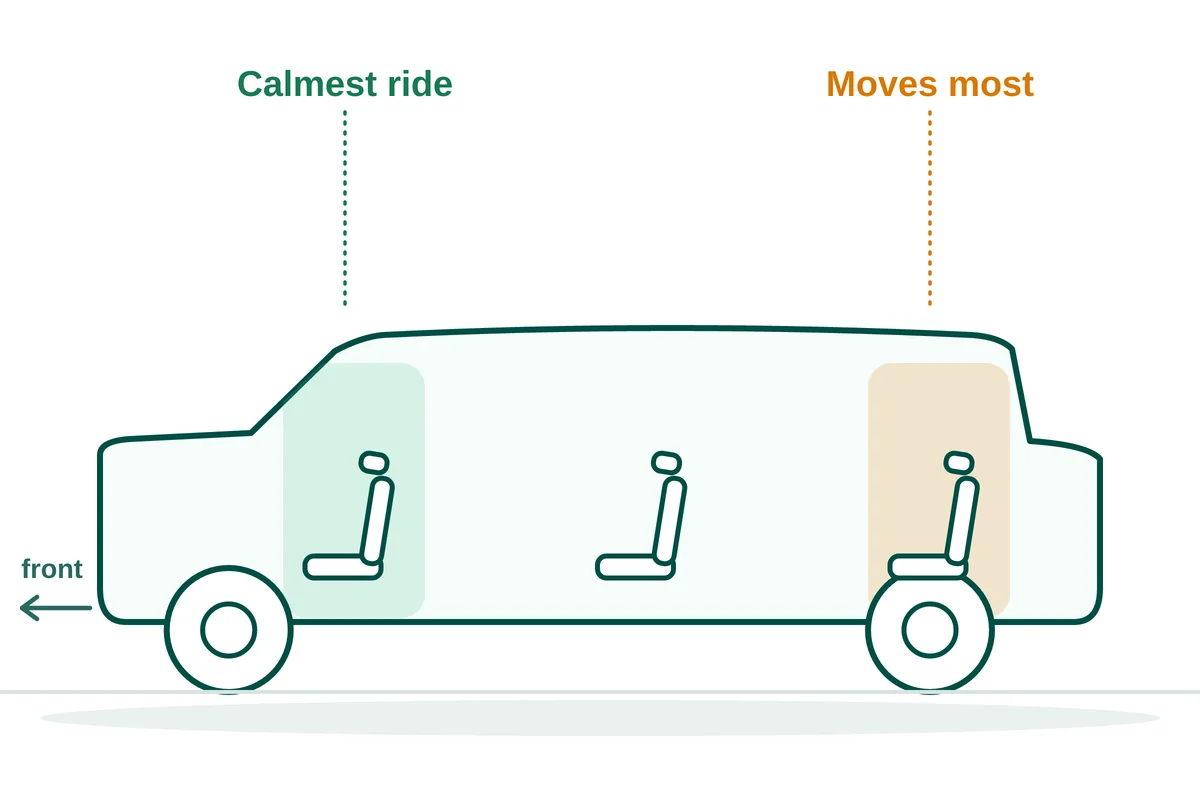
Put the most sensitive rider in the front passenger seat or the second row, ideally a captain's chair with a clear view forward. Keep the third row, which sits low and far back, for short trips or riders who travel well.
Ford's Explorer support page, which covers the Terrain Management System, names a button on the center console (a dial on some models) that cycles the modes: Normal, Eco, Sport, Tow/Haul, Slippery and Trail, plus Deep Snow/Sand on Intelligent 4WD. Sport increases accelerator pedal response and holds lower gears longer, so ask the driver to stay in Normal or Eco. The system resets to Normal each time the Explorer is turned off and on.
Comparing SUVs? See which SUVs have a documented comfort setting, and where the third row sits.
Going on a ride in the Ford Explorer? Have Dizzout ready
Stop car sickness
Dizzout is drug-free sound therapy for passengers in the back seat, with relief in about 90 seconds. It plays precisely calibrated audio through any headphones you already own, wired or Bluetooth. Free to download.
Get your personalized Dizzout plan. Paid subscription for full access.
30,000+ travelers in 30+ countries · How we count

On your phone? Scan to start there.
Comparing apps first? See how the motion sickness apps compare
Not travelling yet? Remind me the day before my trip
Know someone who gets motion sick?
Send them the app that helps stop it, drug-free, in about 90 seconds, works with any headphones. Free to download.
What helps in the Ford Explorer
- Ask the driver to keep the Terrain Management System in Normal or Eco and skip Sport, which sharpens throttle response
- Seat the sensitive rider up front or in a second-row captain's chair, not the low-set third row
- Ask the driver to brake and accelerate gradually, especially in town where the 10-speed shifts most
- Keep eyes on the road ahead and the horizon, not on a phone or the rear screen
- Aim a vent for cool, moving air and stop for a break before symptoms build
- Dizzout is a drug-free, screen-free sound therapy you can start the moment symptoms begin; Dizzout states relief in about 90 seconds
The screens-away item on that list has a page of its own, with the trials attached: see the verdict on putting your phone away.
Why cars set off nausea at all, and what to do once it starts in any car, is in our car sickness guide.
Comparing apps for the drive? The car sickness app guide sets sound therapy against on-screen motion cues, free options included.
Frequently asked questions
Does the Ford Explorer make passengers carsick?
Some riders say so, and others do not. One cars.com owner reported nausea within five miles and a hard kick above about 28 mph, and Consumer Reports describes a stiff-legged ride with frequent jiggles and a low-speed clunky transmission. KBB owners call the same SUV smooth and comfortable. The ride is a design characteristic, not a defect, and how a passenger reacts is very person-dependent.
Which Explorer drive mode is gentlest for passengers?
Normal or Eco. Ford's support page says Sport increases accelerator pedal response and holds lower gears longer, which makes every speed change sharper for a passenger. The modes are cycled with a button or dial on the center console, and the system returns to Normal on every restart.
Is the Explorer's third row bad for motion sickness?
It is the hardest seat for a sensitive rider. Consumer Reports says the third row sits low to the floor and suits small children, and it is the farthest seat from the road ahead, where pitch and bumps are felt most. Seat a queasy passenger up front or in the second row.
Other car motion-sickness guides
Sources & further reading
- https://www.ford.com/support/how-tos/more-vehicle-topics/engine-and-transmission/how-do-i-use-the-terrain-management-system-in-my-ford-explorer/
- https://www.consumerreports.org/cars/ford/explorer/2025/road-test-report/
- https://www.cars.com/research/ford-explorer-2025/
- https://www.cars.com/research/ford-explorer-2021/consumer-reviews/
- https://www.kbb.com/ford/explorer/2025/consumer-reviews/
- https://www.kbb.com/ford/explorer/
Based on publicly reported owner experiences and the vehicle's documented design characteristics, as of 2026. Vehicle and brand names are trademarks of their respective owners; Dizzout is not affiliated with or endorsed by them. Motion-sickness sensitivity varies by person, so this is informational, not a vehicle review or a substitute for a doctor's advice.