
Ford F-150 Motion Sickness: Ride & Seat Tips
The Ford F-150 gets mixed, very person-dependent motion sickness reports from passengers; the thing sensitive riders notice most is a lighter, busier rear ride when the bed is empty. The current 14th-generation truck (2021 onward, freshened for 2024) pairs an aluminum body with a fully boxed steel frame: classic body-on-frame construction with a solid rear axle on leaf springs, built for payload and towing. Set against that, the F-150 gives passengers one of the best forward views of any vehicle here, and the PowerBoost hybrid's regenerative braking is unusually smooth, closer to a normal gas truck than to the abrupt lift-off feel some full EVs have.
Going on a ride in the Ford F-150? Dizzout is drug-free sound therapy for passengers in the back seat, with relief in about 90 seconds.Starts in your browser · works with any headphones
Stop car sickness. Get your personalized Dizzout plan. Paid subscription for full access.

On your phone? Scan to start there.
Full-size Pickup · Hybrid / ICE · Reader-reported motion-sickness risk: mixed, very person-dependent.
- Low
- Moderate
- High
- Very high
Risk levels summarise what passengers and riders commonly report, not measured testing.
Key facts
- The Ford F-150 is a full-size pickup. It is sold as both a hybrid and a combustion model.
- Reader reports place it in the moderate band for motion sickness.
- 6 design factors are documented on this page as motion triggers in the Ford F-150.
- Best seat: Seat the most motion-sensitive rider up front if you can.
- Settings that matter: The biggest lever on an F-150 is load and driving style rather than a menu setting.
Why the Ford F-150 can trigger motion sickness
The F-150 is a body-on-frame full-size pickup, and two of its defining engineering choices are the ones a motion-sensitive rider is most likely to notice. First, the rear suspension uses a live (solid) axle on leaf springs, tuned primarily for load-carrying; with an empty bed there's relatively little weight over the rear wheels, so the back end can feel light and jittery and can hop or pitch over expansion joints, potholes, and washboard pavement. Owners commonly describe an unladen F-150 as riding firmer or bouncier at the rear than a car or a car-based crossover, and note that heavier crew-cab and higher trims ride better because the greater body weight settles the axle. Second, a tall body-on-frame truck sits high with a higher center of gravity, so it leans a bit more in corners and takes a moment to settle after bumps, the slow float-and-recover motion that can unsettle a queasy stomach. Those are normal characteristics of how a full-size pickup is designed rather than a defect, and they're the price of its towing and payload capability. On the helpful side, the commanding seating height and large glass give passengers an excellent view of the road and horizon, and the PowerBoost hybrid blends regenerative and friction braking so seamlessly that reviewers describe the regen as nearly imperceptible, so unlike some EVs its deceleration feel is not a common motion complaint.
- Body-on-frame construction with a solid rear axle on leaf springs, tuned for payload; with an empty bed the rear end is lightly loaded and can feel busy, jittery, or prone to hop and pitch over rough pavement
- As a tall full-size truck it has a high center of gravity, so it leans more in corners and settles more slowly after bumps than a lower car, a slow float-and-recover motion some riders find unsettling
- Ride comfort varies a lot by configuration: heavier SuperCrew cabs and higher trims generally ride more settled than lighter regular-cab trucks because more body weight helps damp the leaf-sprung rear
- Off-road-focused trims (Tremor, Raptor) use taller, softer, longer-travel suspension that pitches and floats more on the highway, which can feel worse for motion-sensitive passengers
- On the positive side, the F-150 has no rearmost row seating behind the axle the way a three-row SUV does, and the tall seating position with large windows gives most seats a clear forward view
- The PowerBoost hybrid blends regenerative and friction braking so smoothly that reviewers describe the regen effect as nearly imperceptible, so its deceleration feel is not a common motion trigger the way abrupt one-pedal EV braking can be
Best seat & setup in the Ford F-150
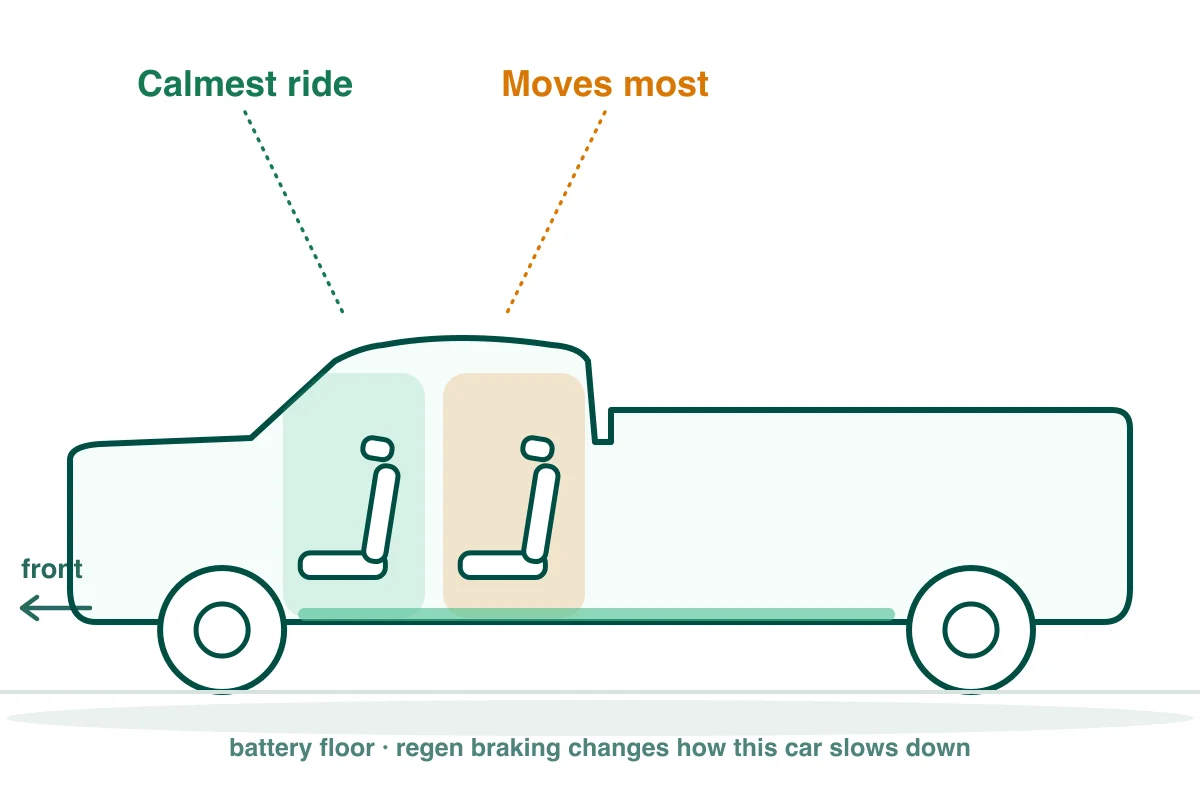
Seat the most motion-sensitive rider up front if you can. The F-150's tall windshield and commanding view make it one of the easier front seats to keep eyes on the road and horizon. If they must ride in back, a SuperCrew (full four-door) cab is far better than a smaller SuperCab: it has proper rear doors, more legroom, and larger side windows for an outside view, and the rear seat sits roughly over the rear axle rather than in an overhang behind it, so pitch is milder than the rear of a long three-row SUV. Wherever they sit, an outboard seat with a clear window beats the middle.
The biggest lever on an F-150 is load and driving style rather than a menu setting. An empty bed rides the busiest, so on a rough road a modest, secured load over the rear axle noticeably calms the back end; brake and accelerate gently and take corners smoothly to reduce the body lean and float a tall truck naturally has. If you're choosing a truck and a sensitive passenger is a priority, a heavier SuperCrew in a standard (non-off-road) trim generally rides the most settled, and the PowerBoost hybrid's braking feel is smooth enough that it isn't something you'll need to adjust around. Adaptive cruise on the highway also keeps speed changes gradual and predictable.
Prepare from the passenger seat
Keep your phone stored on the passenger side before departure. Use ordinary headphones if you want to try Dizzout once you are settled in your seat.
Free to download. Paid subscription for full access.
30,000+ travelers in 30+ countries · How we count

On your phone? Scan to start there.
Comparing apps first? See how the motion sickness apps compare
Not travelling yet? Remind me the day before my trip

Know someone who gets motion sick?
Send them the app that helps stop it, drug-free, in about 90 seconds, works with any headphones. Free to download.
What helps in the Ford F-150
- Seat carsick riders up front where the F-150's tall windshield and high view give the clearest sightline to the road ahead, and keep their eyes on the horizon
- In back, choose a SuperCrew cab and an outboard window seat; avoid the smaller SuperCab rear for a queasy passenger
- On rough roads, a modest secured load over the rear axle settles the leaf-sprung rear end and reduces the empty-bed hop
- Drive smoothly: gentle braking and acceleration and gradual cornering reduce the body lean and float a tall truck naturally has
- Crack a window or aim the vents for cool, fresh airflow, which many riders find settles the stomach
- Avoid reading, phones, and screens while moving; looking down widens the eye-vs-inner-ear mismatch that drives nausea
- Dizzout is a drug-free, screen-free sound therapy you can start the moment symptoms begin; Dizzout states relief in about 90 seconds. Over-the-counter options also exist (follow the label or ask a pharmacist), and check with a pediatrician for children
The screens-away item on that list has a page of its own, with the trials attached: see the verdict on putting your phone away.
Why cars set off nausea at all, and what to do once it starts in any car, is in our car sickness guide.
Comparing apps for the drive? The car sickness app guide sets sound therapy against on-screen motion cues, free options included.
Frequently asked questions
Why does my Ford F-150 feel bouncy or jittery when the bed is empty?
It's a normal characteristic of a full-size pickup rather than a fault. The F-150 uses a solid rear axle on leaf springs tuned mainly for carrying and towing loads, so with an empty bed there's little weight over the rear wheels and the back end rides light and busy, and can hop or pitch over bumps and expansion joints. A modest, secured load over the rear axle settles it noticeably, and heavier crew-cab and higher trims ride more composed because the extra body weight helps damp the rear. If the ride ever feels genuinely abnormal or you hear clunks, have the suspension inspected.
Does the F-150 PowerBoost hybrid's regenerative braking cause motion sickness like some EVs?
Generally no. Unlike the abrupt one-pedal lift-off feel some full electric vehicles have, the F-150 PowerBoost blends its regenerative and friction braking so smoothly that reviewers describe the regen as nearly imperceptible, with pedal feel and stopping distances close to the gas trucks. So the hybrid's deceleration feel is not a common motion complaint. The bigger comfort factors on an F-150 are the empty-bed rear ride and the body lean of a tall truck, both helped by a smooth driving style.
Which F-150 configuration is best for a passenger who gets carsick?
A heavier SuperCrew (four full doors) in a standard, non-off-road trim tends to ride the most settled, and its roomy rear seat with large windows gives a back-seat rider a better outside view than the smaller SuperCab. Off-road-focused trims like the Tremor and Raptor use taller, softer, longer-travel suspension that floats and pitches more on pavement, which can feel worse for a sensitive passenger. Wherever they sit, seating them up front with a clear forward view and driving smoothly help the most.
Other car motion-sickness guides
Sources & further reading
- https://en.wikipedia.org/wiki/Ford_F-Series_(fourteenth_generation)
- https://fordauthority.com/2024/12/should-ford-abandon-leaf-springs-in-the-f-150/
- https://thebrakereport.com/regenerative-braking-virtually-invisible-in-f-150-hybrid/
- https://cleanfleetreport.com/road-test-2024-ford-f-150-supercrew-powerboost-hybrid-platinum-4x4/
- https://wwwnc.cdc.gov/travel/page/motion-sickness
Based on publicly reported owner experiences and the vehicle's documented design characteristics, as of 2026. Vehicle and brand names are trademarks of their respective owners; Dizzout is not affiliated with or endorsed by them. Motion-sickness sensitivity varies by person, so this is informational, not a vehicle review or a substitute for a doctor's advice.