
Honda CR-V Motion Sickness: Why & How to Help
The Honda CR-V is rarely reported as a motion sickness trigger by passengers; the thing sensitive riders notice is the hybrid's regenerative-braking feel on lift-off. The current sixth-generation CR-V (2023 onward) is a two-row compact SUV offered as a 1.5-liter turbo gas model or as a two-motor e:HEV hybrid, and the hybrid now accounts for about half of CR-V sales. Reviewers generally rate it an easy car to ride in: the ride is composed and well controlled, the front seats have a tall, upright view, and Honda fits 'Body Stabilizing' front seats designed to reduce fatigue. The CR-V Hybrid's regen strength is adjustable with steering-wheel deceleration paddles, and the other thing owners tend to raise is the more limited rear-window visibility for back-seat passengers.
Going on a ride in the Honda CR-V? Dizzout is drug-free sound therapy for passengers in the back seat, with relief in about 90 seconds.Starts in your browser · works with any headphones
Stop car sickness. Get your personalized Dizzout plan. Paid subscription for full access.

On your phone? Scan to start there.
Compact SUV · Hybrid / ICE · Reader-reported motion-sickness risk: rarely an issue for most riders.
- Low
- Moderate
- High
- Very high
Risk levels summarise what passengers and riders commonly report, not measured testing.
Key facts
- The Honda CR-V is a compact SUV. It is sold as both a hybrid and a combustion model.
- Reader reports place it in the low band for motion sickness.
- 6 design factors are documented on this page as motion triggers in the Honda CR-V.
- Best seat: Because the CR-V is a two-row SUV, seat the most motion-sensitive rider up front where the large windshield and tall seating give the clearest forward view.
- Settings that matter: In the CR-V Hybrid, the regenerative braking is adjustable, which is useful for carsick-prone passengers: the deceleration paddles behind the steering wheel step regen through four levels, and keeping it in a lower setting gives a gentler, more gradual slow-down that feels more like a conventional car.
Why the Honda CR-V can trigger motion sickness
Most CR-V riders don't find it a strong trigger. It's a mainstream two-row compact SUV with a tall seating position, large front windows and a suspension that reviewers describe as soft without being floaty. Several note the hybrid feels well tied down over undulations, which tends to be easier on passengers prone to travel sickness. Two design characteristics come up in owner discussions. First, the e:HEV hybrid uses the electric motor to slow the car when you lift off the accelerator (regenerative braking) and blends that with the friction brakes; some passengers notice the unfamiliar deceleration feel, as they do across hybrids and EVs. Unlike many hybrids, the CR-V Hybrid gives the driver four selectable levels of regen through paddles behind the wheel, so the strength of that deceleration can be dialed up or down. Second, back-seat visibility is more limited than up front: the rear headrests, seat belts and a relatively small rear window reduce the outward view, and a clear view of the road is one of the biggest factors in keeping a motion-sensitive passenger comfortable. A small number of owners in CR-V forums have described an occasional floaty or unsettled feeling in the newer models, though most reviews rate the ride as composed.
- The e:HEV hybrid uses the electric motor to decelerate the car on lift-off (regenerative braking) blended with the friction brakes, so some passengers notice an unfamiliar deceleration feel, as is commonly reported across hybrids and EVs
- The CR-V Hybrid's regen is driver-adjustable through four levels of steering-wheel deceleration paddles; a higher setting produces stronger, more noticeable deceleration, which a queasy passenger may feel more
- Rear-seat outward visibility is more limited than up front: the back headrests, seat belts and a smaller rear window reduce the view out, and seeing the road clearly is one of the strongest defenses against carsickness
- As a compact SUV the CR-V rides taller than a sedan; reviewers note the ride is generally composed but you still feel sharper bumps and road texture on some trims and tire choices
- On the positive side, the two-row layout means no rear-most 'behind the axle' third row, so pitch and bounce in back are milder than in a three-row SUV
- Reviewers generally praise the CR-V's ride as soft-but-controlled and the front seats as supportive, both of which help most passengers settle in
Best seat & setup in the Honda CR-V
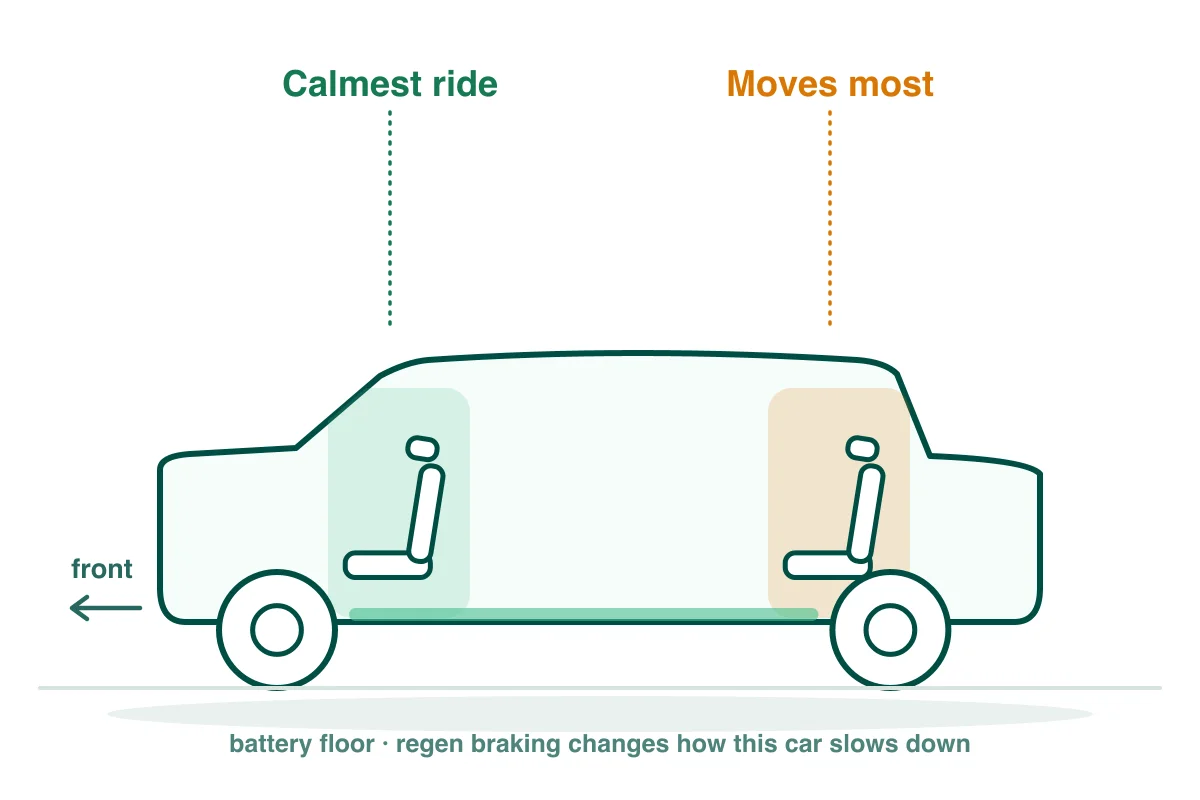
Because the CR-V is a two-row SUV, seat the most motion-sensitive rider up front where the large windshield and tall seating give the clearest forward view. The front-center sightline is the easiest place to keep eyes on the road and horizon. In the second row, the outboard seats offer a better window view than the middle, and all second-row seats sit ahead of the rear axle, so pitch and bounce are gentler than in a three-row SUV. Because rear visibility is more limited, a back-seat passenger who is prone to carsickness benefits most from leaning toward a side window and looking well ahead at the road.
In the CR-V Hybrid, the regenerative braking is adjustable, which is useful for carsick-prone passengers: the deceleration paddles behind the steering wheel step regen through four levels, and keeping it in a lower setting gives a gentler, more gradual slow-down that feels more like a conventional car. Beyond that, the driver's technique matters most: brake earlier and more smoothly so the regen-to-friction handoff goes unnoticed, and use adaptive cruise control on the highway for steadier, more predictable speed changes. In the gas CR-V there is no regen to adjust, so smooth, early braking is the main lever.
Stow the bag before you travel
Secure your bag before the car moves. Keep the phone and headphones you use with Dizzout reachable from the passenger seat without blocking your restraint.
Free to download. Paid subscription for full access.
30,000+ travelers in 30+ countries · How we count

On your phone? Scan to start there.
Comparing apps first? See how the motion sickness apps compare
Not travelling yet? Remind me the day before my trip

Know someone who gets motion sick?
Send them the app that helps stop it, drug-free, in about 90 seconds, works with any headphones. Free to download.
What helps in the Honda CR-V
- Seat carsick riders in the front where the CR-V's large windshield gives the clearest forward view, and keep their eyes on the road ahead
- In the CR-V Hybrid, keep the deceleration paddles in a lower regen setting for a gentler slow-down, and brake earlier and more gradually so the hybrid's regen-to-friction transition feels smoother
- For a back-seat passenger, sit toward a side window and look well ahead, since rear visibility out the back is more limited
- Crack a window or aim the vents for cool, fresh airflow, which many riders find settles the stomach
- Avoid reading, phones and screens while moving; looking down widens the eye-vs-inner-ear mismatch that drives nausea
- Dizzout is a drug-free, screen-free sound therapy you can start the moment symptoms begin; Dizzout states relief in about 90 seconds. Over-the-counter options also exist (follow the label or ask a pharmacist), and check with a pediatrician for children
The screens-away item on that list has a page of its own, with the trials attached: see the verdict on putting your phone away.
Why cars set off nausea at all, and what to do once it starts in any car, is in our car sickness guide.
Comparing apps for the drive? The car sickness app guide sets sound therapy against on-screen motion cues, free options included.
Frequently asked questions
Can the CR-V Hybrid's regenerative braking contribute to motion sickness?
Some passengers notice the CR-V Hybrid's deceleration feel when the electric motor slows the car on lift-off and blends into the friction brakes near a stop. It's a normal characteristic of how the e:HEV hybrid works rather than a fault. Helpfully, the CR-V Hybrid lets the driver dial regen strength through four levels of steering-wheel deceleration paddles, so keeping it in a lower setting produces a gentler, more familiar slow-down. Braking earlier and more gradually smooths it further; if a stop ever feels genuinely abnormal, have the brakes inspected.
Is the back seat of the CR-V worse for carsickness?
Not dramatically, but rear visibility is more limited than up front: the back headrests, seat belts and a smaller rear window reduce the outward view, and a clear view of the road is one of the biggest factors in staying comfortable. A back-seat passenger who is prone to carsickness does best sitting toward a side window and looking well ahead at the road rather than at a phone or the seatback. If a rider is very sensitive, the front seat with its large windshield is the easiest place to be.
Is the Honda CR-V a good SUV for a carsick-prone passenger?
Generally yes. It's a two-row compact SUV with a tall, upright seating position, a large windshield and a ride that reviewers describe as composed and well controlled. Some note the hybrid feels tied down over bumps in a way that suits travel-sick passengers. It also has no rear-most third row, so pitch and bounce are milder than in a larger SUV. The main things to know are the hybrid's adjustable regenerative-braking feel and the more limited rear visibility; seating a sensitive rider up front and driving smoothly help in any trim.
Other car motion-sickness guides
Sources & further reading
- https://en.wikipedia.org/wiki/Honda_CR-V
- https://automobiles.honda.com/cr-v
- https://global.honda/en/tech/Deceleration_Selector/
- https://www.hondainfocenter.com/Terms-and-Technologies/_content/Terms-and-Technologies/Deceleration-Selectors-Hybrid-Vehicles/
- https://www.edmunds.com/honda/cr-v/
- https://www.whatcar.com/honda/cr-v/estate/review/n44
- https://wwwnc.cdc.gov/travel/page/motion-sickness
Based on publicly reported owner experiences and the vehicle's documented design characteristics, as of 2026. Vehicle and brand names are trademarks of their respective owners; Dizzout is not affiliated with or endorsed by them. Motion-sickness sensitivity varies by person, so this is informational, not a vehicle review or a substitute for a doctor's advice.