
Open vs closed safari vehicles: which handles motion sickness better?
Book the open vehicle if you can. Game-drive tracks are rough but speeds are low, and an open safari truck surrounds you with the two things that keep queasy passengers functional: a permanent horizon in every direction and constant moving air. Closed pop-top vans, common on budget East African circuits, ride the same tracks with sealed side windows, interrupted sight lines and real heat, and that combination is where most safari nausea stories come from. The other honest warning: the long transfer drives between parks, hours of corrugated road at speed, are often harder on stomachs than any game drive.
People prone to car sickness often agonise over booking a safari, imagining hours of lurching four-wheel drive. The reassuring truth from guides and returning travellers is that game drives themselves treat most stomachs surprisingly well: the pace is slow, stops are constant, and the whole activity is about looking at the far distance, which is unwittingly perfect motion-sickness technique.
What actually separates a comfortable safari from a rough one is the vehicle type and the bits between the parks. Here is the honest comparison, and how to book the version your inner ear will thank you for.
Whichever option you pick, Dizzout is a drug-free backup for the moment nausea starts: precisely calibrated sound on any headphones, free to try on iOS and Android.
Free to try, no card needed. Or go straight to the App Store or Google Play.
Open vs closed safari vehicles for motion-sensitive travellers
| Factor | Open safari truck | Closed pop-top van |
|---|---|---|
| Horizon visibility | Constant, all directions | Framed by windows, interrupted |
| Airflow | Continuous | Limited; cabin heats up |
| Ride on rough tracks | Firm but purpose-built | Harsher; built for pavement |
| Dust and rain protection | Less | More |
| Typical cost tier | Lodge and private circuits | Budget group circuits |
| Motion sickness verdict | The comfortable pick | Workable: use the roof hatch, front seats, airflow |
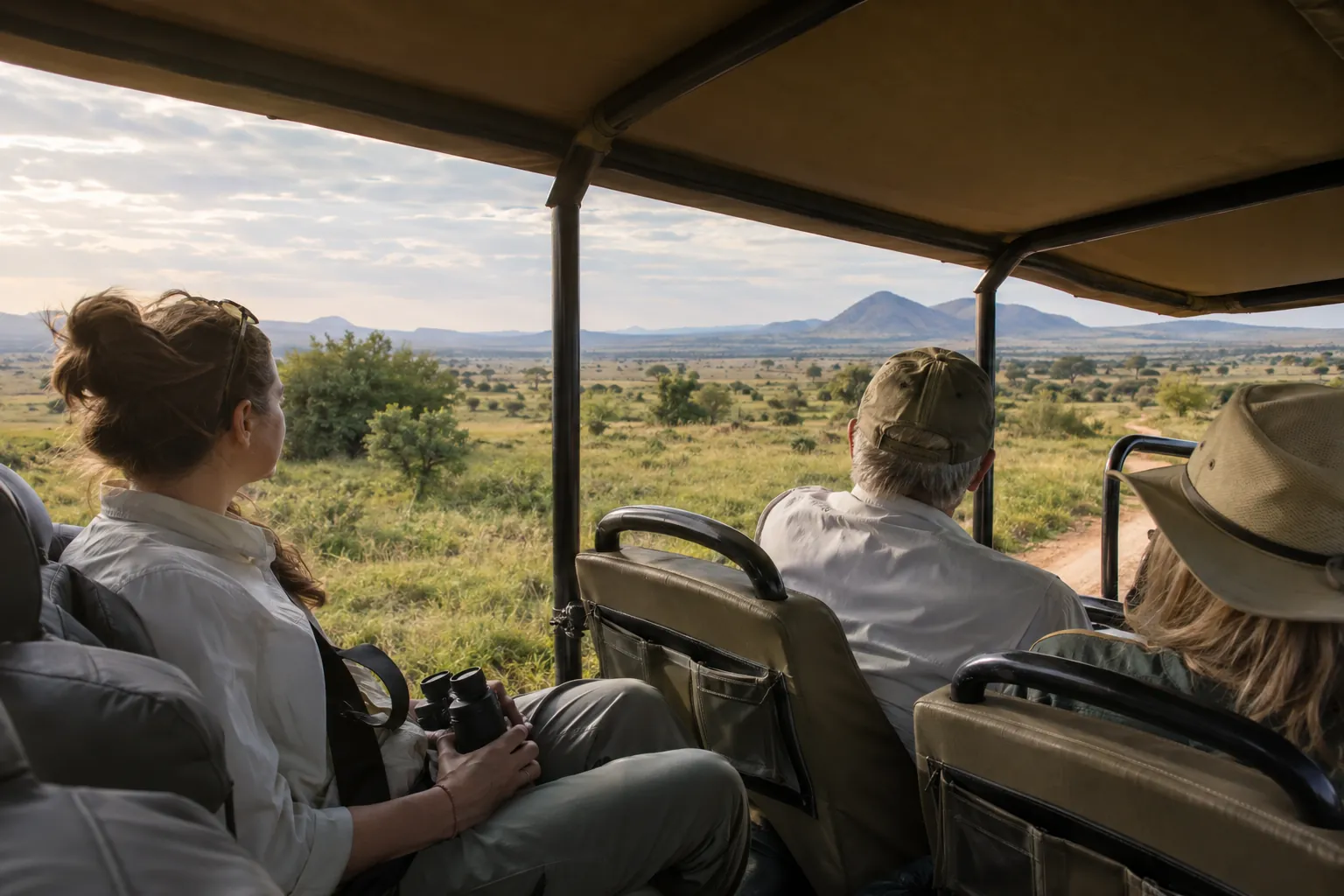
Why open vehicles ride easier than they look
An open or canvas-roofed safari truck looks like the rough option and rides like the kind one. With no window pillars and no glass, your peripheral vision is full of stable landscape and honest horizon wherever you look, so everything your inner ear feels is visually confirmed in real time. Air moves across you constantly, which does the same quiet work fresh air does everywhere. And because the whole activity is scanning the middle distance for animals, your gaze naturally lives exactly where motion-sickness advice tells it to.
Add the pace, walking speed to a slow trot, with frequent long halts at sightings, and a game drive delivers rough-road texture without the sustained, unbroken motion that builds real nausea. It is bumpy; it is rarely relentless.
Where the closed van struggles
The closed minibus with a pop-up roof does the same drive with the protections stripped out. Side windows frame and interrupt the view, and passengers not standing in the roof hatch spend stretches looking at seat backs and glare instead of terrain. Sealed against dust, the cabin warms quickly under an equatorial sun, and heat reliably lowers the nausea threshold. The van's road manners add a final insult: built for pavement, it pitches and rattles harder on corrugations than the purpose-built trucks.
Closed vehicles have real virtues, dust, rain and budget among them, and travellers who are not motion-sensitive do fine. But if car sickness is in your booking calculus at all, vehicle type is the variable worth paying for, and standing in the open hatch, air and horizon restored, is the closed van's own best remedy.
The transfers are the real test
Ask returning travellers what actually made them queasy and the answer is often not the game drive but the getting there: hours of corrugated gravel or winding tarmac between parks, taken at real speed, sometimes in the same closed van, sometimes with luggage-jammed sight lines. Sustained speed over washboard road is a completely different motion diet from a slow game drive, and it is where preparation belongs.
Treat transfer days like the road trips they are: claim a seat with a forward view, keep your eyes up and out rather than on a phone, ask for a window that opens, take the breaks offered, and use whatever normally gets you through winding roads at home. Flying between parks, where budget allows, converts the worst hours of a safari itinerary into the easiest ones, small bush planes and all.
When to use which
Choose operators running open or canvas-top vehicles when motion sickness genuinely worries you; it is a question worth asking before booking, and the answer varies by park and price tier. In a closed van, spend sightings standing in the roof hatch, keep a window cracked for air, and look far rather than near. Respect the transfer days more than the game drives: forward-facing seat, eyes on the road, planned breaks, and your usual winding-road toolkit. And if the itinerary offers flying between parks instead of a six-hour road transfer, the queasy traveller should take the plane.
Try drug-free motion sickness relief
Try Dizzout Free
Free to try on iOS and Android · ~90 seconds · works on any headphones.
Frequently asked questions
Will I get motion sick on a safari game drive?
Most prone travellers manage game drives well, often to their own surprise. The tracks are rough but speeds are very low, stops at sightings are constant, the air is moving, and your eyes spend the whole drive on the middle distance and horizon, which is textbook anti-nausea technique happening by accident. The parts of a safari that deserve your usual precautions are the long, faster transfer drives between parks, not the slow crawl through them.
Are the pop-top minibus safaris worse for car sickness?
They stack the odds less kindly: framed windows instead of open sight lines, warm sealed cabins, and a pavement-tuned ride that rattles harder on corrugations. Plenty of people do them without trouble, and standing in the open roof hatch during drives restores most of what the format takes away, air and horizon. But if motion sickness shapes your bookings, an open-vehicle operator is the safer spend, and it is a fair question to ask any company directly.
What about the small planes between safari parks?
Bush flights are short, typically well under an hour, and they replace the roughest road hours on the itinerary, so most motion-sensitive travellers come out ahead taking them. Light aircraft do feel daytime thermals, and the midday hops are bumpier than morning ones, so the usual small-plane rules apply: morning flights where schedules allow, eyes on the horizon, cool vent air. Our small plane comparison covers that trade in detail.
The safari itself is kinder than your track record suggests: slow, breezy, and staring at the horizon by design. Spend your caution where the itinerary actually spends its motion, the vans, the transfers and the midday hops, and book the open truck that lets Africa do the anti-nausea work for you.
Related comparisons
- Small plane vs airliner
- Winding roads vs highway
- Does fresh air work? The verdict
- Does watching the horizon work? The verdict
- All motion sickness comparisons
This page is general travel information, not medical advice; individual reactions vary. Vehicle types and road conditions vary by country, park and operator, so confirm details with the company you book with.